
Geopolitics: COP28 – Critical Conversations
The 28th COP has been hailed as the inclusive UN climate conference, with the oil and gas industry given a seat at the table and voices from the developing world featured more prominently in discussion. The decision to host COP in the UAE with ADNOC CEO Dr. Sultan Al Jaber as its President-Designate remains divisive with certain members of the climate community, as well as one former US Vice President.
Certainly, the future role of oil and gas in the energy mix was not resolved, with the phase out/phase down debate proving to be one of the most controversial of the global convening. At the time of writing, it seems unlikely that a consensus will be reached on this topic for inclusion in the final COP28 communique. And yet, this first week of COP was accompanied by a number of important pledges on topics such as the Loss and Damage Fund, Global Decarbonization Accelerator, and Global Methane……Pledge that moved the needle on achieving the host’s goal of an actionable gathering. OPEC held its delayed meeting on the first day of COP; OPEC officials in attendance continued to make the case for focusing on emissions and not on phasing out fossil fuels to ensure access to affordable and reliable energy.
The outcome of the OPEC meeting was not a main stage topic, but it was discussed on the sidelines. Questions about OPEC group cohesion and commitment to the pledged cuts continued to weigh on prices, and there were renewed whispers amongst attendees that Saudi Arabia might seek to restore discipline and undercut US producers by ramping up output. And yet, the statements out of Riyadh and Moscow that they are prepared to extend the cuts beyond Q1, as well as the visit of Putin to the UAE and Saudi Arabia, seem to argue against a return to a market share war at this stage.
Oil: Risk & Liquidity Vacuum
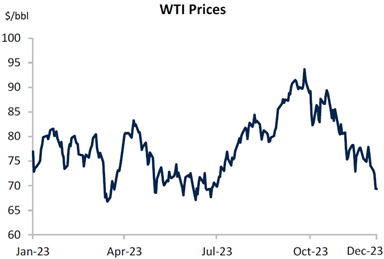
Soft price action since the OPEC+ meeting is reflective of an investor cohort that remains perplexed on how to deploy risk. The near-term path of least resistance is lower, given the degree of ambiguity and lack of catalysts. Oil has become a ‘show me’ type market. Prices will likely remain volatile and potentially directionless until the market sees clear data points pertaining to the voluntary output cuts. With cuts not physically implemented until next month, and country level production and export data to follow subsequent to January, it will be a long and volatile two months before there is even preliminary clarity on quantifiable data points on compliance. This is a long stretch for a market that is seeing a high degree of uncertainty, lack of risk deployment and a liquidity vacuum leading into the holidays.
Natural Gas: Winter Weakness
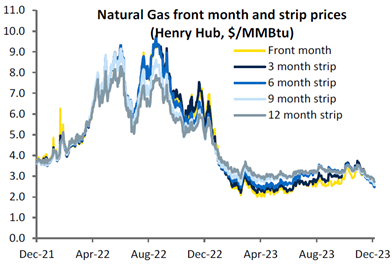
While winter US natural gas prices are naturally exposed to upside price risk given seasonality in balances and potential weather swings, right now this winter seems wildly different. And while there’s limited scope for another leg lower, there aren’t really any strong bullish theses to be found. Balances are loose and market participants seem fully aware of that, spanning all aspects of the corporate landscape as well as the investors we speak to. The only real debate is how weak and for how long, and differing opinions on how much of an impact any eventual cold spurt could have on US natural gas prices this season. Today’s “bullish” storage withdrawal proves as much, with prices lower this morning even after a 117 Bcf withdrawal beat expectations for 107 Bcf (leaving total gas in underground storage at 3.719 Tcf). Bulls are hard to find these days and rightfully so as a bullish thesis seems tough to push, unless we are talking a year from now or in 2025.
Gold: Where’s the Follow Through?
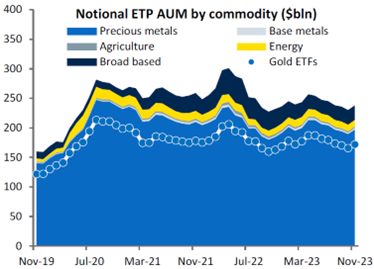
While off the recent high, gold prices continue to hold notably above $2,000/oz ahead of expectations for a H1 loosening in monetary policy. This is, we believe, without substantial geopolitical risk premiums, which were largely built on and then replaced in terms of gold’s price discovery process as market expectations have changed. Gold backed ETP holdings are still off their low, but have lost much of the ground they gained in October and mostly held onto in November. At current levels we think our middle scenario gold prices are still in play because of this lack of follow through that we have seen in terms of investor holdings. Even in November, the gains amid near record prices were unable to offset the weakness this year. For us to really move our high scenario probability to the forefront, we think that we would need to see more investor follow through. Thus, we do think gold is largely going to be rangebound until monetary policy does finally shift.
US Clean Energy: Foreign Entity of Concern
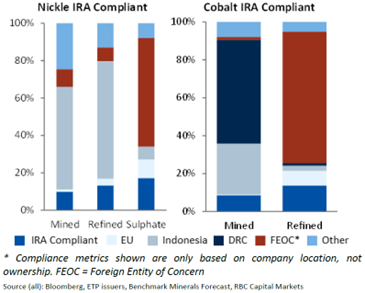
The US Treasury announced a proposed decision on Foreign Entities of Concern (FEOC) for EV tax credits – the covered nations are China, Iran, Russia and North Korea. More granularly, beginning in 2025, if any of the 50 listed critical minerals contained in the battery of an EV were extracted, processed, or recycled in or by an FEOC, they are not eligible for half of the $7,500 EV tax credit. Beginning in 2024, if any of the components of an EV were manufactured or assembled in or by an FEOC, they are ineligible for the remaining $3,750 EV tax credit. Chinese companies dominate the critical mineral supply chain – both in country and abroad, wholly and through JVs. If 25% or more of a company’s board seats, voting rights or equity interests are cumulatively held by an FEOC, directly or indirectly, it is ineligible for the tax credit. Only considering company location and not ownership, FEOCs make up over half of the final critical mineral inputs for EV batteries, likely shrinking the list of the 20 currently eligible EVs.