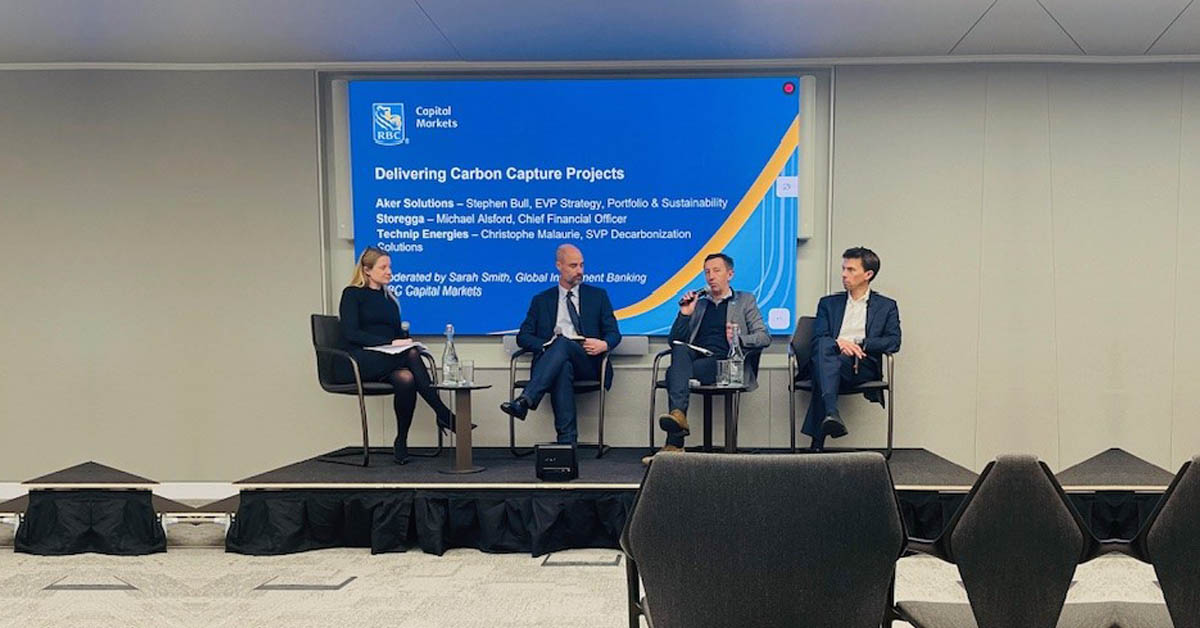
Participating companies included Aker Carbon Capture, Aker Solutions, California Resources Corp., Drax, Entropy, Equinor, OGCI, Storegga and Technip Energies. We see carbon capture as a vital technology for achieving net zero targets, with material growth expected this decade and beyond supported by government and private sector investment. In this article, we share our five key takeaways from the seminar.
Five Key takeaways:
1. Bioenergy with carbon capture and storage (BECCS):
Discussions on the potential technical challenges to building BECCs highlighted that much of the engineering and technical capability is well understood in both Bioenergy and CCS, giving confidence to building BECCs at scale. Drax (DRX LN) continues to effectively manage its respective supply chains in the US and UK, with no significant issues experienced with regards to inflationary pressures. The need for baseload power generation to support intermittent renewables will continue to grow as more renewables come online and Drax has engaged positively with the UK government, with a bridging mechanism expected imminently.
2. How regulations help accelerate investments:
Outside of consistent carbon pricing frameworks, one of the key points raised by the panellists was around building the ecosystem in a synchronized manner, with large emitters, policy makers, capture, as well as transportation and storage players in the value chain all moving together. Permitting was raised as a key next step in the US by California Resources Corporation (CRC.US), and the company was encouraged by recent progress. Finally, one of the key concerns of the panellists was around the 'acceptability of CCUS' in climate policies, and that the industry would need to show progress and evidence on delivery in order to beginpanellists to scale up.
In this video Victoria McCulloch, RBC Capital Markets is joined by Francisco Leon, President & CEO, California Resources Corporation (CRC) to discusses the work they are doing with the community to help decarbonization, their timelines to inject CO2 into the ground, expectations for California in terms of transportation and the impact that could have on projects and finally they talk through the tightening of policy and how proposals put forward could potentially effect CRC in the long term.
3. Technology developments, challenges and scalability:
Technology plays a key role in CCS, particularly with costs the main focus for FIDs. Reducing energy consumption and modularization are key opportunities for technology companies; however, the fiscal and funding environment must also be supportive. The limited timeline of the IRA was noted as a challenge for seeing mass adoption of CCS in the US, but we could see FIDs in 2024 for strong projects. The recent deal by Entropy (owned by AAV TO) with the Canada Growth Fund enables the company to take FID on the Glacier 2 facility in Alberta and underpin the near-term growth with greater carbon price clarity. Aker Carbon Capture (ACC OL) is about to start up the Twence project in the Netherlands, followed by Brevik in Norway later this year, both which should provide operating post-combustion CCS data and operational learnings.
In this video, Ralph Ibendahl, RBC Capital Markets sits down with Stephen Bull, EVP Strategy, Portfolio & Sustainability, Aker Solutions to discuss the state of UK renewables, takeaways from COP28 and his views on the CCUS industry.
4. Delivering carbon capture projects:
Our final panel drew parallels between delivering projects for the oil and gas industry and CCS. Developing projects with collaboration, planning, alignment and delivering on complex engineering being key skills, alongside a strong understanding of the geological storage. Inflation has been a very challenging area for the industry over the past 12 months; however, progress on storage in Europe and FIDs are evidence that projects continue to go ahead.
During this video, Victoria McCulloch, RBC Capital Markets is joined by Mike Belenkie, President & CEO, Advantage Energy to discuss his thoughts on price caps around CCUS, the potential to reach FID and his thoughts on the outlook for the industry in 2024.
5. What could go wrong?
We asked all our panels what might go wrong in the CCS industry that could see it fail to grow towards industry targets in line with current projections. There was a consensus that a lack of progress on costs and delivery were the greatest operational risks, and that the industry should not be aiming for perfection to move forward and grow. Clearly, lack of progress or clarity on the policy front could stall industrial progress, and this is an area that needs to be keenly watched in a record election year globally.