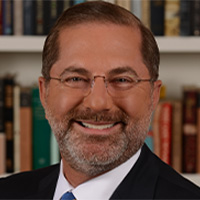
In his keynote address at this year's Global Healthcare Conference, former Health and Human Services Secretary Alex Azar paints a complex picture of the current healthcare policy environment, emphasizing that the U.S. is experiencing a significant political realignment, which has disrupted traditional alliances and introduced new uncertainties into healthcare policymaking.
"We are in the middle of one of the great political party realignments in American history, a once in a multi-generation kind of realignment.”
Hon. Alex Azar, Former Secretary, U.S. Dept. of Health and Human Services
Navigating a shifting political landscape
Azar underscores the profound transformation within the Republican Party, noting a departure from its historically industry-friendly stance. "We are in the middle of one of the great political party realignments in American history, a once in a multi-generation kind of realignment," Azar remarks. This shift has led to a decline in support for the biopharmaceutical industry, leaving the sector with fewer advocates, and complicating efforts to convey their value proposition and innovation focus to policymakers. The evolving political dynamics contribute to a landscape where healthcare policy decisions are increasingly unpredictable.
Regulatory reforms: Ambitions and realities
Discussing the complexities surrounding the implementation of the ‘Most Favored Nation’ (MFN) model, a policy he introduced during his tenure, Azar acknowledges the challenges in its execution. While the concept aims to align U.S. drug prices with those in other developed nations, practical challenges and legal constraints, especially concerning commercial plans, hinder its broad application. He suggests that reintroducing a version of the Medicare Part B MFN proposal might be more feasible than pursuing expansive legislative reforms.
Turning to the Inflation Reduction Act (IRA), Azar acknowledges its durability in the current legislative climate and anticipates that while the IRA will remain largely intact, there may be moves toward more aggressive drug price negotiations. However, he expresses skepticism about the feasibility of extending MFN policies to commercial insurance plans, citing legal constraints.
Medicare Advantage: Growth amid scrutiny
Azar also expresses optimism about the continued growth of Medicare Advantage (MA), attributing it to its holistic approach to healthcare financing and the recent changes to the Medicare Part D program under the IRA. These changes have shifted more costs to health plans and pharmacy benefit managers, inadvertently making traditional fee-for-service Medicare less affordable for seniors.
However, he notes a concerning narrative shift, with reports suggesting that MA may cost more than traditional Medicare. This perception, gaining traction among policymakers, could pose challenges to the program's expansion.
Innovation at a crossroads
Highlighting the strides in biopharmaceutical advancements, Azar describes the current era as a "golden age" of human health. Breakthroughs like genetic therapies for sickle cell disease exemplify the transformative potential of the industry. However, he warns that without robust advocacy and supportive payment models for curative therapies, the U.S. risks ceding its leadership in biomedical innovation to competitors like China.
Azar further emphasizes the need for systems that incentivize the development and reimbursement of one-time, curative treatments, advocating for leveraging artificial intelligence to enhance FDA efficiency, particularly in accelerating drug approvals for areas with high unmet needs.
Regulatory perspectives and the role of AI
Azar highlights the mixed messages emanating from the FDA leadership regarding the agency's potential flexibility on drug approvals. He notes that while there is an opportunity for faster paths for drugs through the FDA, particularly in areas with high unmet needs, there is also a need for caution due to recent cuts at regulatory agencies, which could impact drug approval timelines.
He advocates for the increased use of artificial intelligence in the drug review process, a technology he believes could reduce redundancies and enhance efficiency. This approach could facilitate more rapid paths for certain drug approvals, especially in areas like rare diseases or therapies already approved ex-U.S., while maintaining scrutiny on others.
Advancing value-based care
Azar reiterates his commitment to value-based care, emphasizing the need to move away from the traditional fee-for-service model. He argues that value-based care focuses on paying healthcare providers for outcomes rather than procedures, aligning financial incentives to prioritize patient health. This model rewards quality over quantity, making it essential for reducing costs and improving patient outcomes.
He points to the successes of value-based care models implemented under his tenure, such as the ACO Reach model and the kidney care model, which have shown promise in improving outcomes and reducing costs. Azar stresses that the future of value-based care will depend on the stability of the government's stance, advocating for a public-private partnership that is stable, predictable and transparent with its data.
Azar's keynote insights underscore the intricate interplay between political dynamics, regulatory frameworks and innovation in shaping the future of U.S. healthcare policy. Stakeholders must navigate this evolving landscape with agility and foresight to capitalize on emerging opportunities while mitigating risks.