
Royal Bank of Canadahttps://www.rbcroyalbank.com/personal.htmlhttps://www.rbcroyalbank.com/personal.htmlInsights1200630enCA
Datum[@Name='Source DCR']
2020-05-26New business models emergeWill genetics usher in a new era of healthcare? Is the entire health ecosystem ready for reinvention? Can digital healthcare in life sciences exceed patient expectations?Expanding Ecosystems3/assets/rbccm/images/gib/healthcare/article_3_thumbnail_sm.jpg/assets/rbccm/images/gib/healthcare/article_3_thumbnail.jpg<h3>Shifting Paradigms</h3>
<p>As the convergence of healthcare and technology has accelerated, new business models are rapidly emerging. </p>
<p>In the traditional biopharma model, the customer would be a physician, R&D tools would be chemical or biological, the end product a pill or vial, and the competitors pharma and biotech players.</p>
<p>The digital revolution in healthcare is shifting this long-established paradigm. Today, biopharma companies’ customer groups have grown to include patients of all ages, providers and payers—all equipped with smartphones and apps that generate a vast amount of digital information to empower their decision-making. R&D has added genetic information and digital capability to its toolset. The end product has broadened beyond the pill to include health outcomes enabled by digital devices and therapeutics. And the competitive set has seen the addition of technology players, including consumer-focused apps and online services, as well as digital health and digital therapeutics firms.</p>
<p class="photo-frame text-center"><img style="width: 100%;" src="/assets/rbccm/images/gib/healthcare/Healthcare-Article-3-Graph-1.png" alt="" /></p>
<h3>A Changing Ecosystem</h3>
<p>Indeed, digital and AI applications are radically changing key areas of the biopharma ecosystem and how patients manage their healthcare.</p>
<p>In pre-clinical research, technology is enabling everything from a deeper mining of literature, to predictive modeling and gene-function annotation. Digital apps are simulating molecular dynamics and pushing the limits of cellular imaging.</p>
<p>In clinical trials, digital transformation is helping to automate testing procedures, build global patient databases and collect real-world data.</p>
<p>In diagnostics, tech powers digital pathology, home-based body diagnosis, and computational analysis of tissue arrays. Just like your car leaves the factory with hundreds of sensors that can trigger the check engine light, humans will have wearable and/or implantable sensors to alert them when something is not functioning properly. Another burgeoning area is immune cell monitoring and digital analysis through just a finger prick.</p>
<p>At the point of patient care, digital applications are already delivering virtual consultations, remote monitoring, VR-based cognitive therapy and digital Rx. Demand for telehealth services and health-based social platforms is also increasing and especially vital in a world facing new challenges such as the COVID-19 pandemic.</p>
<p><img src="/assets/rbccm/images/gib/healthcare/healthcare-article-3-graph-2.png" alt="AI and Digital applications are changing key areas of the Healthcare Ecosystem" /></p>
<div id="similar-to-this" style="border-top: 2px #E6E6E7 dotted; border-bottom: 2px #E6E6E7 dotted; margin: 35px 0; padding: 25px;">
<h4 style="font-size: 18px; letter-spacing: 0.5px; border-bottom: 3px #FEDF01 solid; padding: 0 0 8px 0; margin-bottom: 15px;">Similar to this</h4>
</div>
<h3>Digital Transformation</h3>
<p>The digital revolution presents both threats and opportunities to incumbent biopharma companies. Tech is powering efficiencies in all stages of the current ecosystem and is also enabling healthcare providers to expand their capabilities from treatment to prevention.</p>
<div class="quotebox">
<p>“Tech is powering efficiencies in all stages of the current ecosystem and is also enabling healthcare providers to expand their capabilities.”</p>
<p class="attribution" style="color: #0070a3;">– Greg Wiederrecht, Ph.D.</p>
<div class="quote-share">
<p style="display: inline-block;"><span style="margin-right: 15px;">Share </span><a class="blue-circle-outline-sm" href="https://www.linkedin.com/shareArticle?mini=true&url=https%3A//www.rbccm.com/en/gib/healthcare/episode/new_healthcare_business_models_emerge&title=New%20healthcare%20business%20models%20emerge&source=www.rbccm.com" target="_blank" rel="noopener" aria-label="Connect by LinkedIn"><em class="fa fa-linkedin" style="color: #0051a5; margin-left: 3px;"> </em></a> <a class="blue-circle-outline-sm" href="https://twitter.com/home?status=New%20business%20models%20emerge%20https%3A//www.rbccm.com/en/gib/healthcare/episode/new_healthcare_business_models_emerge" target="_blank" rel="noopener" aria-label="Connect by X"><em class="fa fa-twitter" style="color: #0051a5; margin-left: 3px;"> </em></a> <a class="blue-circle-outline-sm" href="mailto:?subject=New%20business%20models%20emerge&body=I%20found%20this%20insights%20piece%20from%20RBC%20Capital%20Markets%20informative%20and%20thought%20it%20might%20be%20of%20interest%20to%20you%3A%0D%0Dhttps%3A//www.rbccm.com/en/gib/healthcare/episode/new_healthcare_business_models_emerge&title=New business models emerge" aria-label="Connect by Email"><em class="fa fa-envelope" style="color: #0051a5; margin-left: 3px;"> </em></a></p>
</div>
</div>
<p> </p>
<p>The increased digitization of human experiences gives access to a wealth of information and knowledge that could help intervene before disease has a chance to strike. A prime example of this is collating data from an Apple Watch to screen for irregular heart rhythms and detect undiagnosed atrial fibrillation. At the other end of the spectrum, digital transformation allows a completely new class of therapies such as digital therapeutics to support specific disorders.</p>
<p>McKinsey and Company’s international survey shows that more than 75% of patients expect to use digital healthcare services in the future.<sup>1</sup> Patients are seeking technology that delivers a level of care they can rely on and trust. Ultimately, the aim of the digital revolution is to develop healthier societies and lower the cost of care.</p>
<p style="word-wrap: break-word;"><sup>1 Source: McKinsey and Company, Healthcare’s Digital Future, July 2014. https://www.mckinsey.com/~/media/McKinsey/Industries/Healthcare%20Systems%20and%20Services/Our%20Insights/Healthcares%20digital%20future/Healthcares%20digital%20future.ashx</sup></p><ul>
<li>Customer groups, R&D and competitors are all rapidly expanding</li>
<li>Tech is reinventing every facet of the biopharma ecosystem</li>
<li>Innovations in patient care is driving adoption of digital services</li>
</ul>text2 min1 minHealthcare Models, Digital Healthcare, Digital Healthcare Apps, Digital Health Diagnostics, Expanding R&D, Healthcare & Tech Convergence, Healthcare Services, Clinical Trials, Remote Patient Monitoring, Digital Therapeutics, Biopharma ecosystem, Cost of CareN/templatedata/rbccm/episode/data/healthcare/amazon_cvs_and_google_healthcare_reimagined/templatedata/rbccm/episode/data/healthcare/big_tech_vs_big_pharma/templatedata/rbccm/episode/data/healthcare/the_healthcare_data_explosionGreg Wiederrecht, Ph.D./assets/rbccm/images/gib/healthcare/greg-wiederrecht.jpgManaging Director, Healthcare Investment Bankinggreg.wiederrecht@rbccm.comhttps://www.linkedin.com/in/gregwiederrecht/Sasson Darwish/assets/rbccm/images/gib/healthcare/sasson-darwish.jpgManaging Director, AI, Analytics and IoT & Israel Country Coverage, Global Technology Investment Bankingsasson.darwish@rbccm.com https://www.linkedin.com/in/sassdarwish/Andrew Callaway/assets/rbccm/images/gib/healthcare/andrew-callaway.jpgManaging Director, Global Head of Healthcare Investment Bankingandrew.callaway@rbccm.comhttps://www.linkedin.com/in/andrew-cal-callaway
DEBUG: DCR
DCR
Royal Bank of Canadahttps://www.rbcroyalbank.com/personal.htmlhttps://www.rbcroyalbank.com/personal.htmlInsights1200630enCA
DCR
2020-05-26New business models emergeWill genetics usher in a new era of healthcare? Is the entire health ecosystem ready for reinvention? Can digital healthcare in life sciences exceed patient expectations?Expanding Ecosystems3/assets/rbccm/images/gib/healthcare/article_3_thumbnail_sm.jpg/assets/rbccm/images/gib/healthcare/article_3_thumbnail.jpg<h3>Shifting Paradigms</h3>
<p>As the convergence of healthcare and technology has accelerated, new business models are rapidly emerging. </p>
<p>In the traditional biopharma model, the customer would be a physician, R&D tools would be chemical or biological, the end product a pill or vial, and the competitors pharma and biotech players.</p>
<p>The digital revolution in healthcare is shifting this long-established paradigm. Today, biopharma companies’ customer groups have grown to include patients of all ages, providers and payers—all equipped with smartphones and apps that generate a vast amount of digital information to empower their decision-making. R&D has added genetic information and digital capability to its toolset. The end product has broadened beyond the pill to include health outcomes enabled by digital devices and therapeutics. And the competitive set has seen the addition of technology players, including consumer-focused apps and online services, as well as digital health and digital therapeutics firms.</p>
<p class="photo-frame text-center"><img style="width: 100%;" src="/assets/rbccm/images/gib/healthcare/Healthcare-Article-3-Graph-1.png" alt="" /></p>
<h3>A Changing Ecosystem</h3>
<p>Indeed, digital and AI applications are radically changing key areas of the biopharma ecosystem and how patients manage their healthcare.</p>
<p>In pre-clinical research, technology is enabling everything from a deeper mining of literature, to predictive modeling and gene-function annotation. Digital apps are simulating molecular dynamics and pushing the limits of cellular imaging.</p>
<p>In clinical trials, digital transformation is helping to automate testing procedures, build global patient databases and collect real-world data.</p>
<p>In diagnostics, tech powers digital pathology, home-based body diagnosis, and computational analysis of tissue arrays. Just like your car leaves the factory with hundreds of sensors that can trigger the check engine light, humans will have wearable and/or implantable sensors to alert them when something is not functioning properly. Another burgeoning area is immune cell monitoring and digital analysis through just a finger prick.</p>
<p>At the point of patient care, digital applications are already delivering virtual consultations, remote monitoring, VR-based cognitive therapy and digital Rx. Demand for telehealth services and health-based social platforms is also increasing and especially vital in a world facing new challenges such as the COVID-19 pandemic.</p>
<p><img src="/assets/rbccm/images/gib/healthcare/healthcare-article-3-graph-2.png" alt="AI and Digital applications are changing key areas of the Healthcare Ecosystem" /></p>
<div id="similar-to-this" style="border-top: 2px #E6E6E7 dotted; border-bottom: 2px #E6E6E7 dotted; margin: 35px 0; padding: 25px;">
<h4 style="font-size: 18px; letter-spacing: 0.5px; border-bottom: 3px #FEDF01 solid; padding: 0 0 8px 0; margin-bottom: 15px;">Similar to this</h4>
</div>
<h3>Digital Transformation</h3>
<p>The digital revolution presents both threats and opportunities to incumbent biopharma companies. Tech is powering efficiencies in all stages of the current ecosystem and is also enabling healthcare providers to expand their capabilities from treatment to prevention.</p>
<div class="quotebox">
<p>“Tech is powering efficiencies in all stages of the current ecosystem and is also enabling healthcare providers to expand their capabilities.”</p>
<p class="attribution" style="color: #0070a3;">– Greg Wiederrecht, Ph.D.</p>
<div class="quote-share">
<p style="display: inline-block;"><span style="margin-right: 15px;">Share </span><a class="blue-circle-outline-sm" href="https://www.linkedin.com/shareArticle?mini=true&url=https%3A//www.rbccm.com/en/gib/healthcare/episode/new_healthcare_business_models_emerge&title=New%20healthcare%20business%20models%20emerge&source=www.rbccm.com" target="_blank" rel="noopener" aria-label="Connect by LinkedIn"><em class="fa fa-linkedin" style="color: #0051a5; margin-left: 3px;"> </em></a> <a class="blue-circle-outline-sm" href="https://twitter.com/home?status=New%20business%20models%20emerge%20https%3A//www.rbccm.com/en/gib/healthcare/episode/new_healthcare_business_models_emerge" target="_blank" rel="noopener" aria-label="Connect by X"><em class="fa fa-twitter" style="color: #0051a5; margin-left: 3px;"> </em></a> <a class="blue-circle-outline-sm" href="mailto:?subject=New%20business%20models%20emerge&body=I%20found%20this%20insights%20piece%20from%20RBC%20Capital%20Markets%20informative%20and%20thought%20it%20might%20be%20of%20interest%20to%20you%3A%0D%0Dhttps%3A//www.rbccm.com/en/gib/healthcare/episode/new_healthcare_business_models_emerge&title=New business models emerge" aria-label="Connect by Email"><em class="fa fa-envelope" style="color: #0051a5; margin-left: 3px;"> </em></a></p>
</div>
</div>
<p> </p>
<p>The increased digitization of human experiences gives access to a wealth of information and knowledge that could help intervene before disease has a chance to strike. A prime example of this is collating data from an Apple Watch to screen for irregular heart rhythms and detect undiagnosed atrial fibrillation. At the other end of the spectrum, digital transformation allows a completely new class of therapies such as digital therapeutics to support specific disorders.</p>
<p>McKinsey and Company’s international survey shows that more than 75% of patients expect to use digital healthcare services in the future.<sup>1</sup> Patients are seeking technology that delivers a level of care they can rely on and trust. Ultimately, the aim of the digital revolution is to develop healthier societies and lower the cost of care.</p>
<p style="word-wrap: break-word;"><sup>1 Source: McKinsey and Company, Healthcare’s Digital Future, July 2014. https://www.mckinsey.com/~/media/McKinsey/Industries/Healthcare%20Systems%20and%20Services/Our%20Insights/Healthcares%20digital%20future/Healthcares%20digital%20future.ashx</sup></p><ul>
<li>Customer groups, R&D and competitors are all rapidly expanding</li>
<li>Tech is reinventing every facet of the biopharma ecosystem</li>
<li>Innovations in patient care is driving adoption of digital services</li>
</ul>text2 min1 minHealthcare Models, Digital Healthcare, Digital Healthcare Apps, Digital Health Diagnostics, Expanding R&D, Healthcare & Tech Convergence, Healthcare Services, Clinical Trials, Remote Patient Monitoring, Digital Therapeutics, Biopharma ecosystem, Cost of CareN/templatedata/rbccm/episode/data/healthcare/amazon_cvs_and_google_healthcare_reimagined/templatedata/rbccm/episode/data/healthcare/big_tech_vs_big_pharma/templatedata/rbccm/episode/data/healthcare/the_healthcare_data_explosionGreg Wiederrecht, Ph.D./assets/rbccm/images/gib/healthcare/greg-wiederrecht.jpgManaging Director, Healthcare Investment Bankinggreg.wiederrecht@rbccm.comhttps://www.linkedin.com/in/gregwiederrecht/Sasson Darwish/assets/rbccm/images/gib/healthcare/sasson-darwish.jpgManaging Director, AI, Analytics and IoT & Israel Country Coverage, Global Technology Investment Bankingsasson.darwish@rbccm.com https://www.linkedin.com/in/sassdarwish/Andrew Callaway/assets/rbccm/images/gib/healthcare/andrew-callaway.jpgManaging Director, Global Head of Healthcare Investment Bankingandrew.callaway@rbccm.comhttps://www.linkedin.com/in/andrew-cal-callaway
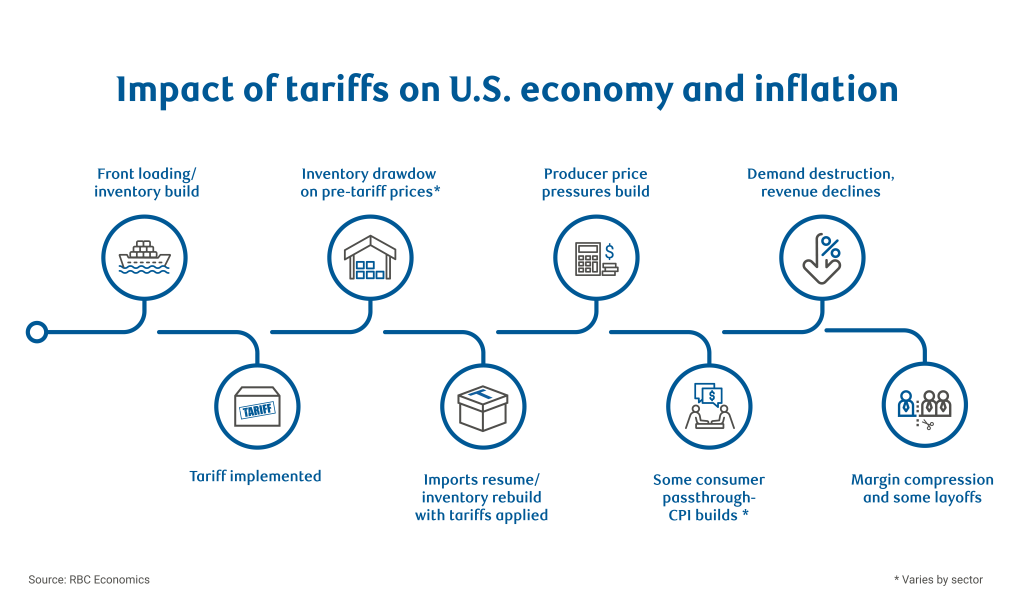
12025-12-04Transmission framework: How tariffs will flow through the US economyEconomists are making a range of assumptions about how tariffs may work their way through the economy without relevant historical precedent.noneInsights<li><a href="/en/">Home</a></li><li><a href="/en/insights.page">Insights</a></li>/assets/rbccm/images/insights/2025/20250722-transmission-framework-how-tariffs-will-flow-through-the-us-economy-th.webp/assets/rbccm/images/insights/2025/20250722-transmission-framework-how-tariffs-will-flow-through-the-us-economy-banner.webphttps://www.rbccm.com/en/story/story.page?dcr=templatedata/article/story/data/2025/07/transmission-framework-how-tariffs-will-flow-through-the-us-economynone<p>Economists are making a range of assumptions about how tariffs may work their way through the economy without relevant historical precedent. Using our own set of assumptions, we expect tariffs will weigh on the labor market and put upward pressure on inflation, exacerbating our view that the US economy is in a stagflation-lite scenario <sup><a title="Link to Footnote" href="#footnotes1">1</a></sup>.</p>
<p>But, when and where those pressures show up will ultimately come down to two core questions: How much inventory has accumulated in the system ahead of the implementation of tariffs, and how much of the cost of tariffs will businesses will pass to consumers.</p>
<p>As policies continue to evolve in the coming months and data begins to show evidence of the impact of tariffs, RBC Economics will be using a transmission framework as a roadmap to monitor the fallout.</p>
<p>Here’s a deeper look at how we are thinking about this historic economic shock:</p>
<p id="ius"><img style="width: 100%;" src="https://www.rbc.com/en/wp-content/uploads/sites/4/2025/07/Inf-1-_-no-time-stamps.png?resize=1024,610" alt="Impact of tarrifs on U.S. economy and inflation timeline infographic. Front loading/inventory build. Tariff implemented. Inventory drawdow on pre-tariff prices*. Imports resume/inventory rebuild with tariffs applied. Producer price pressures build. Some consumer passthrough-CPI builds*. Demand destruction, revenue declines. Margin compression and some layoffs. Source: RBC Economics. *Varies by sector"></p>
<hr>
<h2>The big inventory question: How much time do we have?</h2>
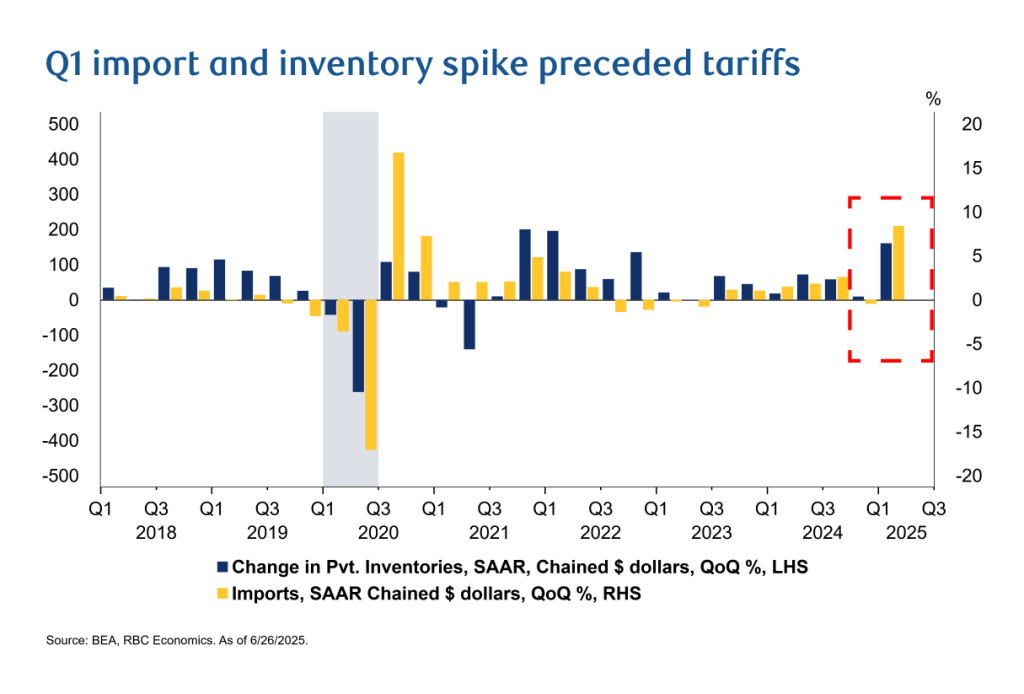
<p>Q1 gross domestic product data shows us that businesses heavily front-loaded goods ahead of tariff implementation with a meaningful surge in imports and resulting jump in inventories.</p>
<p>Until those inventories are drawn down, the impact of tariffs on the economy are stalled as businesses sit on and sell goods at pre-tariffed prices. As long as inventories remain bloated, it will be premature to claim definitively that tariffs will not slow growth or push up prices.</p>
<p>How long will it take for inventories to be fully used up? Problematically, it isn’t straight forward to get a clean read.</p>
<div class="acoordian1" style="padding-bottom: 2px;">
<p style="margin-top: 5px;"><a class="collapse-toggle" title="acoordian1" href="#articleAcoordian1" data-toggle="collapse" aria-expanded="false"> + First, the inventory build varies considerably by sector.</a></p>
<div id="articleAcoordian1" class="collapse-content collapse" aria-expanded="false">
<div class="collapse-inner">
<p id="acoordian1">Durable inputs like metals or motor vehicles and parts may be stored for much longer than non-durable goods like food products, which do not have a substantial shelf-life.<br>The Monthly Advanced Report on Durable Goods showed fabricated metal products as well as electrical equipment and appliances both reported upticks in recent months. Though, we suspect the report is understating the full magnitude of the buildup and expect to see more upward revisions as new data becomes available.</p>
</div>
</div>
</div>
<div class="acoordian2" style="padding-bottom: 2px;">
<p style="margin-top: 5px;"><a class="collapse-toggle" title="acoordian1" href="#articleAcoordian2" data-toggle="collapse" aria-expanded="false"> + Second, inventory data is lagging the real-time economy.</a></p>
<div id="articleAcoordian2" class="collapse-content collapse" aria-expanded="false">
<div class="collapse-inner">
<p id="acoordian2">The national accounts data showed the US trade balance fell by close to $1.4 trillion in Q1, and yet real inventories ramped up by (a still sizeable but much smaller) $160.5 billion. <br>Interestingly, the Advanced Report on Durable Goods has yet to show a meaningful ramp-up in inventories that matches the national accounts data. The data being recorded by businesses and collected by government agenciespan may not fully align, which could instigate a delay in imports being reported as inventories. <br>Additionally, as tariffs are implemented, the use of bonded warehouses may further complicate the reporting process, because goods in bonded warehouses are not cleared by customs for domestic distribution. <br>We expect it will take time to get an accurate picture of the magnitude of the inventory build on a sector basis, and there will likely be significant revisions throughout this process.</p>
</div>
</div>
</div>
<div class="acoordian3" style="padding-bottom: 2px;">
<p style="margin-top: 5px;"><a class="collapse-toggle" title="acoordian3" href="#articleAcoordian3" data-toggle="collapse" aria-expanded="false"> + Third, the pace of inventory draw-down largely depends on consumer and business demand. </a></p>
<div id="articleAcoordian3" class="collapse-content collapse" aria-expanded="false">
<div class="collapse-inner">
<p id="acoordian3">Stronger consumer activity will result in a faster depletion whereas a pullback in consumer spending and/or business investment could lead to a more prolonged drawdown. <br>Recent retail sales reports reflect sustained demand for consumer goods, but also signal pre-tariff front-loading by consumers as well (notably in autos). That could imply that recent consumer demand won’t be sustained. Importantly, we continue to expect high-income consumers will dominate consumption activity and have much higher levels of resilience</p>
</div>
</div>
</div>
<div class="acoordian4" style="padding-bottom: 2px;">
<p style="margin-top: 5px;"><a class="collapse-toggle" title="acoordian4" href="#articleAcoordian4" data-toggle="collapse" aria-expanded="false"> + Fourth, the volatility of tariff policy, including delays, may have encouraged multiple front-loading cycles that further muddy the clarity of inventories builds.</a></p>
<div id="articleAcoordian4" class="collapse-content collapse" aria-expanded="false">
<div class="collapse-inner">
<p id="acoordian4">Based on data we have now, we estimate the aggregate economy has as much as a five months of inventory buildup. In non-durable products like pharmaceuticals which expire, for example, that horizon is shorter.</p>
</div>
</div>
</div>
<p><img style="width: 100%;" src="https://www.rbc.com/en/wp-content/uploads/sites/4/2025/07/Q1-import-and-Inventory2.png?resize=1024,694" alt="Q1 import and inventory spike preceded tarrifs graph. Change in Pvt. Inventories, SAAR, Chaine $ dollars, QoQ %, LHS vs. Imports, SAAR Chained $ dollars, QoQ %, RHS. Source: BEA, RBC Economics, As of 6/26/2025."></p>
<hr>
<h2>Imports will ultimately resume at higher prices—where will we see price pressures first?</h2>
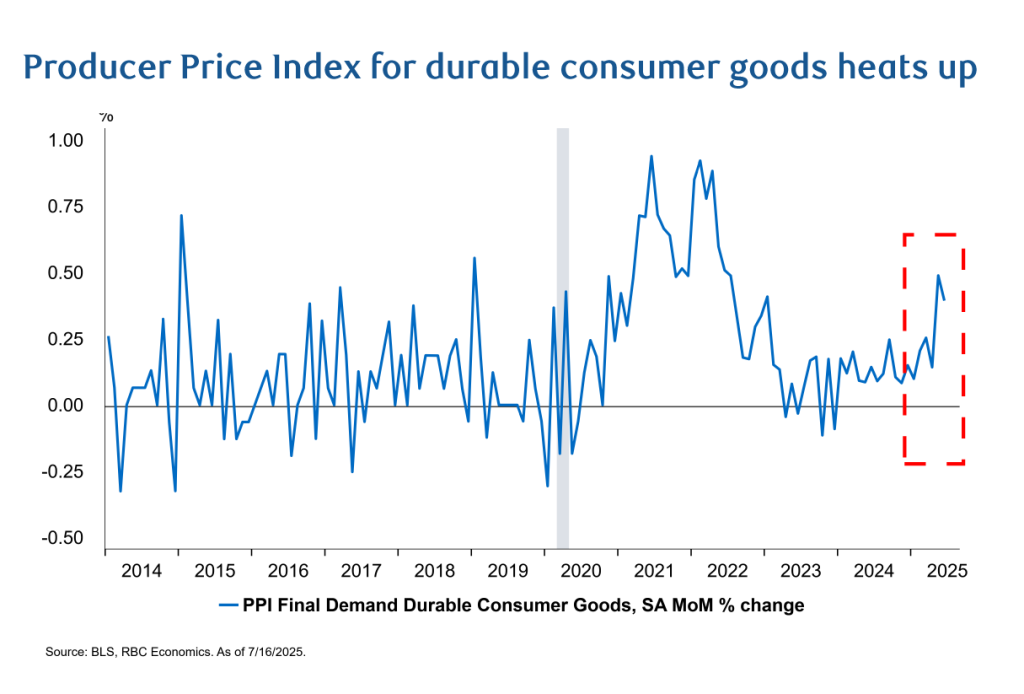
<p>Once inventories are largely depleted and imports resume at tariffed prices, we expect to see higher producer prices, for example, in the Produce Price Index (PPI.).</p>
<p>Helpfully, PPI is structured by stage of production, which allows us to see price pressures emerge in raw materials, intermediate inputs and final goods, giving an indication of potential increases to consumer prices (reflected in consumer price index) in the coming months.</p>
<p>So far, headline PPI seem innocuous, but this is in part because services deflation has been offsetting early upward pressure from goods. Importantly, month-over-month price changes in finished durable consumer goods are heating up, particularly in furniture, household appliances and electrical equipment prices.</p>
<p>Going forward, we also expect to see pressure build in trade services PPI, which measures margins, specifically, the difference between selling and acquisition prices of a good sold to non-manufacturing industries. We have not seen this yet, but trade services PPI will give us a gauge of the extent that margin compression is occurring outside of manufacturing.</p>
<p><img style="width: 100%;" src="https://www.rbc.com/en/wp-content/uploads/sites/4/2025/07/Prod-Price-2.png?resize=1024,694" alt="Producer Price Index for durable consumer goods heats up graph. PPI Final Demand Durable Consumer Goods, SA MoM % change. Source: BLS, RBC Economics. As of 7/26/2025."></p>
<hr>
<h2>Businesses will pass tariffs to consumers, absorb costs or do both</h2>
<p>Tariff revenue has already soared by about $50 billion year-to-date—doubling from a year ago. Those tariffs will need to be paid by some segment(s) of the economy.</p>
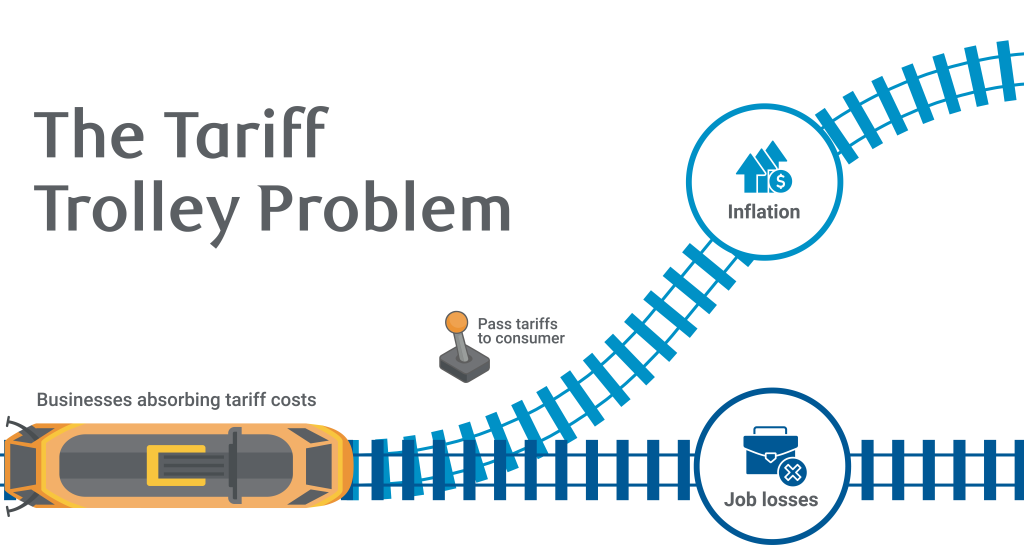
<p>Where the buck stops have different implications for growth, employment and consumer prices. Again, the outcomes are likely to vary by product. In its most simplified form, there are two paths the tariff burden can follow.</p>
<ul style="list-style-type: none;">
<li>
<p><strong>➔ If businesses absorb the tariff, jobs are at risk.</strong> The idea that tariffs will not be inflationary is largely based on the concept that businesses will absorb the higher costs, which would certainly be inflationary for them. While that might imply less pressure on consumer prices, we’d caution against the idea that this is a good outcome for the US economy.</p>
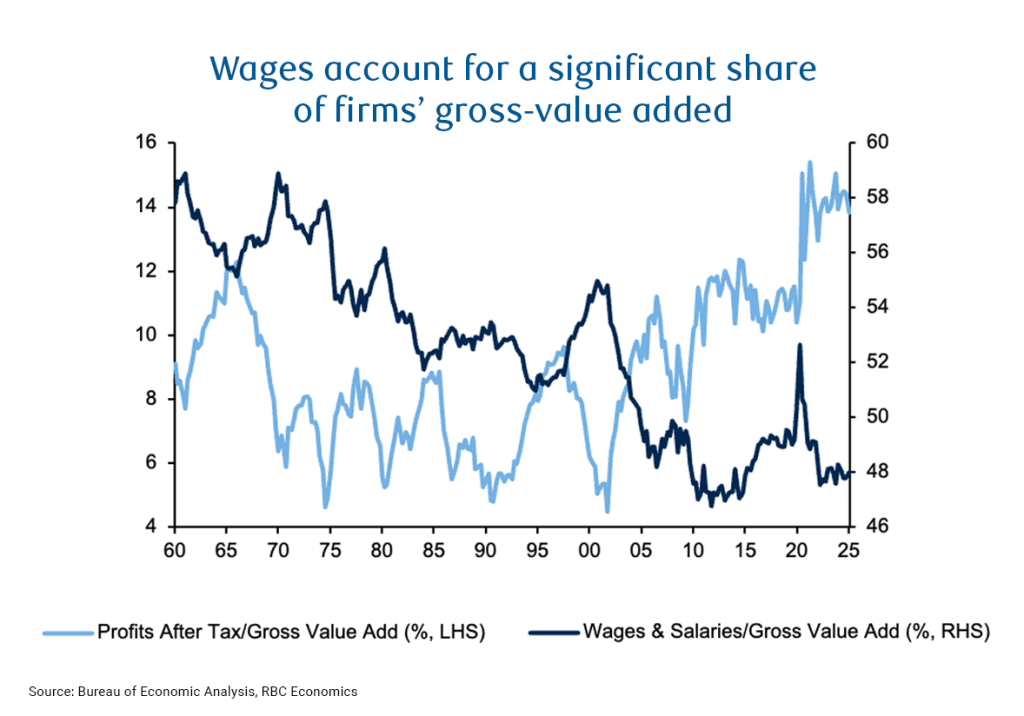
<p>If businesses carry the costs themselves, they’ll face margin compression and need to cut costs elsewhere. Labor is a good candidate. Compensation reflects roughly 48% of gross value added by businesses, suggesting that for every dollar of value generated by a business, 48 cents of that goes to staff.</p>
<p>Clearly, there would be implications for households from job cuts but businesses as well. As we’ve covered in depth <a title="Link to Thought Leadership: Most investors think of demographics is a major economic shock article" href="https://www.rbc.com/en/thought-leadership/economics/featured-insights/america-needs-workers-not-jobs/#:~:text=Most%20investors%20think%20of%20demographics,is%20a%20major%20economic%20shock." target="_blank" rel="noopener noopener">here</a>, employers are facing structurally lower labor supply that is complicating their relationship with workers, and there are likely limitations to how weak the labor market can become as a result. Firms may need to spread cost reductions out, including to capital investment, for example.</p>
</li>
</ul>
<p><img style="width: 100%;" src="https://www.rbc.com/en/wp-content/uploads/sites/4/2025/07/The-Trolley-Problem4.png?resize=1024,555" alt="The Tarrif Trolley Problem infographic with image of trolley on tracks. Businesses absorbing tariff costs. Switch icon - Pass tariffs to consumer. Inflation with arrows up and $ icon one direction of tracks. Job losses with briefcase and X icon."></p>
<ul style="list-style-type: none;">
<li>
<p><strong>➔If businesses pass on tariffs to consumers, prices are at risk.</strong> The businesses that can and will pass tariffs onto consumers will likely vary quite a bit by sector and end-consumer. We continue to expect it will be much easier to pass on price increases to higher-income households than lower- and middle-income ones, who are in a more precarious economic position.</p>
<p>How will we know when and where consumers are absorbing higher costs? We’ll first see evidence of consumers absorbing tariffs via import-exposed sectors. Think core goods prices first, specifically household furnishings and supplies, where the import share is roughly 50%.</p>
<p>Apparel and recreation commodities are largely imported from Asia and especially exposed to tariffs. Later, should sector-specific tariffs on copper, semiconductors and pharmaceuticals be announced, we would also see higher prices for electronics, communications equipment and medical care products.</p>
<p>We would see prices rise in core goods first, but we’d also expect to see it spillover to services with a lag. For example, as motor vehicle parts and equipment become more expensive, auto repairs will cost more, and in time, the cost of auto insurance will be adjusted to account for higher repair costs.</p>
<p>If wages are constant or lower (as we expect), consumers facing higher prices on tariffed products will have to make a choice: Buy less of the tariffed product or buy less of something else.</p>
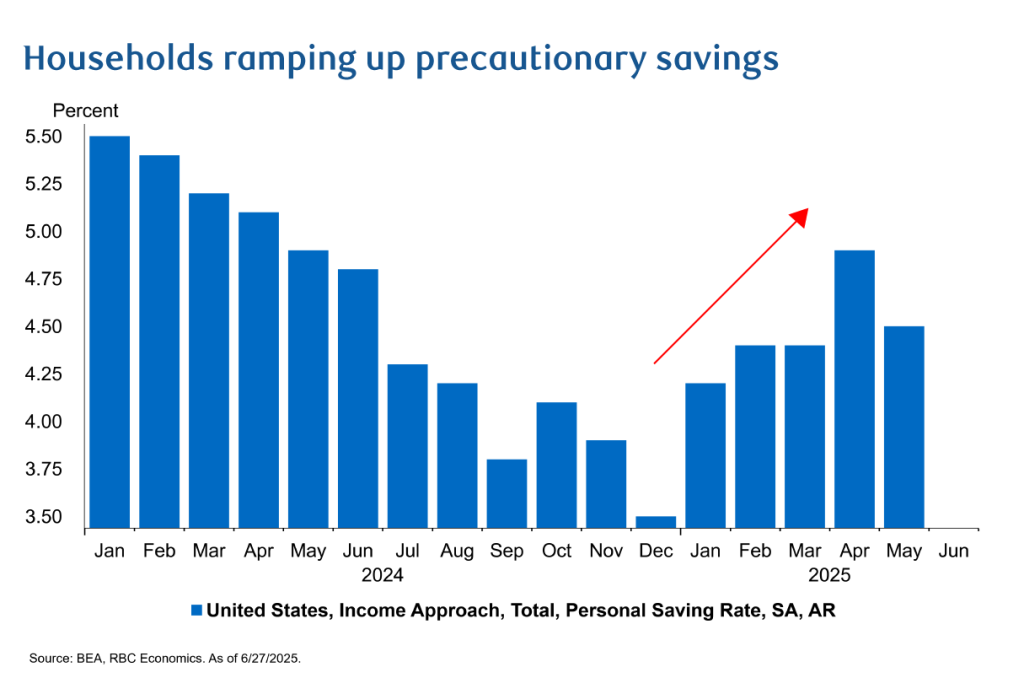
<p>We believe households are more likely to prioritize services consumption at the expense of discretionary goods. But either way, real demand would likely fall, and the difficult reality is that if tariffs derail consumption in pockets of the economy (i.e. demand destruction), business profits weaken, and businesses will also look to cut costs. Consumers may already be preparing for these choices as precautionary savings are already rising.</p>
</li>
</ul>
<p><img style="width: 100%;" src="https://www.rbc.com/en/wp-content/uploads/sites/4/2025/07/Households-2.png?resize=1024,694" alt="Household ramping up precautionary savings graph. United States, Income Approach, Total, Personal Saving Rate, SA, AR. Source: BEA, RBC Economics. As of 6/27/2025."></p>
<hr>
<p>Ultimately, it’s likely that both channels of transmission come into play—with some drift higher in the unemployment rate coupled with higher consumer prices. We expect to see core goods inflation approach 3.4% by year end as the unemployment rate rises towards 4.5%.</p>
<p>Our concerns are more tilted to the inflation side of the picture, because there are other inflationary pressures in the economy, and low- and middle-income households have yet to recover from the pandemic era inflation shock.</p>
<p>Given the significant variability of outcomes, however, we’ll be closely following this transmission framework and updating our forecast as needed.</p>
<p><img style="width: 100%;" src="https://www.rbc.com/en/wp-content/uploads/sites/4/2025/07/chart-Carrie.png?resize=1024,716" alt="Wages account for a significant share of firms' gross-value added graph. Profits After Tax/Gross Value Add (%, LHS) vs. Wages & Salaries/Gross Value Add (%, RHS). Source: Bureau of Economic Analysis, RBC Economics."></p>
<hr>
<p id="footnotes1"></p>
<div style="padding-bottom: 20px;">
<p style="margin-top: 25px;"><a class="collapse-toggle" title="footnotes" href="#articleFootnotes" data-toggle="collapse" aria-expanded="false">+ Footnote</a></p>
<div id="articleFootnotes" class="collapse-content collapse footnotes" aria-expanded="false">
<div class="collapse-inner">
<p id="footnotes"></p>
<ol>
<li>We assume current policy holds with the average effective tariff rate at its current level of 13.8%. Specifically, we consider 50% tariffs on steel and aluminum (with the exception of the UK which faces a 25% rate), 25% tariffs on motor vehicles and parts, and a reduced Liberation Day tariff of 10% for most countries while the 90-day pause is in effect with the exception of China that currently faces a 30% import tariff. <a title="Link to Impact of tariffs on U.S. economy and inflation infographic" href="https://www.rbccm.com/en/story/story.page?dcr=templatedata/article/story/data/2025/07/transmission-framework-how-tariffs-will-flow-through-the-us-economy#ius">↩</a></li>
</ol>
</div>
</div>
</div>
<div class="disclaimer" style="padding-bottom: 20px;">
<p style="margin-top: 25px;"><a class="collapse-toggle" title="disclaimer" href="#articleDisclaimer" data-toggle="collapse" aria-expanded="false"> + Disclaimer</a></p>
<div id="articleDisclaimer" class="collapse-content collapse footnotes" aria-expanded="false">
<div class="collapse-inner">
<p id="disclaimer">This article is intended as general information only and is not to be relied upon as constituting legal, financial or other professional advice. The reader is solely liable for any use of the information contained in this document and Royal Bank of Canada (“RBC”) nor any of its affiliates nor any of their respective directors, officers, employees or agents shall be held responsible for any direct or indirect damages arising from the use of this document by the reader. A professional advisor should be consulted regarding your specific situation. Information presented is believed to be factual and up-to-date but we do not guarantee its accuracy and it should not be regarded as a complete analysis of the subjects discussed. All expressions of opinion reflect the judgment of the authors as of the date of publication and are subject to change. No endorsement of any third parties or their advice, opinions, information, products or services is expressly given or implied by Royal Bank of Canada or any of its affiliates. <br><br>This document may contain forward-looking statements within the meaning of certain securities laws, which are subject to RBC’s caution regarding forward-looking statements. ESG (including climate) metrics, data and other information contained on this website are or may be based on assumptions, estimates and judgements. For cautionary statements relating to the information on this website, refer to the “Caution regarding forward-looking statements” and the “Important notice regarding this document” sections in our latest climate report or sustainability report, available at: <a title="Link to RBC Community Social Impact: Reporting Performance page" href="https://www.rbc.com/community-social-impact/reporting-performance/index.html" target="_blank" rel="noopener noopener">https://www.rbc.com/community-social-impact/reporting-performance/index.html</a>. Except as required by law, none of RBC nor any of its affiliates undertake to update any information in this document.</p>
</div>
</div>
</div>text8 minenglobalOur experts1/templatedata/rbccm/authors/data/frances-donaldfrances-donaldFrances DonaldChief EconomistRoyal Bank of CanadaY/assets/rbccm/images/authors/frances-donald.jpghttps://ca.linkedin.com/in/frances-donald-4836674/templatedata/rbccm/authors/data/michael-reidmichael-reidMichael ReidHead, U.S. EconomicsRBCY/assets/rbccm/images/authors/michael-reid.jpgBy <b>Frances Donald and Mike Reid</b>By <b>Frances Donald and Mike Reid</b>1/templatedata/article/story/data/2025/01/a-playbook-for-how-to-measure-a-tariff-shock-in-canada/templatedata/article/story/data/2025/07/america-needs-workers-not-jobs/templatedata/article/story/data/2025/07/fine-but-not-fabulousEconomy, Tariffs, Inflation, Labor Market, Inventories, Producer Price Index, Consumer Prices, Demand Destruction, Margin CompressioninsightsEconomists are making a range of assumptions about how tariffs may work their way through the economy without relevant historical precedent.Economy, Tariffs, Inflation, Labor Market, Inventories, Producer Price Index, Consumer Prices, Demand Destruction, Margin Compression
Transmission framework: How tariffs will flow through the US economy
Economists are making a range of assumptions about how tariffs may work their way through the economy without relevant historical precedent.
By Frances Donald and Mike Reid Published | 8 min
read
Economists are making a range of assumptions about how tariffs may work their way through the economy without relevant historical precedent. Using our own set of assumptions, we expect tariffs will weigh on the labor market and put upward pressure on inflation, exacerbating our view that the US economy is in a stagflation-lite scenario 1.
But, when and where those pressures show up will ultimately come down to two core questions: How much inventory has accumulated in the system ahead of the implementation of tariffs, and how much of the cost of tariffs will businesses will pass to consumers.
As policies continue to evolve in the coming months and data begins to show evidence of the impact of tariffs, RBC Economics will be using a transmission framework as a roadmap to monitor the fallout.
Here’s a deeper look at how we are thinking about this historic economic shock:
The big inventory question: How much time do we have?
Q1 gross domestic product data shows us that businesses heavily front-loaded goods ahead of tariff implementation with a meaningful surge in imports and resulting jump in inventories.
Until those inventories are drawn down, the impact of tariffs on the economy are stalled as businesses sit on and sell goods at pre-tariffed prices. As long as inventories remain bloated, it will be premature to claim definitively that tariffs will not slow growth or push up prices.
How long will it take for inventories to be fully used up? Problematically, it isn’t straight forward to get a clean read.
Durable inputs like metals or motor vehicles and parts may be stored for much longer than non-durable goods like food products, which do not have a substantial shelf-life. The Monthly Advanced Report on Durable Goods showed fabricated metal products as well as electrical equipment and appliances both reported upticks in recent months. Though, we suspect the report is understating the full magnitude of the buildup and expect to see more upward revisions as new data becomes available.
The national accounts data showed the US trade balance fell by close to $1.4 trillion in Q1, and yet real inventories ramped up by (a still sizeable but much smaller) $160.5 billion. Interestingly, the Advanced Report on Durable Goods has yet to show a meaningful ramp-up in inventories that matches the national accounts data. The data being recorded by businesses and collected by government agenciespan may not fully align, which could instigate a delay in imports being reported as inventories. Additionally, as tariffs are implemented, the use of bonded warehouses may further complicate the reporting process, because goods in bonded warehouses are not cleared by customs for domestic distribution. We expect it will take time to get an accurate picture of the magnitude of the inventory build on a sector basis, and there will likely be significant revisions throughout this process.
Stronger consumer activity will result in a faster depletion whereas a pullback in consumer spending and/or business investment could lead to a more prolonged drawdown. Recent retail sales reports reflect sustained demand for consumer goods, but also signal pre-tariff front-loading by consumers as well (notably in autos). That could imply that recent consumer demand won’t be sustained. Importantly, we continue to expect high-income consumers will dominate consumption activity and have much higher levels of resilience
Based on data we have now, we estimate the aggregate economy has as much as a five months of inventory buildup. In non-durable products like pharmaceuticals which expire, for example, that horizon is shorter.
Imports will ultimately resume at higher prices—where will we see price pressures first?
Once inventories are largely depleted and imports resume at tariffed prices, we expect to see higher producer prices, for example, in the Produce Price Index (PPI.).
Helpfully, PPI is structured by stage of production, which allows us to see price pressures emerge in raw materials, intermediate inputs and final goods, giving an indication of potential increases to consumer prices (reflected in consumer price index) in the coming months.
So far, headline PPI seem innocuous, but this is in part because services deflation has been offsetting early upward pressure from goods. Importantly, month-over-month price changes in finished durable consumer goods are heating up, particularly in furniture, household appliances and electrical equipment prices.
Going forward, we also expect to see pressure build in trade services PPI, which measures margins, specifically, the difference between selling and acquisition prices of a good sold to non-manufacturing industries. We have not seen this yet, but trade services PPI will give us a gauge of the extent that margin compression is occurring outside of manufacturing.
Businesses will pass tariffs to consumers, absorb costs or do both
Tariff revenue has already soared by about $50 billion year-to-date—doubling from a year ago. Those tariffs will need to be paid by some segment(s) of the economy.
Where the buck stops have different implications for growth, employment and consumer prices. Again, the outcomes are likely to vary by product. In its most simplified form, there are two paths the tariff burden can follow.
➔ If businesses absorb the tariff, jobs are at risk. The idea that tariffs will not be inflationary is largely based on the concept that businesses will absorb the higher costs, which would certainly be inflationary for them. While that might imply less pressure on consumer prices, we’d caution against the idea that this is a good outcome for the US economy.
If businesses carry the costs themselves, they’ll face margin compression and need to cut costs elsewhere. Labor is a good candidate. Compensation reflects roughly 48% of gross value added by businesses, suggesting that for every dollar of value generated by a business, 48 cents of that goes to staff.
Clearly, there would be implications for households from job cuts but businesses as well. As we’ve covered in depth here, employers are facing structurally lower labor supply that is complicating their relationship with workers, and there are likely limitations to how weak the labor market can become as a result. Firms may need to spread cost reductions out, including to capital investment, for example.
➔If businesses pass on tariffs to consumers, prices are at risk. The businesses that can and will pass tariffs onto consumers will likely vary quite a bit by sector and end-consumer. We continue to expect it will be much easier to pass on price increases to higher-income households than lower- and middle-income ones, who are in a more precarious economic position.
How will we know when and where consumers are absorbing higher costs? We’ll first see evidence of consumers absorbing tariffs via import-exposed sectors. Think core goods prices first, specifically household furnishings and supplies, where the import share is roughly 50%.
Apparel and recreation commodities are largely imported from Asia and especially exposed to tariffs. Later, should sector-specific tariffs on copper, semiconductors and pharmaceuticals be announced, we would also see higher prices for electronics, communications equipment and medical care products.
We would see prices rise in core goods first, but we’d also expect to see it spillover to services with a lag. For example, as motor vehicle parts and equipment become more expensive, auto repairs will cost more, and in time, the cost of auto insurance will be adjusted to account for higher repair costs.
If wages are constant or lower (as we expect), consumers facing higher prices on tariffed products will have to make a choice: Buy less of the tariffed product or buy less of something else.
We believe households are more likely to prioritize services consumption at the expense of discretionary goods. But either way, real demand would likely fall, and the difficult reality is that if tariffs derail consumption in pockets of the economy (i.e. demand destruction), business profits weaken, and businesses will also look to cut costs. Consumers may already be preparing for these choices as precautionary savings are already rising.
Ultimately, it’s likely that both channels of transmission come into play—with some drift higher in the unemployment rate coupled with higher consumer prices. We expect to see core goods inflation approach 3.4% by year end as the unemployment rate rises towards 4.5%.
Our concerns are more tilted to the inflation side of the picture, because there are other inflationary pressures in the economy, and low- and middle-income households have yet to recover from the pandemic era inflation shock.
Given the significant variability of outcomes, however, we’ll be closely following this transmission framework and updating our forecast as needed.
We assume current policy holds with the average effective tariff rate at its current level of 13.8%. Specifically, we consider 50% tariffs on steel and aluminum (with the exception of the UK which faces a 25% rate), 25% tariffs on motor vehicles and parts, and a reduced Liberation Day tariff of 10% for most countries while the 90-day pause is in effect with the exception of China that currently faces a 30% import tariff. ↩
This article is intended as general information only and is not to be relied upon as constituting legal, financial or other professional advice. The reader is solely liable for any use of the information contained in this document and Royal Bank of Canada (“RBC”) nor any of its affiliates nor any of their respective directors, officers, employees or agents shall be held responsible for any direct or indirect damages arising from the use of this document by the reader. A professional advisor should be consulted regarding your specific situation. Information presented is believed to be factual and up-to-date but we do not guarantee its accuracy and it should not be regarded as a complete analysis of the subjects discussed. All expressions of opinion reflect the judgment of the authors as of the date of publication and are subject to change. No endorsement of any third parties or their advice, opinions, information, products or services is expressly given or implied by Royal Bank of Canada or any of its affiliates.
This document may contain forward-looking statements within the meaning of certain securities laws, which are subject to RBC’s caution regarding forward-looking statements. ESG (including climate) metrics, data and other information contained on this website are or may be based on assumptions, estimates and judgements. For cautionary statements relating to the information on this website, refer to the “Caution regarding forward-looking statements” and the “Important notice regarding this document” sections in our latest climate report or sustainability report, available at: https://www.rbc.com/community-social-impact/reporting-performance/index.html. Except as required by law, none of RBC nor any of its affiliates undertake to update any information in this document.

Related content
Our experts
Frances Donald
Chief Economist, Royal Bank of Canada
Michael Reid
Head, U.S. Economics, RBC
More insights
Stay informed
Get the latest insights and news from RBC Capital Markets delivered to your inbox.