Royal Bank of Canadahttps://www.rbcroyalbank.com/personal.htmlhttps://www.rbcroyalbank.com/personal.htmlInsights1200630enCA
Datum[@Name='Source DCR']
2020-05-26New business models emergeWill genetics usher in a new era of healthcare? Is the entire health ecosystem ready for reinvention? Can digital healthcare in life sciences exceed patient expectations?Expanding Ecosystems3/assets/rbccm/images/gib/healthcare/article_3_thumbnail_sm.jpg/assets/rbccm/images/gib/healthcare/article_3_thumbnail.jpg<h3>Shifting Paradigms</h3>
<p>As the convergence of healthcare and technology has accelerated, new business models are rapidly emerging. </p>
<p>In the traditional biopharma model, the customer would be a physician, R&D tools would be chemical or biological, the end product a pill or vial, and the competitors pharma and biotech players.</p>
<p>The digital revolution in healthcare is shifting this long-established paradigm. Today, biopharma companies’ customer groups have grown to include patients of all ages, providers and payers—all equipped with smartphones and apps that generate a vast amount of digital information to empower their decision-making. R&D has added genetic information and digital capability to its toolset. The end product has broadened beyond the pill to include health outcomes enabled by digital devices and therapeutics. And the competitive set has seen the addition of technology players, including consumer-focused apps and online services, as well as digital health and digital therapeutics firms.</p>
<p class="photo-frame text-center"><img style="width: 100%;" src="/assets/rbccm/images/gib/healthcare/Healthcare-Article-3-Graph-1.png" alt="" /></p>
<h3>A Changing Ecosystem</h3>
<p>Indeed, digital and AI applications are radically changing key areas of the biopharma ecosystem and how patients manage their healthcare.</p>
<p>In pre-clinical research, technology is enabling everything from a deeper mining of literature, to predictive modeling and gene-function annotation. Digital apps are simulating molecular dynamics and pushing the limits of cellular imaging.</p>
<p>In clinical trials, digital transformation is helping to automate testing procedures, build global patient databases and collect real-world data.</p>
<p>In diagnostics, tech powers digital pathology, home-based body diagnosis, and computational analysis of tissue arrays. Just like your car leaves the factory with hundreds of sensors that can trigger the check engine light, humans will have wearable and/or implantable sensors to alert them when something is not functioning properly. Another burgeoning area is immune cell monitoring and digital analysis through just a finger prick.</p>
<p>At the point of patient care, digital applications are already delivering virtual consultations, remote monitoring, VR-based cognitive therapy and digital Rx. Demand for telehealth services and health-based social platforms is also increasing and especially vital in a world facing new challenges such as the COVID-19 pandemic.</p>
<p><img src="/assets/rbccm/images/gib/healthcare/healthcare-article-3-graph-2.png" alt="AI and Digital applications are changing key areas of the Healthcare Ecosystem" /></p>
<div id="similar-to-this" style="border-top: 2px #E6E6E7 dotted; border-bottom: 2px #E6E6E7 dotted; margin: 35px 0; padding: 25px;">
<h4 style="font-size: 18px; letter-spacing: 0.5px; border-bottom: 3px #FEDF01 solid; padding: 0 0 8px 0; margin-bottom: 15px;">Similar to this</h4>
</div>
<h3>Digital Transformation</h3>
<p>The digital revolution presents both threats and opportunities to incumbent biopharma companies. Tech is powering efficiencies in all stages of the current ecosystem and is also enabling healthcare providers to expand their capabilities from treatment to prevention.</p>
<div class="quotebox">
<p>“Tech is powering efficiencies in all stages of the current ecosystem and is also enabling healthcare providers to expand their capabilities.”</p>
<p class="attribution" style="color: #0070a3;">– Greg Wiederrecht, Ph.D.</p>
<div class="quote-share">
<p style="display: inline-block;"><span style="margin-right: 15px;">Share </span><a class="blue-circle-outline-sm" href="https://www.linkedin.com/shareArticle?mini=true&url=https%3A//www.rbccm.com/en/gib/healthcare/episode/new_healthcare_business_models_emerge&title=New%20healthcare%20business%20models%20emerge&source=www.rbccm.com" target="_blank" rel="noopener" aria-label="Connect by LinkedIn"><em class="fa fa-linkedin" style="color: #0051a5; margin-left: 3px;"> </em></a> <a class="blue-circle-outline-sm" href="https://twitter.com/home?status=New%20business%20models%20emerge%20https%3A//www.rbccm.com/en/gib/healthcare/episode/new_healthcare_business_models_emerge" target="_blank" rel="noopener" aria-label="Connect by X"><em class="fa fa-twitter" style="color: #0051a5; margin-left: 3px;"> </em></a> <a class="blue-circle-outline-sm" href="mailto:?subject=New%20business%20models%20emerge&body=I%20found%20this%20insights%20piece%20from%20RBC%20Capital%20Markets%20informative%20and%20thought%20it%20might%20be%20of%20interest%20to%20you%3A%0D%0Dhttps%3A//www.rbccm.com/en/gib/healthcare/episode/new_healthcare_business_models_emerge&title=New business models emerge" aria-label="Connect by Email"><em class="fa fa-envelope" style="color: #0051a5; margin-left: 3px;"> </em></a></p>
</div>
</div>
<p> </p>
<p>The increased digitization of human experiences gives access to a wealth of information and knowledge that could help intervene before disease has a chance to strike. A prime example of this is collating data from an Apple Watch to screen for irregular heart rhythms and detect undiagnosed atrial fibrillation. At the other end of the spectrum, digital transformation allows a completely new class of therapies such as digital therapeutics to support specific disorders.</p>
<p>McKinsey and Company’s international survey shows that more than 75% of patients expect to use digital healthcare services in the future.<sup>1</sup> Patients are seeking technology that delivers a level of care they can rely on and trust. Ultimately, the aim of the digital revolution is to develop healthier societies and lower the cost of care.</p>
<p style="word-wrap: break-word;"><sup>1 Source: McKinsey and Company, Healthcare’s Digital Future, July 2014. https://www.mckinsey.com/~/media/McKinsey/Industries/Healthcare%20Systems%20and%20Services/Our%20Insights/Healthcares%20digital%20future/Healthcares%20digital%20future.ashx</sup></p><ul>
<li>Customer groups, R&D and competitors are all rapidly expanding</li>
<li>Tech is reinventing every facet of the biopharma ecosystem</li>
<li>Innovations in patient care is driving adoption of digital services</li>
</ul>text2 min1 minHealthcare Models, Digital Healthcare, Digital Healthcare Apps, Digital Health Diagnostics, Expanding R&D, Healthcare & Tech Convergence, Healthcare Services, Clinical Trials, Remote Patient Monitoring, Digital Therapeutics, Biopharma ecosystem, Cost of CareN/templatedata/rbccm/episode/data/healthcare/amazon_cvs_and_google_healthcare_reimagined/templatedata/rbccm/episode/data/healthcare/big_tech_vs_big_pharma/templatedata/rbccm/episode/data/healthcare/the_healthcare_data_explosionGreg Wiederrecht, Ph.D./assets/rbccm/images/gib/healthcare/greg-wiederrecht.jpgManaging Director, Healthcare Investment Bankinggreg.wiederrecht@rbccm.comhttps://www.linkedin.com/in/gregwiederrecht/Sasson Darwish/assets/rbccm/images/gib/healthcare/sasson-darwish.jpgManaging Director, AI, Analytics and IoT & Israel Country Coverage, Global Technology Investment Bankingsasson.darwish@rbccm.com https://www.linkedin.com/in/sassdarwish/Andrew Callaway/assets/rbccm/images/gib/healthcare/andrew-callaway.jpgManaging Director, Global Head of Healthcare Investment Bankingandrew.callaway@rbccm.comhttps://www.linkedin.com/in/andrew-cal-callaway
DEBUG: DCR
DCR
Royal Bank of Canadahttps://www.rbcroyalbank.com/personal.htmlhttps://www.rbcroyalbank.com/personal.htmlInsights1200630enCA
DCR
2020-05-26New business models emergeWill genetics usher in a new era of healthcare? Is the entire health ecosystem ready for reinvention? Can digital healthcare in life sciences exceed patient expectations?Expanding Ecosystems3/assets/rbccm/images/gib/healthcare/article_3_thumbnail_sm.jpg/assets/rbccm/images/gib/healthcare/article_3_thumbnail.jpg<h3>Shifting Paradigms</h3>
<p>As the convergence of healthcare and technology has accelerated, new business models are rapidly emerging. </p>
<p>In the traditional biopharma model, the customer would be a physician, R&D tools would be chemical or biological, the end product a pill or vial, and the competitors pharma and biotech players.</p>
<p>The digital revolution in healthcare is shifting this long-established paradigm. Today, biopharma companies’ customer groups have grown to include patients of all ages, providers and payers—all equipped with smartphones and apps that generate a vast amount of digital information to empower their decision-making. R&D has added genetic information and digital capability to its toolset. The end product has broadened beyond the pill to include health outcomes enabled by digital devices and therapeutics. And the competitive set has seen the addition of technology players, including consumer-focused apps and online services, as well as digital health and digital therapeutics firms.</p>
<p class="photo-frame text-center"><img style="width: 100%;" src="/assets/rbccm/images/gib/healthcare/Healthcare-Article-3-Graph-1.png" alt="" /></p>
<h3>A Changing Ecosystem</h3>
<p>Indeed, digital and AI applications are radically changing key areas of the biopharma ecosystem and how patients manage their healthcare.</p>
<p>In pre-clinical research, technology is enabling everything from a deeper mining of literature, to predictive modeling and gene-function annotation. Digital apps are simulating molecular dynamics and pushing the limits of cellular imaging.</p>
<p>In clinical trials, digital transformation is helping to automate testing procedures, build global patient databases and collect real-world data.</p>
<p>In diagnostics, tech powers digital pathology, home-based body diagnosis, and computational analysis of tissue arrays. Just like your car leaves the factory with hundreds of sensors that can trigger the check engine light, humans will have wearable and/or implantable sensors to alert them when something is not functioning properly. Another burgeoning area is immune cell monitoring and digital analysis through just a finger prick.</p>
<p>At the point of patient care, digital applications are already delivering virtual consultations, remote monitoring, VR-based cognitive therapy and digital Rx. Demand for telehealth services and health-based social platforms is also increasing and especially vital in a world facing new challenges such as the COVID-19 pandemic.</p>
<p><img src="/assets/rbccm/images/gib/healthcare/healthcare-article-3-graph-2.png" alt="AI and Digital applications are changing key areas of the Healthcare Ecosystem" /></p>
<div id="similar-to-this" style="border-top: 2px #E6E6E7 dotted; border-bottom: 2px #E6E6E7 dotted; margin: 35px 0; padding: 25px;">
<h4 style="font-size: 18px; letter-spacing: 0.5px; border-bottom: 3px #FEDF01 solid; padding: 0 0 8px 0; margin-bottom: 15px;">Similar to this</h4>
</div>
<h3>Digital Transformation</h3>
<p>The digital revolution presents both threats and opportunities to incumbent biopharma companies. Tech is powering efficiencies in all stages of the current ecosystem and is also enabling healthcare providers to expand their capabilities from treatment to prevention.</p>
<div class="quotebox">
<p>“Tech is powering efficiencies in all stages of the current ecosystem and is also enabling healthcare providers to expand their capabilities.”</p>
<p class="attribution" style="color: #0070a3;">– Greg Wiederrecht, Ph.D.</p>
<div class="quote-share">
<p style="display: inline-block;"><span style="margin-right: 15px;">Share </span><a class="blue-circle-outline-sm" href="https://www.linkedin.com/shareArticle?mini=true&url=https%3A//www.rbccm.com/en/gib/healthcare/episode/new_healthcare_business_models_emerge&title=New%20healthcare%20business%20models%20emerge&source=www.rbccm.com" target="_blank" rel="noopener" aria-label="Connect by LinkedIn"><em class="fa fa-linkedin" style="color: #0051a5; margin-left: 3px;"> </em></a> <a class="blue-circle-outline-sm" href="https://twitter.com/home?status=New%20business%20models%20emerge%20https%3A//www.rbccm.com/en/gib/healthcare/episode/new_healthcare_business_models_emerge" target="_blank" rel="noopener" aria-label="Connect by X"><em class="fa fa-twitter" style="color: #0051a5; margin-left: 3px;"> </em></a> <a class="blue-circle-outline-sm" href="mailto:?subject=New%20business%20models%20emerge&body=I%20found%20this%20insights%20piece%20from%20RBC%20Capital%20Markets%20informative%20and%20thought%20it%20might%20be%20of%20interest%20to%20you%3A%0D%0Dhttps%3A//www.rbccm.com/en/gib/healthcare/episode/new_healthcare_business_models_emerge&title=New business models emerge" aria-label="Connect by Email"><em class="fa fa-envelope" style="color: #0051a5; margin-left: 3px;"> </em></a></p>
</div>
</div>
<p> </p>
<p>The increased digitization of human experiences gives access to a wealth of information and knowledge that could help intervene before disease has a chance to strike. A prime example of this is collating data from an Apple Watch to screen for irregular heart rhythms and detect undiagnosed atrial fibrillation. At the other end of the spectrum, digital transformation allows a completely new class of therapies such as digital therapeutics to support specific disorders.</p>
<p>McKinsey and Company’s international survey shows that more than 75% of patients expect to use digital healthcare services in the future.<sup>1</sup> Patients are seeking technology that delivers a level of care they can rely on and trust. Ultimately, the aim of the digital revolution is to develop healthier societies and lower the cost of care.</p>
<p style="word-wrap: break-word;"><sup>1 Source: McKinsey and Company, Healthcare’s Digital Future, July 2014. https://www.mckinsey.com/~/media/McKinsey/Industries/Healthcare%20Systems%20and%20Services/Our%20Insights/Healthcares%20digital%20future/Healthcares%20digital%20future.ashx</sup></p><ul>
<li>Customer groups, R&D and competitors are all rapidly expanding</li>
<li>Tech is reinventing every facet of the biopharma ecosystem</li>
<li>Innovations in patient care is driving adoption of digital services</li>
</ul>text2 min1 minHealthcare Models, Digital Healthcare, Digital Healthcare Apps, Digital Health Diagnostics, Expanding R&D, Healthcare & Tech Convergence, Healthcare Services, Clinical Trials, Remote Patient Monitoring, Digital Therapeutics, Biopharma ecosystem, Cost of CareN/templatedata/rbccm/episode/data/healthcare/amazon_cvs_and_google_healthcare_reimagined/templatedata/rbccm/episode/data/healthcare/big_tech_vs_big_pharma/templatedata/rbccm/episode/data/healthcare/the_healthcare_data_explosionGreg Wiederrecht, Ph.D./assets/rbccm/images/gib/healthcare/greg-wiederrecht.jpgManaging Director, Healthcare Investment Bankinggreg.wiederrecht@rbccm.comhttps://www.linkedin.com/in/gregwiederrecht/Sasson Darwish/assets/rbccm/images/gib/healthcare/sasson-darwish.jpgManaging Director, AI, Analytics and IoT & Israel Country Coverage, Global Technology Investment Bankingsasson.darwish@rbccm.com https://www.linkedin.com/in/sassdarwish/Andrew Callaway/assets/rbccm/images/gib/healthcare/andrew-callaway.jpgManaging Director, Global Head of Healthcare Investment Bankingandrew.callaway@rbccm.comhttps://www.linkedin.com/in/andrew-cal-callaway
12026-01-272025 Canadian Public Sector Issuers Roundtable seriesRBC capital markets convened Canadian Public Sector debt issuance roundtable discussions in december 2025.noneInsights<li><a href="/en/">Home</a></li><li><a href="/en/insights.page">Insights</a></li>/assets/rbccm/images/insights/2025/20251224-canadian-public-sector-issuers-th.webp/assets/rbccm/images/insights/2025/20251224-canadian-public-sector-issuers-banner.webphttps://www.rbccm.com/en/story/story.page?dcr=templatedata/article/story/data/2025/12/2025-canadian-public-sector-issuers-roundtable-seriesNnone<p>RBC Capital Markets' Government Finance team facilitated two separate roundtable discussions in December 2025, bringing together a diverse cross-section of Canadian public sector participants and institutional investors to discuss debt issuance trends and economic outlook.</p>
<p>The roundtables convened representatives from the Canadian Federal Government, federal agencies, provincial issuers, non-agent crown corporations, and municipal issuers. The discussions focused on the current economic environment in Canada, borrowing patterns throughout 2025, and expectations shaping debt issuance strategy for the new year.</p>
<p>The publications below document these roundtables captures key takeaways and strategic considerations for stakeholders across the sector. We thank all participants who contributed their time and expertise to these discussions.</p>
<div id="accordion1" class="accordion" style="padding: 0;">
<div class="panel-group" aria-multiselectable="true">
<div class="accordion-item">
<div id="heading4" class="panel-heading">
<div class="panel-title"><a class="accordion-toggle collapsed" style="font-family: 'RBCDisplay',Georgia,Times,serif; font-size: 24px; line-height: 28px;" href="#collapse4" aria-controls="collapse4" aria-expanded="false" data-parent="#accordion1" data-toggle="collapse">Public Sector Roundtable Key Themes </a></div>
</div>
<div id="collapse4" class="panel-collapse collapse" style="height: 0px;" aria-labelledby="heading4" aria-expanded="false">
<div class="panel-body">
<div class="row" style="border: 1px solid #c4c8cc; margin: 0; margin-bottom: 20px;">
<div class="col-xs-3" style="display: inline-block; vertical-align: top; padding: 0;"><img class="alignleft size-full wp-image-23215" style="max-width: 100%;" src="/assets/rbccm/images/insights/2025/public-sector-roundtable-th.jpg" alt="Image of mountain for the Public Sector Issuers Roundtable Report"></div>
<div class="col-xs-8" style="display: inline-block; vertical-align: top; padding: 15px !important;">
<h3 style="margin-top: 5px;">Public Sector Issuers Roundtable Report</h3>
<!--<strong>Coming soon</strong> -->
<p><a class="btn btn-blue" title="Link to Public Sector Issuers Roundtable Report" href="/assets/rbccm/docs/insights/2025/public_sector_roundtable.pdf" target="_blank" rel="noopener noreferrer">Download</a></p>
</div>
</div>
<p><strong>Macroeconomic Outlook and Growth:</strong> The Canadian economy is expected to continue to experience modest growth in 2026. Real GDP growth around 1% should be viewed as healthy given structural headwinds including near-zero population growth, weak productivity gains, and minimal business investment. The labour market has held up better than anticipated, though weakness in specific sectors like manufacturing highlight ongoing structural challenges. Consumer spending has been surprisingly resilient and is identified as critical to sustaining growth, though mortgage refinancing pressures and consumer caution about job security pose downside risks.</p>
<p><strong>Trade Tariffs and USMCA Uncertainty:</strong> Tariff impacts have proven less dramatic than originally feared across provincial economies. Canada's economic diversity proved its worth, with resource sectors helping offset manufacturing pressures across different regions. However, uncertainty around USMCA renegotiation and new trade tariff measures pose potential challenges. Businesses are adapting by diversifying trade relationships beyond the United States and pursuing domestic opportunities.</p>
<p><strong>Housing Market Dynamics:</strong> The market is shifting to rental-oriented construction and the government is addressing the affordability crisis via multi-unit residential-friendly construction policies. Housing affordability remains a significant constraint, although the pace of mortgage arrears growth remains very low. The slowdown in immigration is expected to ease demand pressures somewhat, but insufficient housing supply remains a structural challenge.</p>
<p><strong>Funding programs maintain domestic focus while pursuing strategic offshore diversification: </strong>Canadian public sector issuers are expected to maintain a thoughtful balance between a consistent domestic issuance presence and international expansion, centered on maintaining strong relationships with core domestic investors while strategically accessing offshore markets for diversification. Borrowing requirements for Canadian public sector issuers are expected to remain elevated in 2026. Notably, the CMB program is increasing its public borrowing requirement by C$20 billion in 2026. </p>
<p><strong>Credit Spreads Remain at Multi-Year Tight Levels: </strong>Credit spreads have compressed significantly, with front-end provincial and CMB domestic credit spreads at levels last seen in 2008. Record high overall funding volumes and all-time high levels of offshore issuance over the previous two years have been absorbed smoothly. Participants anticipate spreads remaining generally stable in the near term. Potential risks to this base case include: a sharp economic deterioration, increasing tensions over USMCA negotiations, and a significant increase in domestic issuance from the provinces due to a decline in offshore issuance.</p>
<p><strong>‘Canada Inc.’ Brand Strengthens Collective IR Effort:</strong> The "Canada Inc" marketing approach positioning the Canadian public sector issuers as an appealing investment alternative amid global uncertainty is gaining traction with investors. There is deliberate coordination among the Canadian issuers to maintain depth in the domestic market while pursuing offshore opportunities strategically. International investor outreach initiatives are paying dividends with improved access to international capital markets.</p>
</div>
</div>
</div>
<div class="accordion-item">
<div id="heading5" class="panel-heading">
<div class="panel-title"><a class="accordion-toggle collapsed" style="font-family: 'RBCDisplay',Georgia,Times,serif; font-size: 24px; line-height: 28px;" href="#collapse5" aria-controls="collapse5" aria-expanded="false" data-parent="#accordion1" data-toggle="collapse">Municipal and Agency Roundtable</a></div>
</div>
<div id="collapse5" class="panel-collapse collapse" style="height: 0px;" aria-labelledby="heading5" aria-expanded="false">
<div class="panel-body">
<div class="row" style="border: 1px solid #c4c8cc; margin: 0; margin-bottom: 20px;">
<div class="col-xs-3" style="display: inline-block; vertical-align: top; padding: 0;"><img class="alignleft size-full wp-image-23215" style="max-width: 100%;" src="/assets/rbccm/images/insights/2025/municipal-agency-roundtable-1-th.webp" alt="Image of mountain for the Municipal and Agency Roundtable Report"></div>
<div class="col-xs-8" style="display: inline-block; vertical-align: top; padding: 15px !important;">
<h3 style="margin-top: 5px;">Municipal and Agency Roundtable Report</h3>
<!--<strong>Coming soon</strong> -->
<p><a class="btn btn-blue" title="Link to Municipal and Agency Roundtable Report" href="/assets/rbccm/docs/insights/2025/gib-muni-roundtable-final.pdf" target="_blank" rel="noopener noreferrer">Download</a></p>
</div>
</div>
<ol>
<li><strong>Strategic Capital Investment Drives Municipal Growth and Infrastructure Modernization</strong> <br>Municipal and Agency borrowing has intensified as cities pursue ambitious capital plans, with 2025 marking a record year of C$8.68 billion in borrowing across this sector. This reflects municipalities' commitment to modernizing infrastructure, enabling growth, and building climate-resilient systems. Municipalities are executing multi-billion-dollar capital investment plans focused on infrastructure modernization, supported by strong credit ratings and robust market access. Disciplined debt management ensures costs remain manageable while strategically deploying capital to drive sustainable development.</li>
<li><strong>Housing Solutions and Community Stability Take Center Stage</strong> <br>The affordable housing opportunity continues to energize municipal agendas, with rapid population growth spurring innovative solutions and substantial resource mobilization. Municipalities are directing significant resources toward housing acceleration through streamlined approvals, unlocking city-owned land, and strategic investments in new affordable housing and preservation. Enhanced funding for homelessness prevention and shelter expansion reflects municipalities' commitment to building resilient, inclusive communities through collaborative partnerships with senior levels of government.</li>
<li><strong>Transit Systems Evolve: Ridership Recovery and Innovation in Motion</strong> <br>Transit ridership has strongly recovered to near pre-pandemic levels across most regions, demonstrating public confidence in municipal systems. Municipalities and related agencies are modernizing services through electric bus adoption while receiving provincial support and pursuing network expansions to drive ridership growth. With ridership expected to improve further in 2026, these issuers are exploring innovative revenue models and positioning transit as a cornerstone of sustainable urban mobility.</li>
<li><strong>ESG Leadership: Municipalities & Agencies Continue to Drive Growth in The Labeled Bond Market </strong> <br>Municipal and Agency labelled bond issuance reached record levels of C$4.2 billion in ESG offerings in 2025. Bond proceeds are strategically deployed toward green infrastructure, renewable energy, affordable housing, climate adaptation and First Nations. Environmental leadership includes transit fleet electrification, and renewable energy integration. By embedding ESG principles into capital planning, municipalities and agencies are building resilient communities while attracting investor confidence.</li>
<li><strong>Building Stronger Partnerships: Senior Government Collaboration Accelerating Progress</strong> <br>Municipalities and Agencies are strengthening partnerships with provincial and federal governments through collaborative programs including housing acceleration funds, transit funding, and homelessness prevention grants. These partnerships enable municipalities to scale impact beyond their fiscal capacity. As agreements evolve beyond 2026, issuers are diversifying revenue sources and building financial resilience while advocating for continued partnership and predictable funding frameworks.</li>
</ol>
</div>
</div>
</div>
<div class="accordion-item">
<div id="heading6" class="panel-heading">
<div class="panel-title"><a class="accordion-toggle collapsed" style="font-family: 'RBCDisplay',Georgia,Times,serif; font-size: 24px; line-height: 28px;" href="#collapse6" aria-controls="collapse6" aria-expanded="false" data-parent="#accordion1" data-toggle="collapse">Government Finance Canadian Public Sector Debt Market Update</a></div>
</div>
<div id="collapse6" class="panel-collapse collapse" style="height: 0px;" aria-labelledby="heading6" aria-expanded="false">
<div class="panel-body">
<div class="row" style="border: 1px solid #c4c8cc; margin: 0; margin-bottom: 20px;">
<div class="col-xs-4" style="display: inline-block; vertical-align: top; padding: 0;"><img class="alignleft size-full wp-image-23215" style="max-width: 100%;" src="/assets/rbccm/images/insights/2025/government-finance-canadian-public-sector-debt-market-th.webp" alt="Image of Canadian Public Sector Debt Market Update"></div>
<div class="col-xs-8" style="display: inline-block; vertical-align: top; padding: 15px !important;">
<h3 style="margin-top: 5px;">Government Finance Canadian Public Sector Debt Market Update</h3>
<p><a class="btn btn-blue" title="Link to Government Finance Canadian Public Sector Debt Market Update Report" href="/assets/rbccm/docs/insights/2025/government-finance-canadian-public-sector-debt-market.pdf" target="_blank" rel="noopener noreferrer">Download</a></p>
</div>
</div>
<ul>
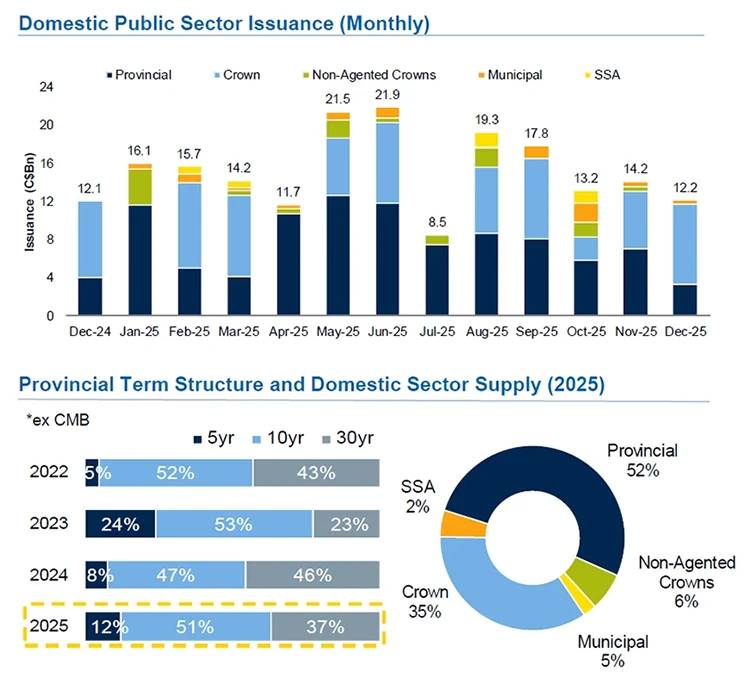
<li>Domestic public sector supply totaled C$186.2 billion in 2025, coming off the record C$188.5 billion see in 2024, though well above the average of C$142 billion seen between 2021-2023.</li>
<li>December saw 8 issuances for C$12.2 billion of domestic funding. Issuers remained active through the first half of the month ahead of the quiet holiday period.</li>
<li>Issuance across all currencies and sectors stands at C$294.4 billion equiv. in 2025, surpassing 2024’s record to mark the most active year ever by volume.</li>
<li>Provincial borrowers have completed C$115.5 billion (87.8%) of their 2025/26 total borrowing programs despite being just 75% through the fiscal year, holding them in an exceptionally strong position heading into the last quarter of 2025/26.</li>
<li>Canada Housing Trust completed its 8th and final trade of 2025 with a C$8.5 billion 5-year re-opening to bring total funding on the year to C$60.0 billion ‒ The Canada Budget 2025 reflected an increase to the CMHC borrowing program to C$80 billion in 2026 from C$60 billion with Government purchases remaining constant at C$30 billion. The increase will inject the market with C$20 billion throughout the year.</li>
<li>Canadian PSE/PF sector supply continues to grow, with C$45 billion completed this year across five currencies, representing a new record year for the sector. Of note, 73% of PSE issuance was funded in non-CAD currencies.</li>
<li>The Municipal and Agency sector had an unusual active December, the C$394 million of new issue supply brought the total 2025 issuance to C$8.7 billion, marked the most active year by volume on record.</li>
<li>Maple SSA primary issuance saw an uptick versus 2024, the market saw C$4.4 billion across five transactions in 2025, an uptick from C$3.7 billion in 2024. Maple pricing levels have been less competitive for the better part of the year however broke the hiatus post-summer as CAD/USD swap spreads converged.</li>
<li>ESG issuance remained comparable to 2024 volumes with C$16.9 billion of supply in 2025 across Green, Social, and Sustainability bonds.</li>
</ul>
<p><img style="max-width: 100%;" src="/assets/rbccm/images/insights/2025/2025-canadian-public-sector-issuers-roundtable-1.webp" alt="Image of chart - Domestic Publis Sector Issuance (Monthly), Provicinal Term Structure and Domestic Sector Supply (2025) "></p>
</div>
</div>
</div>
<div class="accordion-item">
<div id="heading7" class="panel-heading">
<div class="panel-title"><a class="accordion-toggle collapsed" style="font-family: 'RBCDisplay',Georgia,Times,serif; font-size: 24px; line-height: 28px;" href="#collapse7" aria-controls="collapse7" aria-expanded="false" data-parent="#accordion1" data-toggle="collapse">Select RBC-led Transactions in 2025</a></div>
</div>
<div id="collapse7" class="panel-collapse collapse" style="height: 0px;" aria-labelledby="heading7" aria-expanded="false">
<div class="panel-body">
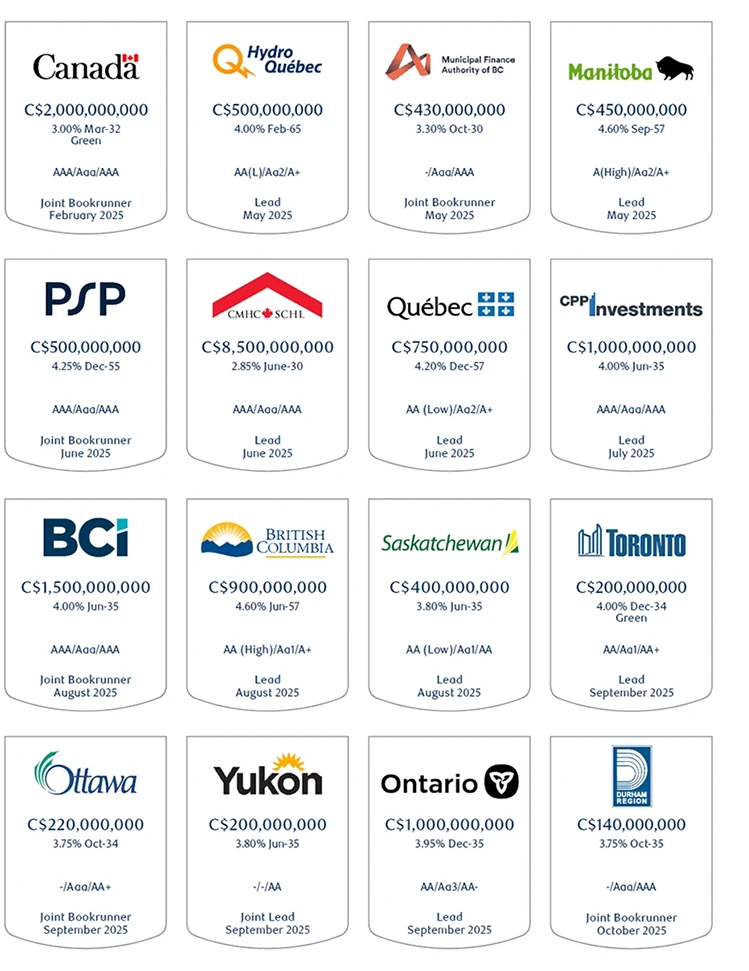
<p><strong>Transactions for Canadian Public Sector Issuers – Domestic</strong></p>
<p><img style="max-width: 100%;" src="/assets/rbccm/images/insights/2025/2025-canadian-public-sector-issuers-roundtable-2.webp" alt="Select RBC-Led Transactions in 2025 tombstones: Transactions for Canadian Public Sector Issuers – Domestic image"></p>
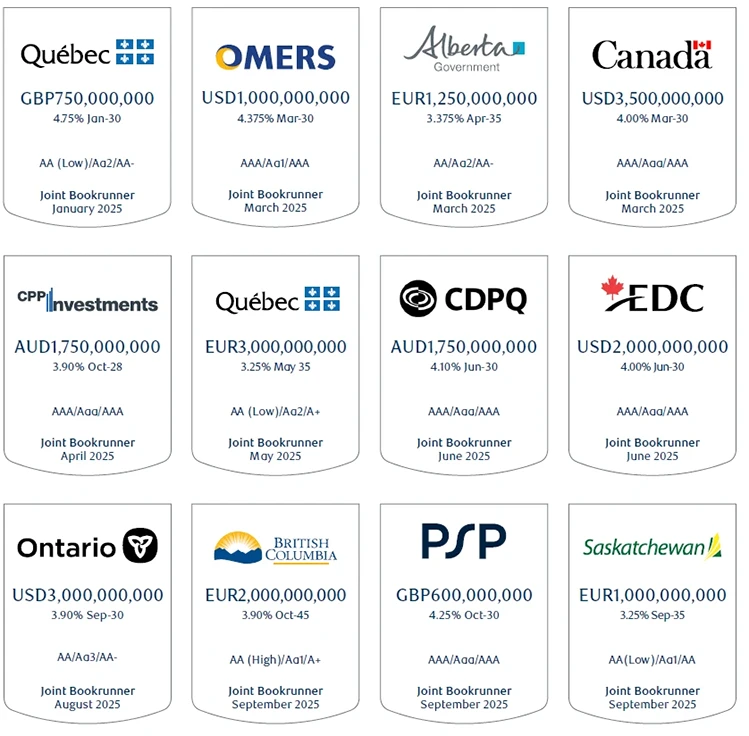
<p><strong>Transactions for Canadian Public Sector Issuers - Offshore</strong></p>
<p><img style="max-width: 100%;" src="/assets/rbccm/images/insights/2025/2025-canadian-public-sector-issuers-roundtable-3.webp" alt="Select RBC-Led Transactions in 2025 tombstones: Canadian Public Sector Issuers - Offshore Image"></p>
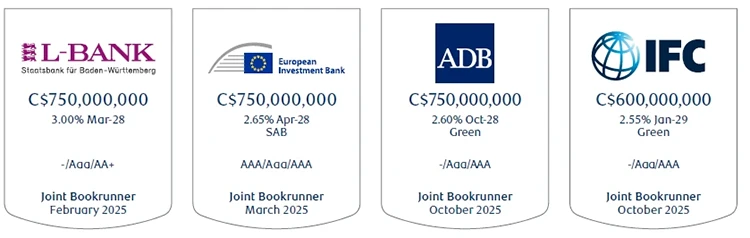
<p><strong>Transactions for Maple Offerings</strong></p>
<p><img style="max-width: 100%;" src="/assets/rbccm/images/insights/2025/2025-canadian-public-sector-issuers-roundtable-4.webp" alt="Select RBC-Led Transactions in 2025 tombstones: Maple Offerings image"></p>
</div>
</div>
</div>
<p style="margin-top: 25px;">Contact info: <br>RBCCM Government Finance<br><a title="Link to RBCCM Government Finance email" href="mailto:RBCCMGovernmentFinance@rbccm.com">RBCCMGovernmentFinance@rbccm.com</a><br>416-842-7756</p>
</div>
</div>
<hr><!--<div id="related-content-panel">
<div class="social-share hidden-xs">
<div style="margin-top: 25px;">
<div class="row">
<div class="col-lg-2">
<div class="display-iblock" style="padding-left: 0px; padding-bottom: 10px;"><span id="shareheader" class="uppercase" style="color: #424242; line-height: 45px;">Share</span></div>
</div>
<div class="col-lg-10"><a class="blue-circle-outline" style="margin-left: 0;" href="https://www.linkedin.com/shareArticle?mini=true&url=https%3A//www.rbccm.com/en/insights/story.page%3Fdcr%3Dtemplatedata/article/insights/data/2022/12/2022_canadian_public_sector_issuers_roundtable_series&title=2022%20Canadian%20Public%20Sector%20Issuers%20Roundtable%20Series&source=www.rbccm.com" target="_blank" rel="noopener" aria-label="Share to LinkedIn"><em class="fa fa-linkedin" style="color: #0051a5; margin-left: 13px;" aria-hidden="true"> </em></a><a class="blue-circle-outline" href="https://twitter.com/intent/tweet?url=https%3A//www.rbccm.com/en/insights/story.page%3Fdcr%3Dtemplatedata/article/insights/data/2022/12/2022_canadian_public_sector_issuers_roundtable_series&text=2022%20Canadian%20Public%20Sector%20Issuers%20Roundtable%20Series" target="_blank" rel="noopener" aria-label="Share to Twitter"><em class="fa fa-twitter" style="color: #0051a5; margin-left: 12px;" aria-hidden="true"> </em></a></div>
</div>
</div>
</div>
</div>
<div> </div>
</div>-->
<p> </p>text5 minenglobal1NBy <strong>RBCCM Government Finance</strong>By <strong>RBCCM Government Finance</strong>1Y/templatedata/article/story/data/2025/01/2024-canadian-public-sector-issuers-roundtable-series/templatedata/article/story/data/2024/01/2023-canadian-public-sector-issuers-roundtable-series/templatedata/article/insights/data/2022/12/2022_canadian_public_sector_issuers_roundtable_seriesCanadian public sector debt, Debt issuance, Government finance, Provincial issuersinsightsRBC Canadian Public Sector Issuers Roundtables examine Canadian public sector debt issuance trends, economic conditions, and 2025 borrowing strategies with federal, provincial, and municipal issuers.Canadian public sector debt, Debt issuance, Government finance, Provincial issuers, Municipal borrowing, Economic outlook Canada, SSA maple issuers
2025 Canadian Public Sector Issuers Roundtable series
RBC capital markets convened Canadian Public Sector debt issuance roundtable discussions in december 2025.
By RBCCM Government Finance Published | 5 min
read
Y
RBC Capital Markets' Government Finance team facilitated two separate roundtable discussions in December 2025, bringing together a diverse cross-section of Canadian public sector participants and institutional investors to discuss debt issuance trends and economic outlook.
The roundtables convened representatives from the Canadian Federal Government, federal agencies, provincial issuers, non-agent crown corporations, and municipal issuers. The discussions focused on the current economic environment in Canada, borrowing patterns throughout 2025, and expectations shaping debt issuance strategy for the new year.
The publications below document these roundtables captures key takeaways and strategic considerations for stakeholders across the sector. We thank all participants who contributed their time and expertise to these discussions.
Macroeconomic Outlook and Growth: The Canadian economy is expected to continue to experience modest growth in 2026. Real GDP growth around 1% should be viewed as healthy given structural headwinds including near-zero population growth, weak productivity gains, and minimal business investment. The labour market has held up better than anticipated, though weakness in specific sectors like manufacturing highlight ongoing structural challenges. Consumer spending has been surprisingly resilient and is identified as critical to sustaining growth, though mortgage refinancing pressures and consumer caution about job security pose downside risks.
Trade Tariffs and USMCA Uncertainty: Tariff impacts have proven less dramatic than originally feared across provincial economies. Canada's economic diversity proved its worth, with resource sectors helping offset manufacturing pressures across different regions. However, uncertainty around USMCA renegotiation and new trade tariff measures pose potential challenges. Businesses are adapting by diversifying trade relationships beyond the United States and pursuing domestic opportunities.
Housing Market Dynamics: The market is shifting to rental-oriented construction and the government is addressing the affordability crisis via multi-unit residential-friendly construction policies. Housing affordability remains a significant constraint, although the pace of mortgage arrears growth remains very low. The slowdown in immigration is expected to ease demand pressures somewhat, but insufficient housing supply remains a structural challenge.
Funding programs maintain domestic focus while pursuing strategic offshore diversification: Canadian public sector issuers are expected to maintain a thoughtful balance between a consistent domestic issuance presence and international expansion, centered on maintaining strong relationships with core domestic investors while strategically accessing offshore markets for diversification. Borrowing requirements for Canadian public sector issuers are expected to remain elevated in 2026. Notably, the CMB program is increasing its public borrowing requirement by C$20 billion in 2026.
Credit Spreads Remain at Multi-Year Tight Levels: Credit spreads have compressed significantly, with front-end provincial and CMB domestic credit spreads at levels last seen in 2008. Record high overall funding volumes and all-time high levels of offshore issuance over the previous two years have been absorbed smoothly. Participants anticipate spreads remaining generally stable in the near term. Potential risks to this base case include: a sharp economic deterioration, increasing tensions over USMCA negotiations, and a significant increase in domestic issuance from the provinces due to a decline in offshore issuance.
‘Canada Inc.’ Brand Strengthens Collective IR Effort: The "Canada Inc" marketing approach positioning the Canadian public sector issuers as an appealing investment alternative amid global uncertainty is gaining traction with investors. There is deliberate coordination among the Canadian issuers to maintain depth in the domestic market while pursuing offshore opportunities strategically. International investor outreach initiatives are paying dividends with improved access to international capital markets.
Strategic Capital Investment Drives Municipal Growth and Infrastructure Modernization Municipal and Agency borrowing has intensified as cities pursue ambitious capital plans, with 2025 marking a record year of C$8.68 billion in borrowing across this sector. This reflects municipalities' commitment to modernizing infrastructure, enabling growth, and building climate-resilient systems. Municipalities are executing multi-billion-dollar capital investment plans focused on infrastructure modernization, supported by strong credit ratings and robust market access. Disciplined debt management ensures costs remain manageable while strategically deploying capital to drive sustainable development.
Housing Solutions and Community Stability Take Center Stage The affordable housing opportunity continues to energize municipal agendas, with rapid population growth spurring innovative solutions and substantial resource mobilization. Municipalities are directing significant resources toward housing acceleration through streamlined approvals, unlocking city-owned land, and strategic investments in new affordable housing and preservation. Enhanced funding for homelessness prevention and shelter expansion reflects municipalities' commitment to building resilient, inclusive communities through collaborative partnerships with senior levels of government.
Transit Systems Evolve: Ridership Recovery and Innovation in Motion Transit ridership has strongly recovered to near pre-pandemic levels across most regions, demonstrating public confidence in municipal systems. Municipalities and related agencies are modernizing services through electric bus adoption while receiving provincial support and pursuing network expansions to drive ridership growth. With ridership expected to improve further in 2026, these issuers are exploring innovative revenue models and positioning transit as a cornerstone of sustainable urban mobility.
ESG Leadership: Municipalities & Agencies Continue to Drive Growth in The Labeled Bond Market Municipal and Agency labelled bond issuance reached record levels of C$4.2 billion in ESG offerings in 2025. Bond proceeds are strategically deployed toward green infrastructure, renewable energy, affordable housing, climate adaptation and First Nations. Environmental leadership includes transit fleet electrification, and renewable energy integration. By embedding ESG principles into capital planning, municipalities and agencies are building resilient communities while attracting investor confidence.
Building Stronger Partnerships: Senior Government Collaboration Accelerating Progress Municipalities and Agencies are strengthening partnerships with provincial and federal governments through collaborative programs including housing acceleration funds, transit funding, and homelessness prevention grants. These partnerships enable municipalities to scale impact beyond their fiscal capacity. As agreements evolve beyond 2026, issuers are diversifying revenue sources and building financial resilience while advocating for continued partnership and predictable funding frameworks.
Domestic public sector supply totaled C$186.2 billion in 2025, coming off the record C$188.5 billion see in 2024, though well above the average of C$142 billion seen between 2021-2023.
December saw 8 issuances for C$12.2 billion of domestic funding. Issuers remained active through the first half of the month ahead of the quiet holiday period.
Issuance across all currencies and sectors stands at C$294.4 billion equiv. in 2025, surpassing 2024’s record to mark the most active year ever by volume.
Provincial borrowers have completed C$115.5 billion (87.8%) of their 2025/26 total borrowing programs despite being just 75% through the fiscal year, holding them in an exceptionally strong position heading into the last quarter of 2025/26.
Canada Housing Trust completed its 8th and final trade of 2025 with a C$8.5 billion 5-year re-opening to bring total funding on the year to C$60.0 billion ‒ The Canada Budget 2025 reflected an increase to the CMHC borrowing program to C$80 billion in 2026 from C$60 billion with Government purchases remaining constant at C$30 billion. The increase will inject the market with C$20 billion throughout the year.
Canadian PSE/PF sector supply continues to grow, with C$45 billion completed this year across five currencies, representing a new record year for the sector. Of note, 73% of PSE issuance was funded in non-CAD currencies.
The Municipal and Agency sector had an unusual active December, the C$394 million of new issue supply brought the total 2025 issuance to C$8.7 billion, marked the most active year by volume on record.
Maple SSA primary issuance saw an uptick versus 2024, the market saw C$4.4 billion across five transactions in 2025, an uptick from C$3.7 billion in 2024. Maple pricing levels have been less competitive for the better part of the year however broke the hiatus post-summer as CAD/USD swap spreads converged.
ESG issuance remained comparable to 2024 volumes with C$16.9 billion of supply in 2025 across Green, Social, and Sustainability bonds.