Navigating uncertainty: William Hague’s blueprint for Britain in 2026
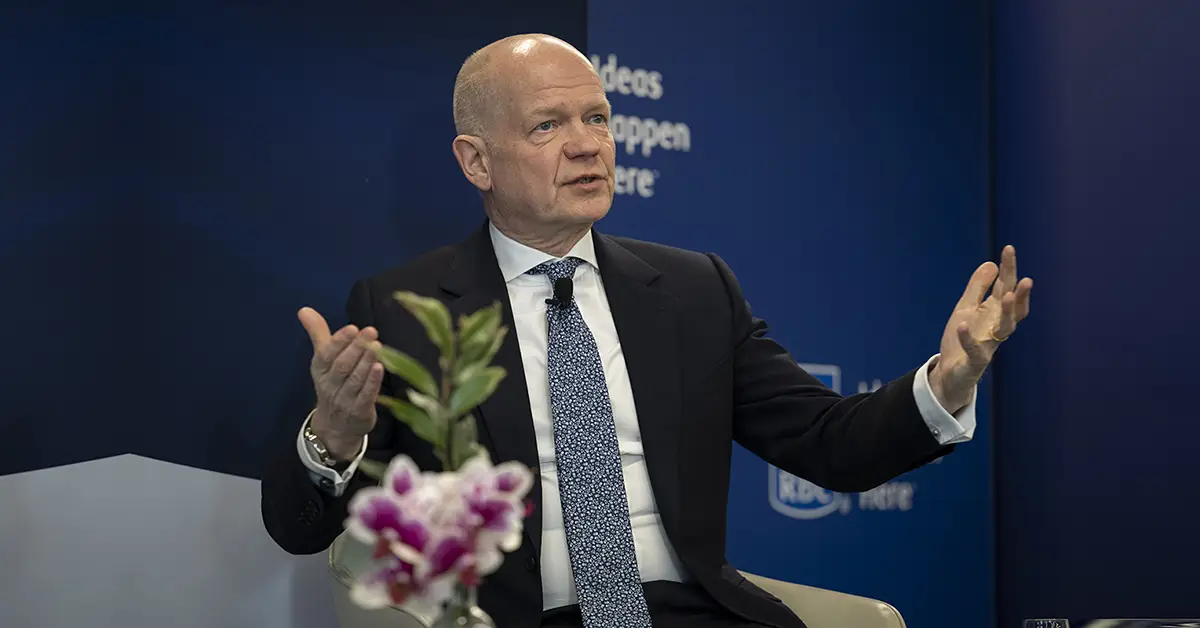
Former UK Foreign Secretary William Hague delivered a sobering yet ultimately optimistic assessment of Britain’s prospects at RBC’s UK Focus Conference, painting a picture of a world at an inflection point between unprecedented danger and extraordinary opportunity.
The geopolitical inflection point: when the rule-keepers become rule-breakers
Hague opened by focusing on the unprecedented geopolitical landscape of 2026. With three of the five UN Security Council permanent members—China, Russia, and the United States—now actively pursuing territorial expansion, the traditional global order has fundamentally shifted. Trump’s recent capture of Venezuelan President Maduro signals an appetite for military intervention, while China’s patient strategy toward Taiwan and Russia’s hybrid warfare tactics in Europe create a dangerous confluence of threats. Unlike previous eras where the superpowers at least paid lip service to international law, today’s major powers are openly disregarding it, transforming the world from a rules-based order into one governed by raw power.
"This is the most dangerous time that we've ever lived in...It's exciting and dangerous."
-William Hague, Former UK Foreign Secretary, Chancellor of Oxford University
Britain’s lost leverage: repositioning a middle power in a fragmented world
Hague candidly acknowledged Britain’s diminished role and the urgent need for strategic repositioning, with our political leaders having lost two of the five strategic levers once available to influence global affairs. The loss of EU membership and the material reduction in the development budget have constrained British diplomatic reach at precisely the moment when the world needs stabilizing middle powers. Yet Hague argues that Britain retains genuine influence—evidenced by its critical role in supporting Ukraine and shaping European security guarantees. The path forward requires a clear-eyed focus on what makes Britain valuable: the rule of law, social stability and economic success at home, which in turn attracts investment and talent globally.
The credibility crisis: why domestic politics matter on the world stage
Hague was frank about the damage inflicted by recent political instability, with multiple prime ministers in rapid succession and the current administration facing historically low approval ratings. This political volatility undermines Britain’s "brand" on the world stage at a moment when potential partners and investors are evaluating whether to commit to the UK. The silver lining, Hague noted, is that British politics overall remains relatively moderate compared to some other democracies—but the risk of further destabilization remains high, with a 50/50 chance of another change of prime minister within the year.
The welfare bind: why reform is essential to fund defense and innovation
Hague emphasized the critical need for welfare and pensions reform alongside increased capital mobilization for innovation, highlighting that government spending on defense and research is constrained by an unsustainable welfare budget that is growing faster than GDP. The pension triple lock, while politically untouchable, is mathematically unsustainable and must eventually be addressed. More immediately, however, Britain must recognize that in the 21st century, success requires merging talent with technology and capital—and the UK is failing on the third leg of this stool. While Britain excels in producing world-class researchers and breakthrough innovations, UK capital consistently fails to follow these innovations to maturity, resulting in intellectual property being sold to American and Asian acquirers.
"We've got some of the most talented people in the country in the world, and we actually invent a lot of the new technology of the world...but then we let everybody else buy it."
-William Hague, Former UK Foreign Secretary, Chancellor of Oxford University
Britain’s hidden asset: unlocking the trillion-dollar potential of UK innovation
Hague remarked passionately on the extraordinary potential embedded in Britain’s university sector and innovation ecosystem. His year as Chancellor of Oxford has shown him firsthand the revolutionary work happening in quantum computing, sustainable chemistry, genomics and vaccine development. The UK maintains three of the world’s top ten universities despite representing only 1% of global population—an extraordinary asset. Oxford alone has spun out 180 companies, yet recent examples like Oxford Ionics and OrganOx were immediately acquired by foreign corporations for $1+ billion each. This pattern underscores Hague’s central thesis: if Britain can successfully deploy domestic capital behind domestic talent, it could retain potential trillion-dollar companies within the UK rather than exporting them. This is not a question of innovation capability but of political will and capital mobilization.
The missing ingredient
In closing, Hague’s message to RBC’s audience—predominantly investors and corporate executives—was direct: Britain stands at a crossroads. The geopolitical environment is treacherous, domestic politics are unstable and public finances are constrained. Yet the scientific and technological potential is unmatched, the universities are world-leading and the talent pipeline is abundant. The missing ingredient is capital. For those positioned to provide it, the opportunity is immense.