The "to be continued" outcome of Friday's Iranian nuclear talks seemingly puts some time back on the clock for a negotiated outcome, but lingering differences between Tehran and Washington, as well as Israeli Prime Minister Benjamin Netanyahu's upcoming U.S. visit, could still clearly tilt the scales in favor of another military engagement. Both Washington and Tehran have put a positive spin on the Oman talks, signaling that further discussions will likely be held in the coming weeks.
During recent visits to the Gulf, regional observers suggested that the fear of higher oil prices could ultimately push President Trump to seek a negotiated settlement. They drew parallels to the Greenland situation, noting that the White House ultimately walked back its maximalist territorial demands when faced with a sharp market selloff. Several GCC leaders have also been actively lobbying the White House to avoid another military confrontation with Iran, arguing that it could lead to a much wider war than in June, with energy and other key economic assets potentially caught in the crosshairs.
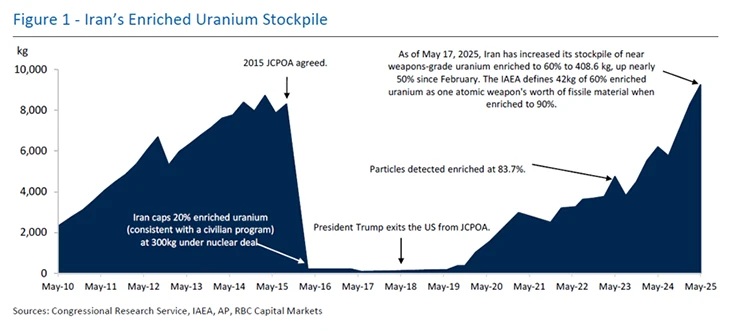
Nevertheless, Washington may have to make the lion's share of concessions to secure a diplomatic off-ramp, as Iran continues to insist on the right to enrich uranium and strictly limiting the talks to the nuclear file. A narrow JCPOA 2.0 settlement would stand the best chance of success with Tehran. Under such an arrangement, Iran would forego high-level enrichment and use of high-speed centrifuge and take additional actions to extend its nuclear breakout timeline to over a year. Deal optimists contend that it is in Iran's best interest to take such a compromise given that the U.S./Israeli June strikes severely degraded its nuclear capabilities.
And yet, recent efforts to craft such a longer, stronger JCPOA+ deal have failed to get across the finish line. During the Biden administration, talks faltered after the Iranians insisted on permanent sanctions relief and the complete revocation of all congressional measures. In June, the U.S. and Iran also struggled to bridge differences over breakout time, international monitoring, and sanctions relief right up to the commencement of Israeli strikes on the nuclear sites.
“Washington may have to make the lion's share of concessions to secure a diplomatic off-ramp, as Iran continues to insist on the right to enrich uranium and strictly limiting the talks to the nuclear file.”
Helima Croft, Head of Global Commodity Strategy and MENA Research, RBC Capital Markets
Israeli Prime Minister Netanyahu is expected to make the case for military action against Iran when he visits Washington on Wednesday. Netanyahu has consistently sought to make the Iranian missile program a core component of the negotiations, as retaining unrestricted access to Iranian airspace is reportedly a priority for his government. Leading proliferation experts have suggested that the Iranian government has made more progress rebuilding its air defense capabilities and ballistic missile stockpiles than reviving its nuclear program after June. Prior to Netanyahu's New Year's Eve visit to Mar-a-Lago, ballistic missiles were not a core component of the U.S./Iran negotiations.
If President Trump reverts to the more expansive, Netanyahu-aligned position, it could raise the risk of a military strike. At the same time, Israel could still take unilateral action against Iran even if President Trump remains more reticent about a kinetic engagement. If U.S./Israel does commence another round of strikes against Iran, the risk to regional energy supplies would be heightened if either party directly targets the Supreme Leader as a part of a regime change effort.
However, limited and surgical strikes could lead to a more measured Iranian response along the lines of what occurred last summer or in January 2020 in the aftermath of the fatal U.S. drone strike on Quds Force Leader Qasem Soleimani.
Helima Croft authored "Iran Update: Rules of Engagement," published on February 9, 2026. For more information on the full report, please contact your RBC representative.