
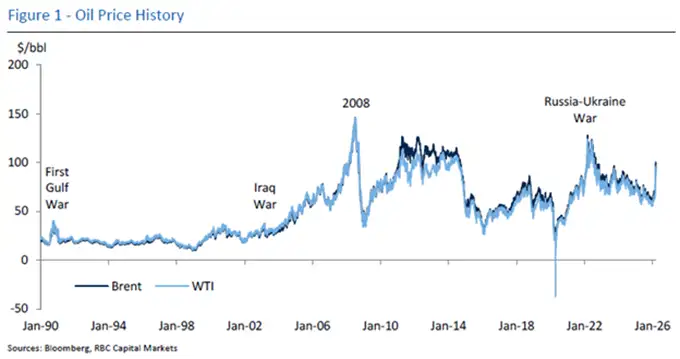
Based on conversations in Washington, the estimated timeline for the Iran war and concurrent oil price impacts has shifted. A number of experts have suggested that a combination of expanded U.S. war aims as well as Iranian asymmetric capabilities and desire to restore deterrence could prolong the conflict well into the spring. It is likely that we will exceed the Russia-Ukraine oil price highs of $128/bbl in 2022 if the war continues for another three to four weeks with minimal progress on maritime security, and that we will surpass the 2008 peak of $146/bbl if it extends for several more months.
It appears that the Trump White House had initially planned for a short duration conflict with minimal economic fallout, bolstered by the Venezuela success as well as the lack of contagion from the 12-day war in June. However, at the moment, the White House apparently is considering sending in some ground troops to secure the enriched uranium stockpiles buried under the Isfahan reactor. Such an operation would be complex and carry a casualty risk. Though a direct military strike on Kharg Island is not seemingly under serious consideration, an operation to seize the oil export facility could still gain traction according to knowledgeable DC experts.
“Iran has sufficient Shahed drone and short-range missile stockpiles to continue targeting Gulf neighbors and regional energy facilities.”
Helima Croft, Head of Global Commodity Strategy and MENA Research, RBC Capital Markets
A close-knit group of administration principals are apparently driving the Iran war decision-making process, and they are not relying heavily on a robust interagency coordination and analysis process. Some have suggested that the dismantling of the State Department's Bureau of Energy and Natural Resources may have contributed to a lack of scenario planning on regional energy risks before the joint U.S./Israeli bombing commenced.
There is an emerging consensus that Iran will likely continue the fight for some time to deter future Israeli and U.S. strikes even if the White House seeks an early exit due to rising economic costs. According to experts we spoke with, Iran has sufficient Shahed drone and short-range missile stockpiles to continue targeting Gulf neighbors and regional energy facilities. The Shahed drones are vastly cheaper than interceptors being deployed against them (less than $10k versus over $3 million) and are increasingly sophisticated due to Chinese chips and Russian parts. At the same time, the U.S. and Israeli strikes have depleted the medium-range missiles primarily used to target Israel but have reportedly not made as much of a dent against short-range stockpiles. Iran also retains significant mining capabilities and autonomous small boats that can be packed with explosives to target ships.
Despite U.S. and Israeli calls for Iranians to rise up against the government, the IRGC reportedly remains unified and deeply committed to a war of attrition. In addition, all the major players in Tehran seem to have coalesced around a very hardline agenda, even those who were once viewed as relatively pragmatic, including Secretary of the Supreme National Security Council Ali Larijani.
There is significant skepticism that a robust U.S. Navy tanker escort service will be operational soon due to capacity constraints as well as the fact that Iran's enhanced military capabilities will pose a bigger challenge than the U.S. faced during the Tanker Wars of the 1980s. Similarly, the DFC insurance plan is not generating much enthusiasm as it only covers the roughly 22 miles of sea lanes in the Strait, not the surrounding waterways, and offers neither casualty nor environmental coverage. Above all, we are struck by the fact that a number of Washington-based security analysts seem to be working with longer-duration timelines than market participants residing outside the Beltway.
