
The rise of robotic intelligence
Humanoid robots represent one of the most significant technological opportunities of the coming decades. The industry is estimated to reach a total addressable market of approximately $9 trillion by 2050, driven by deployment across households, agriculture, manufacturing, logistics, and retail. While hardware revenue forms the foundation of this market, software and services could add an additional $3 trillion through app store ecosystems where users download capabilities ranging from caregiving to meal preparation.
This trajectory represents a fundamental shift in how intelligent machines may integrate into the global workforce and daily life. The industry is expected to evolve across multiple decades, with distinct phases of adoption driven by technological maturity, cost reduction, and application complexity. Humanoid robots could eventually surpass automobiles in total units produced, as their broad utility across industries and households enables frequent use in diverse applications, potentially scaling into the billions as capabilities and adoption expand over the coming decades. Technological advancements and manufacturing efficiencies could reduce average unit costs to approximately $25,000 by 2050, making widespread adoption increasingly feasible.
China's expected market leadership
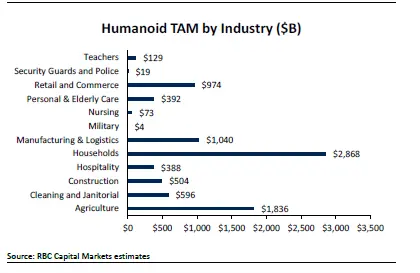
China is positioned to play a pivotal role in the humanoid robotics revolution, potentially accounting for approximately 61% of the estimated $9 trillion market. This expected dominance reflects both manufacturing scale advantages and significant domestic demand across industrial and household applications. Government backing through venture funds and infrastructure investment may accelerate development and adoption timelines. The household sector alone could contribute approximately $2.9 trillion, representing 33% of the total addressable market, with China showing the highest penetration potential.
From a competitive standpoint, Chinese firms generally excel in hardware production, while European and U.S. companies lead in software innovation. This geographic division creates opportunities across the value chain, from component manufacturing to platform development. The market remains highly fragmented with no clear leaders yet emerging, featuring players including established robotics companies alongside technology innovators.
Industrial adoption expected to outpace consumer deployment by decades
Early adoption is expected to focus on industries with repetitive, labor-intensive, or hazardous tasks, such as industrial automation, warehousing, and agriculture, where limited dexterity and narrow capabilities can deliver immediate value. Household robots capable of handling complex tasks like cooking, cleaning, and caregiving may require 20 or more years to fully materialize, as they demand advanced physical interaction, fine motor skills, and autonomous planning capabilities still in development. However, limited-functionality models for niche use cases, such as entertainment robots or specific assistance applications, could reach consumers within five years, primarily appealing to early adopters and affluent buyers.
Households constitute ~33% of the Humanoid TAM
The software revenue opportunity
A significant upside may exist beyond hardware sales. Humanoid robots could adopt a hybrid pricing model combining one-time hardware purchases with ongoing software subscriptions, similar to smartphones. Companies could offer app store ecosystems where users download skill-enhancing capabilities, generating high-margin recurring revenue. Drawing parallels to Apple's services business, which generated approximately 26% of total revenue in 2025 and grew at approximately 13% annually from 2023 to 2025, software applications could represent an incremental $3 trillion in market value beyond the core $9 trillion hardware TAM. This model may enable continuous functionality improvements over a robot's lifecycle without necessitating major hardware upgrades.
"Humanoid robots could operate similarly to smartphones, with users downloading applications from an app store to expand the robot's capabilities."
Tom Narayan, Lead Equity Analyst, Global Autos, RBC Capital Markets
Competition remains wide open
The competitive landscape is highly fragmented, with no clear leader yet emerging. This early-stage market dynamic creates significant investment opportunities spanning multiple categories. Component manufacturers producing sensors, actuators, and cameras may benefit as critical hardware components are widely used across different robot models and manufacturers. Software developers building operating systems and specialized applications could capture high-margin recurring revenue. Interoperability solutions enabling robot collaboration and platform integration may become increasingly valuable as the market matures. Hardware manufacturers with competitive advantages in platform design or cost efficiency could emerge as category leaders.
Component suppliers may present particularly attractive opportunities in the near term, as their technologies are required across the ecosystem regardless of which specific robot platforms ultimately achieve market success.
Tom Narayan authored the report "The Rise of Robotic Intelligence - Diving into the $9T+ Opportunity," published on December 3, 2025. For more information on the full report, please contact your RBC representative.