
The digital transformation of global retail
The retail sector has weathered numerous disruptions over the past three decades, from the rise of department stores to the expansion of discount retailers to the arrival of online commerce. Yet today, the industry stands at the threshold of another transformative shift. This moment represents less an incremental evolution and more a fundamental repositioning of retail ecosystems across customer engagement, operations, and revenue generation.
At the heart of this transformation lies the emergence of "the 8th Continent," a concept recognizing that digital platforms have become so vast they now function as virtual societies on unprecedented scales. Facebook hosts nearly 3 billion monthly active users, YouTube exceeds 2.5 billion, and platforms continue expanding rapidly. These digital spaces have developed the characteristics of nation-states: governance systems through content moderation, native currencies through tips and tokens, and economies built on creator-led trade. For retailers, this shift represents both unprecedented opportunity and formidable competition.
The five interconnected digital trends emerging from this transformation — social commerce, artificial intelligence, alternative revenue streams, supply chain flexibility, and consumer loyalty — are reshaping how retailers operate and how consumers shop.
"Over the next several years, the largest populations on Earth aren't nations, they are platform nations. Meta, TikTok, and YouTube become de facto digital states, each with their own governance, currencies, economies, and civic rituals."
Richard Chamberlain, Global Co-Head, Consumer and Retail Research
Social commerce: A new channel emerges
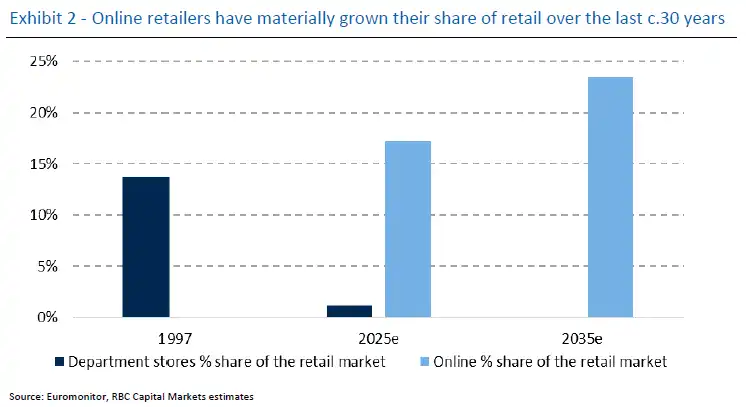
Following a resurgence in physical retail in the immediate years after the COVID-19 pandemic, global ecommerce penetration is rising again. Using a combination of industry forecasts and independent analysis, estimates suggest online retail could approach approximately 25% of total retail sales by 2035, an increase of roughly 7 percentage points from today. This acceleration is expected to be particularly pronounced in Continental Europe, which has historically lagged the UK, the U.S., and China in online penetration, partly due to slower infrastructure development and varied service availability across markets.
More significantly, social commerce is emerging as a distinct and rapidly growing channel within ecommerce. Platforms including Instagram Shop, Facebook Marketplace, and most prominently TikTok Shop combine features of social media and ecommerce, embedding purchasing directly within social environments. These marketplaces allow retailers to sell products directly to consumers while also enabling creator-driven retailing in which influencers market and sell products through social platforms.
Social commerce presents a double-edged sword for retailers. On one hand, it represents increased competition: platforms are capturing share of the broader ecommerce market, and TikTok Shop in particular is expected to continue rapid growth, particularly among younger consumers and for lower-priced goods. On the other hand, social media provides a valuable additional channel through which retailers can engage consumers, reach new audiences, and build brand loyalty through authentic, creator-led content.
View detailed year by year data
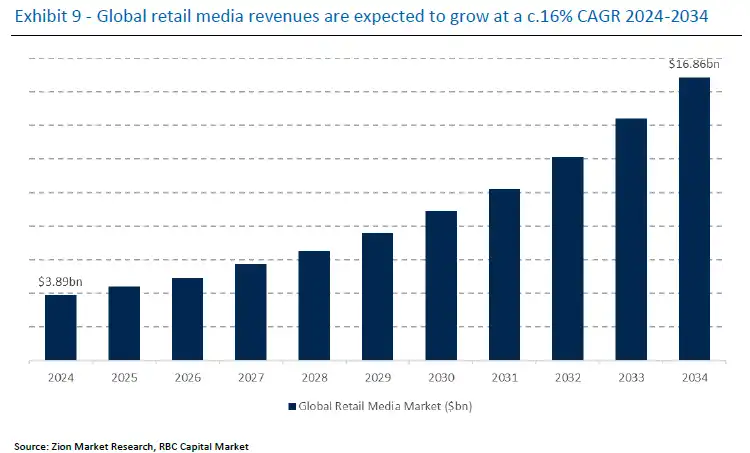
Bar chart titled 'Exhibit 9 - Global retail media revenues are expected to grow at a c.16% CAGR 2024-2034' showing the Global Retail Media Market value in billions of dollars from 2024 to 2034. Dark blue vertical bars display steady growth from $3.89 billion in 2024 to $16.88 billion in 2034, with values increasing each year. Source: Zion Market Research, RBC Capital Market.
Artificial Intelligence: From assistants to agents
A critical evolution within digital commerce is the rise of agentic artificial intelligence (AI capable of operating with minimal human intervention). Agentic commerce represents a key potential application: AI agents that can research products, compare prices, negotiate terms, and ultimately purchase goods and services on behalf of customers.
Consumer attitudes toward AI-assisted shopping are shifting rapidly. Research indicates that 28% of UK consumers are comfortable with AI shopping assistants making purchases automatically without explicit permission, while 58% welcome AI product recommendations. This growing consumer acceptance, combined with technological advances, may position AI agents as a primary interface between consumers and retailers in the coming years.
While some observers worry that agentic AI could disintermediate traditional retail with AI agents transacting directly with brands rather than retailers, evidence suggests the opposite may be more likely. Instead, agentic AI can be an opportunity for retailers with scale, range superiority, and competitive delivery propositions. These retailers may be positioned to capture increased traffic as AI agents direct consumers to platforms offering the widest selection, lowest prices, and fastest delivery.
"We expect agentic AI to provide a more personalized offer for customers; one which is in-tune to the preferences and tastes of the customer it serves. It should also facilitate cross selling and up selling of additional products, thus increasing basket sizes.”
Richard Chamberlain, Global Co-Head, Consumer and Retail Research
Beyond customer-facing applications, artificial intelligence is driving significant backend efficiencies. Forward-thinking retailers are deploying AI tools to improve demand forecasting, optimize inventory management, enhance supplier negotiations, and reduce staffing costs. Visual search technologies allow customers to photograph products and instantly find relevant items or replacements. Markdown management tools powered by AI can reduce promotional markdown costs by approximately 15% while driving higher full-price sales. These operational efficiencies translate directly into margin improvement and competitive advantage.
Beyond traditional retail
The digital transformation has unlocked new revenue streams that leverage existing retail infrastructure. Two of the most significant are retail media and marketplace offerings, both of which generate substantially higher margins than traditional retail operations.
Retail media allows retailers to leverage online websites and digital in-store screens to advertise suppliers' products. This provides additional revenues at attractive margins: on-site advertising typically generates 70–90% margins, while off-site advertising ranges from 20–40%, yielding blended margins around 55%. Based on industry analysis, retail media alone could create an estimated $7 billion in additional global profit by 2034 compared to 2024. Some of this revenue may represent a reallocation of traditional marketing spend, but the targeting precision and closed-loop customer data that retail media provides and enables suppliers to understand which customer cohorts engage with specific promotions and at what times, should generate meaningful incremental revenue beyond historical marketing budgets.
View detailed year by year data
Bar chart titled 'Exhibit 2 - Online retailers have materially grown their share of retail over the last c.30 years' comparing department stores percentage share (dark blue) versus online percentage share (light blue) of the retail market across three time periods. In 1997, department stores held approximately 14% market share while online was near 0%. By 2025e (estimated), department stores declined to about 1% while online grew to approximately 17%. Projections for 2035e show online reaching approximately 23% while department stores remain minimal. Source: Euromonitor, RBC Capital Markets estimates.
Marketplace models provide complementary benefits. By enabling third-party sellers to offer products through retailer platforms, marketplaces expand product assortment in an inventory-light manner, increasing website traffic and enabling cross-selling. In an AI-driven environment, greater range significantly improves the likelihood that AI agents will direct consumers to these platforms, as they offer a one-stop destination for multi-item shopping lists compared to smaller competitors with narrower assortments.
The economics are compelling: marketplace take-rates typically range from 10–15% of transaction value, significantly lower than traditional retail margins, yet the gross margins on marketplace sales (80–90%) make these offerings highly accretive to overall profitability after accounting for associated technology and marketing costs.
The nearshoring imperative
Viral culture and social media connectivity have fundamentally compressed the window for retailers to capitalize on consumer trends. What once took months to develop now unfolds over weeks. Trends go global faster, driven by online connectivity and influencer networks, forcing retailers to respond with unprecedented speed. This acceleration has driven a renewed emphasis on supply chain flexibility and a meaningful increase in nearshoring activity.
“Retailers now need flexible production capabilities, wider ranges and more agile logistics networks to respond to fast moving consumer trends. As a result, we have seen a renewed interest in nearshoring in recent years.”
Richard Chamberlain, Global Co-Head, Consumer and Retail Research
Data reflects this shift: nearshoring has increased by approximately 20% for the U.S. and 8% for Europe between 2019 and 2024, with Latin America and Turkey emerging as key regional hubs. Concurrently, retailers have begun shifting sourcing away from China toward lower-cost Asian markets including Vietnam and Cambodia, partly driven by tariff concerns.
This nearshoring movement serves a strategic purpose beyond cost optimization. By reducing lead times and enabling faster production, nearshoring allows retailers to respond quickly to emerging trends, reducing the proportion of inventory marked down at season's end and improving full-price sales mix. For apparel retailers in particular, faster response time translates directly into improved profitability and customer satisfaction.
Consumer loyalty: Winning share of wallet
The growth of online shopping has fundamentally altered consumer behavior. Easy access to an expansive range of retailers and products has eroded traditional brand loyalty, and this erosion may continue as agentic AI tools direct consumers to alternative retail options and influencers drive increasingly fickle consumer preferences. The result: retailers must work harder to win and retain customer loyalty.
This dynamic has prompted the emergence of increasingly sophisticated customer loyalty schemes. Rather than simple points-based systems, modern loyalty programs employ tiered structures that reward higher spending, paid membership models, and interactive gamification elements such as challenges and competitions that drive engagement. Critically, these programs now leverage personalization, using historical spending data to tailor rewards and product recommendations to individual customers.
The strategic importance of loyalty has only intensified given elevated consumer uncertainty stemming from geopolitical tensions, recent inflationary periods, and pandemic-related disruptions. In times of uncertainty, customers become even more price-conscious and value-oriented, making strong loyalty programs essential tools for maintaining share of wallet. Programs that deliver genuine value through personalized rewards, exclusive member benefits, and gamified experiences build emotional connections that transcend simple transactional relationships.
Richard Chamberlain authored “Rise of the 8th Continent – the next Retail disruptor,” published on February 26, 2026. For more information please contact your RBC representative.