
President Trump's surprise 14-day ceasefire announcement has triggered a sharp selloff in paper oil prices, but significant doubts persist about the deal's mechanics and durability. After threatening the annihilation of Iranian civilization at the start of the day on Tuesday, President Trump announced an unexpected ceasefire that has markets reassessing geopolitical risk in the Middle East.
Yet the ceasefire is already being tested. Gulf countries have been subject to a significant wave of attacks since the announcement. The UAE's Ministry of Defense reported that 17 ballistic missiles and 45 drone attacks had been intercepted since the ceasefire took place. Kuwaiti officials reported "intense" attacks throughout Wednesday, targeting oil infrastructure and three power and water desalination facilities, with 28 drones intercepted at the time of writing. A pumping station on Saudi Arabia's key East-West Pipeline, which has allowed the Kingdom to maintain exports in excess of 5 mb/d, was also struck earlier that morning. These Gulf countries are unlikely to welcome a deal that essentially enshrines a $2 million Tehran tollbooth fee.
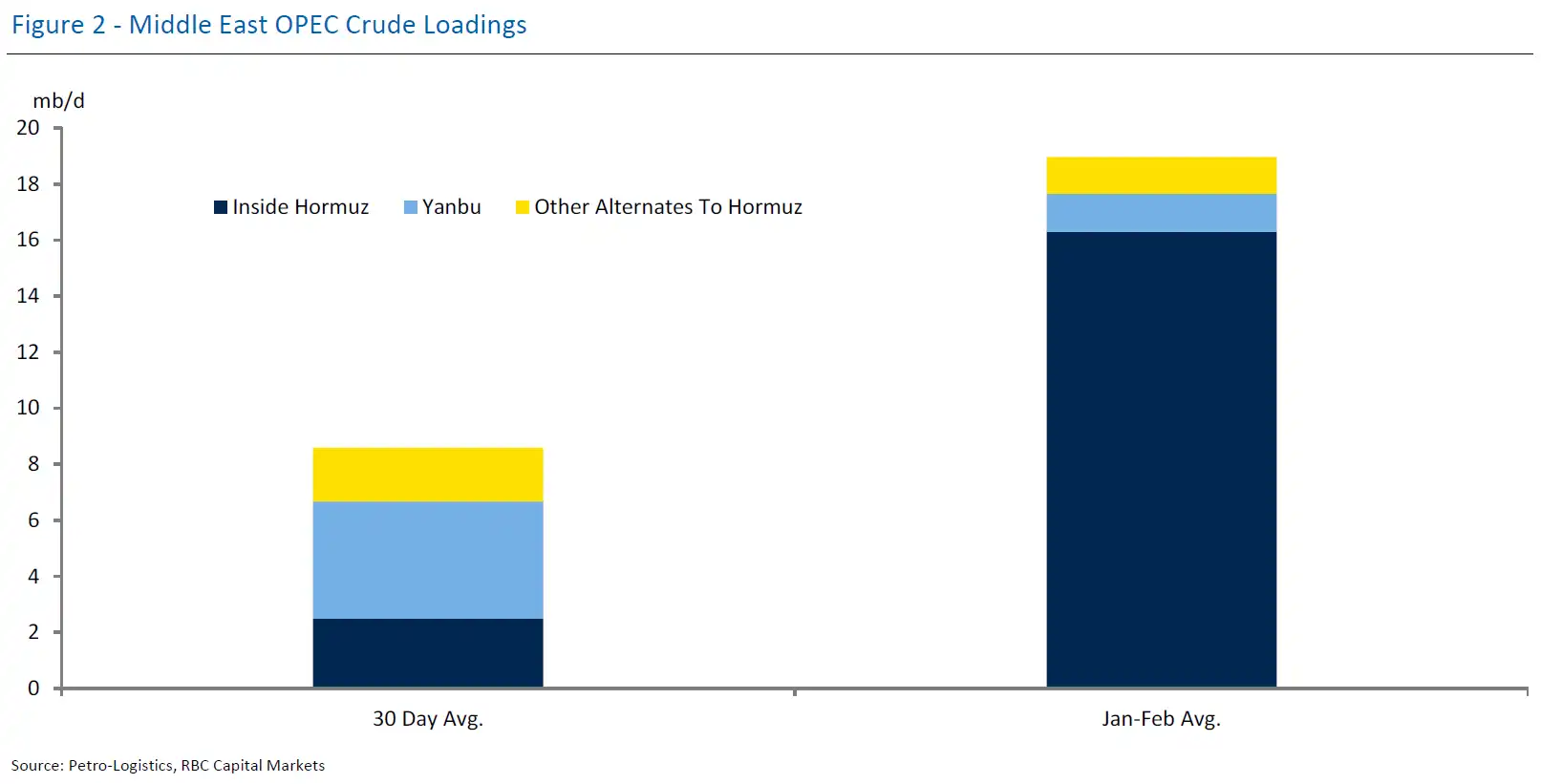
Figure 2 titled "Middle East OPEC Crude Loadings" is a stacked bar chart displaying crude oil loading volumes measured in million barrels per day (mb/d) across two time periods. The chart uses three color-coded categories: Inside Hormuz (dark blue), Yanbu (light blue), and Other Alternates To Hormuz (yellow).
The left bar represents the 30 Day Average with a total of approximately 8.5 mb/d, comprised of approximately 2.5 mb/d from Inside Hormuz, 4 mb/d from Yanbu, and 2 mb/d from Other Alternates To Hormuz.
The right bar represents the January-February Average with a total of approximately 19 mb/d, showing a dramatic increase primarily driven by Inside Hormuz volumes rising to approximately 16 mb/d, while Yanbu decreased to approximately 1.5 mb/d and Other Alternates To Hormuz remained at approximately 1.5 mb/d.
The chart demonstrates a more than doubling of total crude loadings between the two periods, with a significant shift in routing patterns favoring Inside Hormuz over alternative routes. Source: Petro-Logistics, RBC Capital Markets.
Transit through the Strait of Hormuz faces substantial headwinds. Actual transit levels through the waterway will remain significantly depressed given that Iran insists vessels must coordinate with its military or face destruction. Most critically, Iranian state media reported that transit through the Strait is now halted in response to ongoing Israeli attacks on Lebanon. Additionally, Parliamentary Speaker and presumptive leader negotiator Ghalibaf stated that three clauses of the ceasefire plan have already been violated, raising the key question of who will enforce the terms of the deal.
The issue of Iranian enrichment will likely dominate negotiations, which are set to commence in the coming days in Islamabad. Washington's zero enrichment demands doomed previous rounds of talks, and President Trump has already indicated he is sticking with his maximalist position. Three possible paths now emerge: the divide between Washington and Tehran's negotiating positions proves too difficult to bridge and fighting resumes; a deal is reached that largely meets Iran's established enrichment and missile priorities and comes with the added bonus of Hormuz control; or a no-peace, no-hot-war pause of indeterminate duration emerges that renders the ultimate security of the region's waterways unsettled.
"The mechanics of reopening the Strait will be exceedingly messy, with Iran potentially having a vote on nearly every barrel that exits the waterway until Gulf countries can build more alternative access routes."
Helima Croft, Head of Global Commodity Strategy and MENA Research, RBC Capital Markets
Unblocking the Strait of Hormuz will prove protracted regardless of the negotiations' outcome, as a number of countries and companies will resist coordination of passage and payment with Iran. Saudi Arabia has already issued statements calling for the reopening of the Strait without restrictions in line with UN conventions and may continue to use the East-West Pipeline and Red Sea exit routes in order to avoid having to obtain permission from Iran to traverse the waterway. Before Tuesday night's announcement, officials from the UAE made very public calls for ending Iranian control over the Strait, and hence, Abu Dhabi will likely reject Tehran's transit terms. It is also noteworthy that Singapore has already released a statement indicating it will not negotiate with Iran, claiming it is in violation of international law. In addition, major shipping companies have signaled caution about resuming transits through the Strait in the current environment.
View detailed year by year data
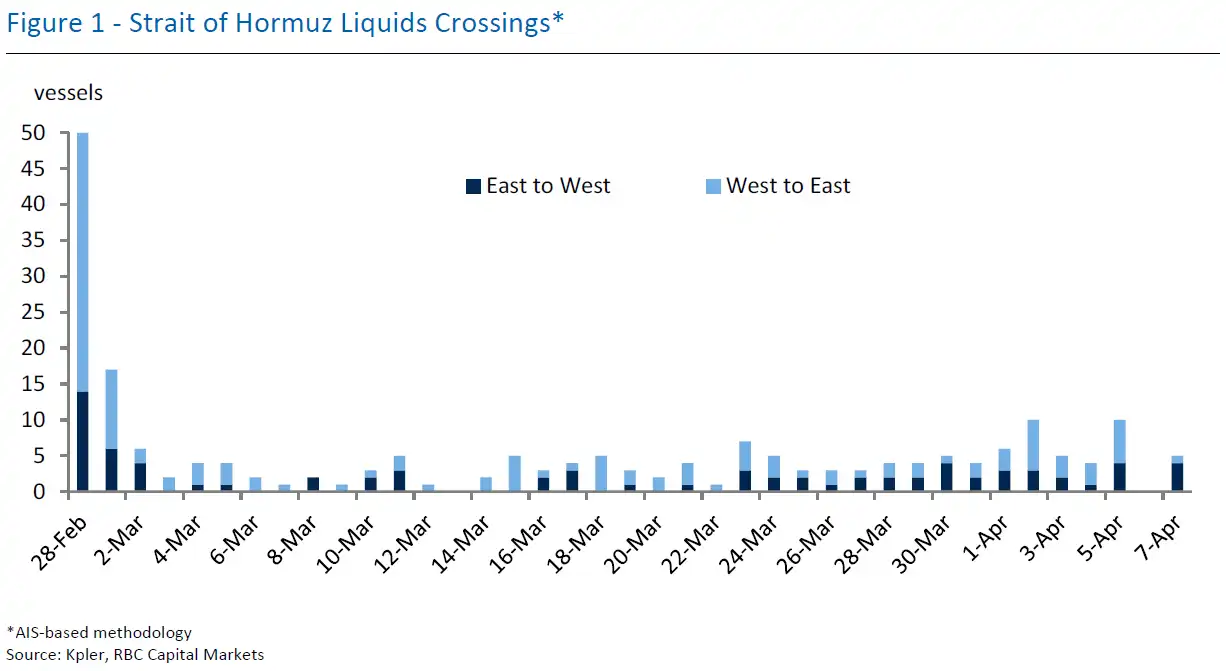
Figure 1 titled "Strait of Hormuz Liquids Crossings" is a grouped bar chart tracking the number of vessels crossing the Strait of Hormuz daily from February 28 to April 7, 2026. The chart displays two directional categories: East to West (dark blue) and West to East (light blue), measured in number of vessels on the y-axis (ranging from 0 to 50+).
Key data points include:
February 28 shows the highest activity with approximately 15 vessels traveling East to West and approximately 50 vessels traveling West to East, totaling roughly 65 vessels.
March 2 shows a significant drop to approximately 5 vessels East to West and 17 vessels West to East.
From March 4 through April 7, daily crossings remain substantially lower, generally ranging from 0 to 10 total vessels per day in either direction, with occasional small spikes.
The West to East direction consistently shows slightly higher vessel counts than East to West throughout most of the period after the initial decline.
Notable spikes occur around March 24, April 3, and April 5, where West to East crossings reach approximately 7-10 vessels.
The chart demonstrates a dramatic 85-90% reduction in vessel traffic through the strait following February 28, with activity remaining suppressed through early April. The data is based on AIS (Automatic Identification System) methodology. Source: Kpler, RBC Capital Markets.
Sanctions relief could prove to be a difficult issue in the upcoming negotiations given that President Trump has limited repeal authority for the most punitive measures. Many U.S. sanctions originate in Congress, and the Iran Nuclear Agreement Review Act gives the legislature oversight on any deal reached. Significant congressional pushback is anticipated against any White House effort to vacate sanctions after what has transpired over the past six weeks. Hence, Iran may have to live with the current non-enforcement regime rather than a full repeal that would pave the way for reintegration into Western financial markets. Importantly for energy markets, the continuing sanctions status quo would make it exceedingly difficult for a number of shipping companies to pay the sanctioned IRGC transit fees. In this limited sanctions relief situation, the IRGC may be doubly incentivized to secure higher oil prices to fund reconstruction and rearmament efforts.
Helima Croft authored "Iran Quick Take: Messy Mechanics," published on April 8, 2026. For more information on the full report, please contact your RBC representative.
