The energy economics of artificial intelligence
Energy has become a defining constraint in the artificial intelligence infrastructure race. As computing demands accelerate, the cost of reliable power is increasingly influencing where data center operators choose to build and how they structure their operations. The observation that "the cost of intelligence will converge to the cost of energy," as noted during recent congressional testimony, illuminates an emerging reality: abundant, affordable energy is becoming a strategic competitive advantage that shapes returns on capital and determines which regions attract infrastructure investment.
This dynamic is reshaping U.S. natural gas markets in fundamental ways. In our latest analysis, we forecast natural gas consumption from data centers reaching approximately 6.1 billion cubic feet per day by 2030 (versus 2024 levels), substantially higher than our previous expectations. This is due to a maturing development pipeline with a growing number of projects advancing toward completion and a notable geographic overlap between planned data center locations and the nation's gassiest energy grids and most prolific natural gas basins.
We expect data center demand to equate to roughly 17% of 2025's average U.S. power consumption by the end of this decade, positioning it as one of the two most consequential factors driving natural gas demand through 2030, alongside liquefied natural gas export growth. Beyond 2030, we anticipate zero-carbon energy sources will increasingly displace natural gas in the power mix; however, through the current decade, natural gas is positioned as a backbone fuel supporting the AI infrastructure buildout.
Geographic concentration and regional dynamics
Data center deployment is creating a regional pattern of concentration with important implications for natural gas infrastructure and investment. Nearly 40% of operating, planned, and under-construction data centers are concentrated in Texas and Virginia, the nation's established data center hubs. However, this geographic concentration is beginning to diversify as developers encounter regulatory hurdles, extended interconnection queues, and rising power costs in traditional markets.
Emerging secondary markets are attracting billions of dollars in investment. Georgia, Ohio, Illinois, and Arizona together host approximately 17% of planned and under-construction projects. A deliberate developer strategy has come into focus: states offering favorable regulatory environments and proximity to natural gas supplies are becoming increasingly attractive alternatives to traditional hubs. For example, Louisiana has implemented a "Lightning Speed" regulatory framework that streamlines approval timelines for power plants serving data centers. The state is already expanding gas transmission infrastructure to support planned hyperscaler projects, with Energy Transfer expanding its Tiger Pipeline system in northern Louisiana to deliver approximately 250 million MMBtu daily beginning in early 2028 to power a 5-gigawatt data center facility.
Similarly, Pennsylvania is attracting substantial data center investment due to its proximity to ultra-low latency fiber corridors and the Appalachian Basin. Notably, construction has begun on what is anticipated to become the nation's largest natural gas power plant developed specifically to power an on-site data center, underscoring the scale of infrastructure being deployed to meet baseload requirements.
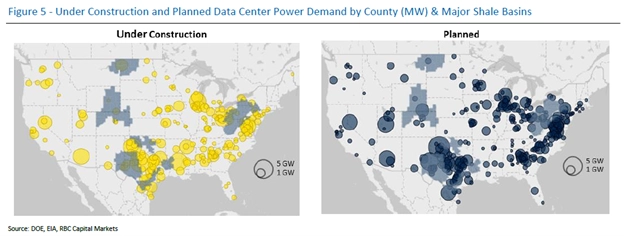
Figure 5 – Under Construction and Planned Data Center Power Demand by County (MW) & Major Shale Basins
Figure 5 presents two side-by-side maps of the United States comparing data center power demand by county, overlaid with major shale basins shaded in blue-grey. The left map, labeled "Under Construction," uses yellow circles of varying sizes (scaled to 1 GW and 5 GW) to indicate current power demand, showing significant concentrations in Texas and the East Coast. The right map, labeled "Planned," uses dark blue circles to represent future power demand, indicating a broader and denser expansion across the country, particularly in Texas, the Midwest, and the East Coast. The data is sourced from the DOE, EIA, and RBC Capital Markets.
The geographic overlap between data center location decisions and natural gas availability is not coincidental. The top six states for data center development — Texas, Virginia, Georgia, Ohio, Illinois, and Arizona — have grids where natural gas supplies nearly half of electricity generation (with the exception of Illinois). This alignment has directly informed our revision higher on natural gas consumption: the concentration of projects in gas-rich regions combined with the near-term availability of natural gas relative to nuclear or other zero-carbon alternatives makes natural gas the practical choice for developers facing urgent timelines and interconnection constraints.
The dual architecture of data center power: front and behind the meter
Meeting accelerating data center growth requires a two-pronged power approach that is reshaping how developers conceptualize energy infrastructure. According to data compiled by the Department of Energy, approximately 36.6 gigawatts of data center capacity are currently under construction, and 201.5 gigawatts are in planning stages across the United States. In response, front-of-the-meter grid development is accelerating to address constrained interconnection queues and expand transmission capacity while behind-the-meter generation solutions are providing immediate and reliable baseload-type capacity.
The planned natural gas capacity queued for interconnection between 2026 and 2030 has grown dramatically. At the start of 2025, only 23.8 gigawatts of natural gas capacity was planned to come online during this period. By January 2026, this had expanded by approximately 24 gigawatts. In the first quarter of 2026 alone, an additional 16 gigawatts was added to the queue, bringing the total planned natural gas project pipeline to 64 gigawatts by 2030, representing not only the addition of new projects but also a shift toward larger-scale facilities. New projects added in 2025 averaged 590 megawatts in capacity compared to 509 megawatts for projects already in the queue.
However, extended interconnection queues spanning five years or longer have prompted hyperscalers to pursue an alternative strategy: behind-the-meter generation. This implies a structural recalibration of how data centers source power. With grid interconnection bottlenecks increasingly constrained, hyperscalers and colocation providers have pivoted to self-generating power solutions, positioning natural gas as an essential fuel bridging the gap between intermittent renewables and the 24/7 dispatchability required by mission-critical computing facilities.
The scale of behind-the-meter development is substantial. As of 2026, data center developers have announced approximately 101 gigawatts of behind-the-meter natural gas generation capacity in the United States. While some of these projects may be speculative, over 57 gigawatts have already publicly disclosed equipment orders, and approximately 7 gigawatts are already under construction. Texas is attracting the most behind-the-meter investment, with an estimated 38 gigawatts in development. As of March 2026, ERCOT had received approximately 356 gigawatts of data center interconnection requests, creating unprecedented queue pressure and incentivizing behind-the-meter alternatives.
"On-site gas generation is being increasingly viewed as a permanent fixture of the digital infrastructure landscape through decade's end at least, and potentially beyond."
Christopher Louney, Commodity Strategist, RBC Capital Markets
The largest behind-the-meter project under construction illustrates the infrastructure scale now being deployed: the nearly 4.4-gigawatt Homer City Generating Station, a natural gas-fired generator being built at a retired coal plant in Pennsylvania to serve a planned data center campus, will require approximately 665,000 MMBtu daily delivered via multiple pipeline systems beginning in 2027. Similarly, Meta has announced plans to fund the construction of seven new natural gas power plants across Louisiana to fuel its expanding data center portfolio.
Behind-the-meter deployment also is accelerating through mobile and temporary solutions. One recent example in Tennessee deployed 200 megawatts of data center load using mobile natural gas generators in just 122 days, underscoring the speed advantage of natural gas solutions when traditional grid interconnection timelines prove prohibitive.
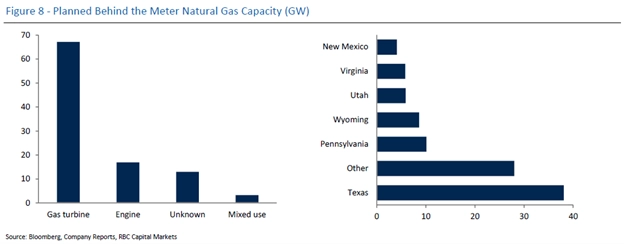
Figure 8 – Planned Behind the Meter Natural Gas Capacity (GW)
Figure 8 displays two bar charts detailing planned behind-the-meter natural gas capacity in gigawatts (GW). The left vertical bar chart categorizes capacity by technology, showing Gas turbine as the dominant type at nearly 70 GW, followed by Engine at approximately 18 GW, Unknown at 13 GW, and Mixed use at 3 GW. The right horizontal bar chart breaks down capacity by location, highlighting Texas as the leader with nearly 40 GW, followed by the "Other" category at roughly 28 GW, Pennsylvania at 10 GW, and smaller amounts in Wyoming, Utah, Virginia, and New Mexico. The data is sourced from Bloomberg, Company Reports, and RBC Capital Markets.
Strategic advantages and energy security
The appeal of natural gas for data center operators extends beyond simple economics. U.S. natural gas markets offer structural advantages that enhance predictability and reduce geopolitical risk, a critical consideration in today's volatile energy environment.
While global natural gas prices have spiked dramatically in response to regional supply disruptions, U.S. Henry Hub prices have remained remarkably resilient and contained. European benchmark prices (TTF) have risen over 40% in response to Middle Eastern supply disruptions, and Asian liquefied natural gas prices have surged as geopolitical tensions threaten critical maritime chokepoints. By contrast, U.S. natural gas markets are largely insulated from international geopolitical shocks due to domestic supply abundance, significant storage capacity, and fully utilized (and thus naturally capped) LNG export capacity aside from planned additions through the end of the decade.
"As competition for AI infrastructure intensifies and energy costs surface as a deciding factor in returns on capital, this geopolitical shield around American natural gas becomes a strategic advantage in the competition for near-term development."
Christopher Louney, Commodity Strategist, RBC Capital Markets
For data center developers and operators, this structural insularity adds measurable certainty to the business case for natural gas infrastructure. This positioning becomes increasingly valuable as competition for AI infrastructure intensifies and energy costs surface as a decisive factor in returns on capital.
Headwinds: regulation, supply, and community resistance
Data center expansion faces mounting structural headwinds that could constrain natural gas demand growth and reshape deployment timelines. Three categories of challenges warrant close attention: regulatory changes, turbine supply constraints, and community opposition.
At the federal level, the Federal Energy Regulatory Commission (FERC) is expected to unveil a regulatory proposal in June aimed at establishing nationwide interconnection rules for large loads. The goal is to move away from case-by-case approvals toward a standardized, non-discriminatory framework to manage rapid load growth. However, this federal approach faces resistance from state regulators who have already begun implementing solutions through state-level tariffs.
Twenty states have already enacted large-load tariff structures dedicating rate classes specifically for data centers. These tariffs aim to shield residential consumers from price increases while also filtering speculative "phantom projects" from interconnection queues. At the regional level, FERC issued a landmark order directing PJM to overhaul its transmission tariff framework. Under the new service options, data centers must now explicitly purchase generation firmness either through self-supply or formal transmission contracts with defined curtailment rights. Critically, this regulatory shift creates a structural bias toward firm generation sources like natural gas, which can reliably meet baseload capacity requirements, over intermittent renewables, which would require massive battery overbuilding to achieve equivalent firm capacity. For infrastructure investors, this regulatory framework effectively locks in long-duration natural gas contracting opportunities.
Another critical constraint is the global turbine supply shortage. Data center build-out has substantially outpaced turbine production capacity, creating a structural supply shortage that will extend infrastructure deployment timelines. Global orders for natural gas turbines reached an estimated 100 gigawatts by the end of 2025, yet global manufacturing capacity is estimated at only 60–70 gigawatts annually. While suppliers are working to ramp production capacity, planned increases may fall short of potential demand.
New turbine orders are commanding price premiums of 10–20% above existing backlog levels, and near-term available capacity is increasingly spoken for by early-moving hyperscalers and developers. This dynamic raises procurement costs for future projects while compressing available near-term generation capacity.
Perhaps the most acute near-term headwind is growing community opposition to data center expansion. At least 25 data center projects were canceled in 2025 following community opposition. In the second quarter of 2025 alone, an estimated $98 billion in projects were blocked or delayed, representing the largest quarterly total since data center expansion accelerated in 2023. State lawmakers have proposed over 300 bills to address challenges these facilities present. Two prominent U.S. legislators recently proposed a data center moratorium bill, advocating for a development slowdown pending congressional action on worker and environmental protections.
Rising electricity rates, symptomatic of grid aging and broader electrification but increasingly attributed to data center demand, have prompted communities to resist new development. Recent polling data shows that far more Americans view data centers negatively than positively regarding environmental impact (39% vs. 4%), home energy costs (38% vs. 6%), and local quality of life (30% vs. 6%). In response, major technology companies recently signed the "Ratepayer Protection Pledge," a non-binding commitment to cover the full cost of power and grid infrastructure for their data centers. However, this commitment has largely lacked specificity around timing, scope, and enforcement, leaving regulatory uncertainty intact.
The recalibration
The momentum behind the AI data center buildout is real, and our analysis of planned and under-construction data center projects reflects a materially higher trajectory for natural gas consumption than we previously anticipated. Through 2030, natural gas is positioned as a backbone fuel supporting the AI infrastructure race, driven by geographic concentration of projects in gas-rich regions, the near-term practical availability of natural gas relative to zero-carbon alternatives, and the structural advantages of U.S. natural gas markets in an uncertain geopolitical environment.
We forecast natural gas consumption from data centers reaching approximately 6.1 billion cubic feet per day by 2030, with a likely range of 6–7 billion cubic feet per day by decade's end. This is roughly a 20% increase to baseline power demand from 2025 levels and remains secondary to planned liquefied natural gas export capacity additions expected through 2030. Beyond 2030, we anticipate zero-carbon energy sources will gain relative share, but natural gas is likely to retain a significant operational role based on current technology trajectories and infrastructure development timelines.
Christopher Louney authored "Natural Gas Strategy: Gas Is Powered Up," published on May 3, 2026. For more information on the full report, please contact your RBC Capital Markets representative.