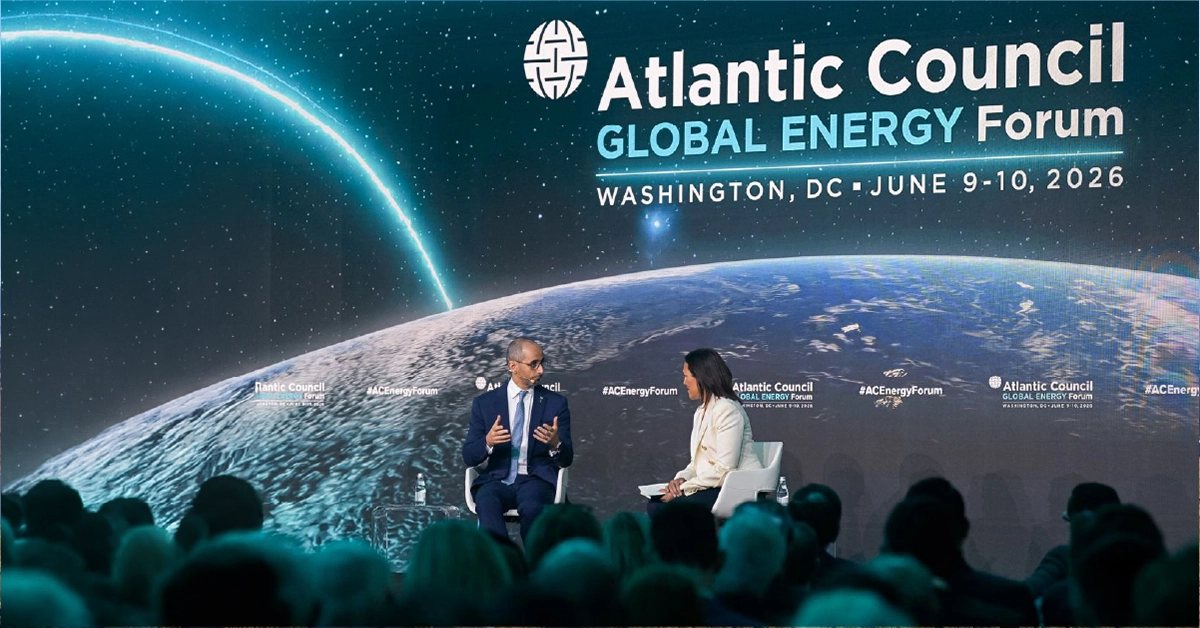

This year’s Atlantic Council Global Energy Forum took place as global markets faced a historic energy supply shock.
Against that backdrop, government officials, policymakers, investors and industry leaders focused on the immediate pressures of disruption, volatility and supply constraints, while also looking at the longer-term implications for energy security, infrastructure investment and global cooperation.
The discussions reflected a sector managing near-term market stress while preparing for a more diversified, resilient and interconnected energy system.
Energy security remains the central theme
Global energy markets remain deeply interconnected. Energy independence and energy dominance continue to shape policy priorities, but supply, transportation, trade and consumption still operate across connected global systems.
The Strait of Hormuz was central to that discussion. Strategic reserve releases, alternative export routes and demand curtailment can help limit near-term disruption, but they do not replace the need for secure passage through one of the world’s most critical energy corridors.
Participants also pointed to the limits of inventories and emergency reserves. Stronger stock levels can provide a buffer during periods of stress, but they cannot fully offset sustained production losses or prolonged disruption to major transportation routes.
The discussion reinforced that energy security is now a global operating challenge. Disruption in one region can quickly affect supply chains, commodity pricing and economic conditions across markets.
Markets are looking beyond the immediate crisis
The Forum also focused on how demand could evolve once the current disruption subsides. A recurring view was that some demand now being described as ‘demand destruction’ may prove to be demand deferral.
Several speakers compared current consumption patterns to the COVID period, when demand declined temporarily before recovering as economic activity resumed. That experience is shaping expectations for a more resilient longer-term demand outlook.
The need for energy security could also reinforce future demand. Governments seeking to increase strategic reserves, expand storage capacity and strengthen supply buffers may add another layer of structural demand over time.
Asia was cited as a key example, with countries across the region focused on reserve capacity, storage infrastructure and long-term supply security.
Once market conditions normalize, inventory rebuilding, reserve replenishment and deferred consumption could contribute to stronger demand than current conditions suggest.
Supply diversification is accelerating
Across oil, natural gas and infrastructure discussions, participants emphasized the need to reduce dependence on single routes, regions or suppliers.
The Americas were central to the diversification discussion, as speakers pointed to regional production growth across Canada, the United States, Brazil, Argentina and Venezuela as a potential source of additional supply for global markets.
Current disruption may not have a near-term substitute, but it is likely to increase focus on alternative sources of supply over time.
That focus extends beyond production. Export capacity, storage infrastructure and transportation networks are becoming central to how countries strengthen long-term energy security.
Even as geopolitical risk remains elevated, many participants continued to view the Middle East as an attractive long-term investment destination given its resource quality and cost competitiveness. The emerging view was not one of replacement, but of diversification — expanding sources of supply rather than relying more heavily on any single region.
Gas and LNG infrastructure remain central to growth
LNG discussions reflected the same balance between near-term uncertainty and long-term demand growth.
Strong appetite for U.S. LNG exports was evident throughout the Forum, with participants pointing to rising global demand and continued interest in long-duration supply agreements.
At the same time, infrastructure development, permitting reform and project timelines remain key constraints on how quickly new supply can reach the market.
The scale of the opportunity remains significant. Long-term LNG demand is expected to be supported by energy security priorities, economic development and rising electricity demand.
South America also featured in the LNG growth outlook, with opportunities in Argentina and Venezuela linked to the potential for floating LNG to accelerate development timelines.
The broader view was that global demand could absorb substantial additional LNG supply over the coming decades. Even with significant capacity expansion, some scenarios still point to potential supply shortages into the 2030s.
AI is becoming an energy story
Across both formal sessions and private conversations, participants described AI as one of the most significant drivers of future energy demand
While earlier conversations around AI focused primarily on computational capability and technological innovation, today, power availability, affordability and infrastructure delivery are now central to how AI growth is assessed.
AI-related load growth is putting execution at the center of the energy discussion. The issue is how quickly power supply, grid capacity and supporting infrastructure can be developed to meet rising demand.
Natural gas remains a near-term priority given its scale and reliability, while advanced nuclear, small modular reactors, demand response programs and behind-the-meter generation are being evaluated as part of a broader supply mix.
As power needs grow, capital formation will be critical. Public-private partnerships were discussed as one mechanism to advance infrastructure development and support long-term economic competitiveness.
Permitting remains one of the clearest barriers to delivery. Across pipelines, LNG facilities, transmission networks and power generation, delays continue to affect how quickly new infrastructure can be brought online.
North America's strategic opportunity
North American competitiveness was a recurring focus, particularly as the United States, Canada and Mexico approach the next phase of USMCA discussions.
Participants pointed to opportunities for deeper regional collaboration across energy, critical minerals and AI-related infrastructure.
Policy outcomes remain uncertain, but geopolitical developments are reinforcing the strategic importance of North American energy integration.
The Forum also showed how closely energy security, supply diversification, AI infrastructure and trade competitiveness are now linked.
For the sector, the priority is managing near-term disruption while continuing to invest for long-term growth.