A powerful evolving tool
Carbon markets are here to stay – but uncertainty, volatility, and a diverse range of schemes are creating challenges for corporates.
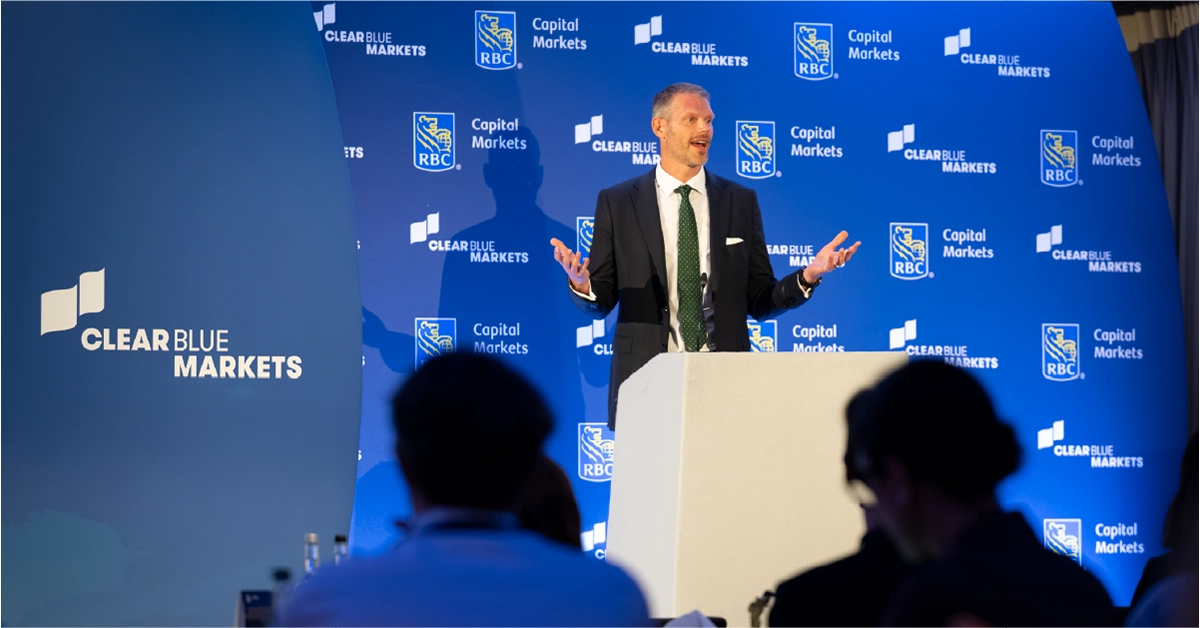
This was part of the consensus emerging as corporates and investors met in London to chart progress on the topic, at a conference hosted by RBC Capital Markets and ClearBlue Markets.
There is no doubting the potential power and reach of carbon markets. As Ralph Ibendahl, Global Head of Energy Transition, told the event, “Carbon markets are clearly a very powerful tool for governments and corporates to send policy signals, not just about pricing and helping reduce emissions today, but about what gets built tomorrow.”
One speaker highlighted how compliance carbon markets now deliver over $100 billion in annual revenue to governments, money that is then reinvested in communities and to accelerate the energy transition. Leading corporates are showing how carbon is becoming an asset to be managed, not a cost, and for those not yet engaged, how waiting is no longer a valid strategy.
But geopolitical fragmentation, energy security and broader affordability concerns have added new pressures for regulators to manage, creating uncertainty for market participants.
“Carbon markets are a very powerful tool for governments and corporates to send policy signals, not just about pricing and helping reduce emissions today, but about what gets built tomorrow.”
Ralph Ibendahl, Global Head of Energy Transition
ETS grapples with reform
Globally, carbon markets are under review, and there are common themes for the regulators. Jennifer McIsaac, ClearBlue’s Chief Market Intelligence officer noted, “The low-hanging fruit of decarbonisation has been harvested, and regulators are under political pressure to soften the rules just as ambition needs to increase. Decisions in 2026 are filtered through affordability and competitiveness.”
2026 is poised to be a consequential year for reform of the E.U.’s Emissions Trading System (ETS), the largest and most liquid global market, with a comprehensive proposal package which released in July.
An ETS review is intended to ensure the system delivers on its climate objectives while also using the flexibilities of the market structure to support competitiveness and investment in Europe. It comes amid pressure from energy-intensive industries facing high compliance costs.
Participants at the conference voiced concern that companies in some sectors face “industrial destruction” due to international competition unless the carbon price effects are alleviated. There were calls for continued access to a free pool of permits. Speakers expected that the proposal would extend flexibilities and support for the industry, now confirmed in the July package.
Delegates recognized that the review is a challenging one. “The Commission is in a difficult position,” said Gordon Evens, Head of Emission and Power Trading. “There’s a lot of thoughtful compromises that need to be made.”
The proposed link between the U.K ETS and E.U. ETS was also discussed under the shadow of the resignation of the U.K.’s Prime Minister, Keir Starmer, which delayed the summit that was set to sign off this agreement. However, the conference heard that the two systems are still likely to link up given the benefits to liquidity, price discovery, market efficiency and increased economic interconnectedness between the U.K and E.U.
CBAM: a first step to global pricing?
Meanwhile, the E.U. has rolled out its Carbon Border Adjustment Mechanism (CBAM), with CBAM imports facing priced obligations as of 2026. The measure is designed to prevent “carbon leakage”, the risk of carbon-intensive production moving to countries with less strict climate policy and gaining price advantage at the expense of the environment.
In response, many other countries are introducing their own carbon pricing mechanisms, adding a further dimension to corporates’ calculations. Speakers highlighted how the program, while a net-positive for E.U. industry in theory, had loopholes that needed to be addressed and data gaps that needed to be updated before it could function as intended. However, as Sarah Hay from Norsk Hydro stated, “CBAM Is here to stay.”
Airlines face mixed signals
Discussions took place under the spectre of the E.U. adding all air travel in and out of the E.U. into the ETS, as a backstop for CORSIA (Carbon Offsetting and Reduction Scheme for International Aviation) which had been set up a decade ago to avoid this very issue. The July package materially limited this, again a sign that the EU is balancing climate ambition and industrial competitiveness. Nevertheless, participants from that industry spoke of “running on a treadmill” as they attempt to balance activity on carbon markets, offsets, and sustainable fuels with pricing that is acceptable to customers.
While the first phase of the CORSIA is rolling out, speakers highlighted how some participating countries have yet to embed penalties for compliance, creating mixed signals for airlines.
More generally, speakers highlighted how the linking of voluntary project-based credits into compliance programs can deliver valuable real-world results. One participant described the vastly improved agricultural yield achieved by communities in sub-Saharan Africa, through biochar production and emerging techniques such as enhanced rock weathering. These types of projects can be supported by programs like CORSIA and new rules around allowing international project-based credits in the EU ETS.
Carbon as an asset, not a cost
The current complexities of carbon markets can make the system extremely difficult to manage for corporates.
However, some businesses are becoming more sophisticated in their response, treating carbon as a potential asset and an opportunity, rather than a liability.
Michael Berends, CEO of ClearBlue Markets said, “Companies need to manage carbon the same way they manage energy or any other major commodity. It’s no longer just a compliance cost, it’s a tradable position that can be optimized, creating both cost savings and commercial opportunities.”
“While carbon is global, the policies are local,” concluded Sarah Thompson, Global Head of Sustainable Finance. “Success or failure will really depend on engaging local constituents and ensuring that we’re delivering value.”
“While carbon is global, the policies are local – success or failure will depend on engaging local constituents and ensuring that we’re delivering value.”
Sarah Thompson, Global Head of Sustainable Finance