
The brief ceasefire engineered by the Trump administration in Versailles has unraveled, with Iranian forces resuming attacks on commercial vessels and the U.S. reestablishing its blockade. The agreement was always viewed through different lenses by the parties involved: the White House anticipated full Iranian oil flows resuming, while Tehran sought economic concessions and control of the Hormuz chokepoint. Market participants largely embraced the optimistic narrative, evidenced by the rapid exodus of ships seeking to capitalize on anticipated normalcy.
The central question now is whether both sides have the appetite for another cycle of active conflict. IRGC hardliners may see economic pressure as leverage ahead of midterm elections, though skepticism about American commitment to any deal runs deep given recent tensions. Within Republican circles, fissures are evident between the "America First" withdrawal faction and those advocating to "finish the job" against Iran.
The damage from renewed fighting is already visible in Hormuz traffic, with seven-day moving average flows collapsing to 3.9 mb/d from pre-ceasefire levels. The International Maritime Organization has declared the Strait too dangerous for commercial crossings. Even in a best-case scenario involving a strategic retreat by the administration, traffic will not return to pre-war baselines as long as shippers face mines, missiles, drones, and tolls. The fatality on an ADNOC vessel will likely reinforce caution, and the absence of a final deal remains a persistent obstacle for Tier 1 Western and Japanese shippers.
Red Sea escalation now threatens a second critical export artery. Monday saw the most significant cross-border escalation since 2022, as the Yemen-based Houthis launched missiles and drones at Abha airport with Saudi air defenses intercepting the barrage. Houthi representatives threatened to close Saudi airspace pending what they describe as lifting a "Saudi siege" on Sanaa. The incident appears connected to a disputed airstrike on Sanaa airport earlier in the week; while Houthi sources blamed Saudi Arabia, Yemen's internationally recognized government claimed responsibility. U.S. officials alleged the targeted Iranian airliner carried weapons, missile components, and military personnel.
"Saudi Arabia's exports through the East-West Pipeline and Yanbu port have been a key offset for the Hormuz disruption, and a resumption of attacks on tankers in and around the Red Sea will likely lead to a serious reappraisal of the reliability of this vital alternative route."
-Helima Croft, Head of Global Commodity Strategy and MENA Research, RBC Capital Markets
These strikes mark the first Houthi military action since their May 2025 ceasefire with the U.S., signaling that constraints may be loosening. The group's demonstrated capacity to disrupt maritime activity (evident from sustained 2024 campaigns against vessel traffic and forced Cape of Good Hope diversions) poses serious implications given current supply dynamics. Saudi Arabia has surged Red Sea exports to roughly 4 mb/d since the outbreak of the Iran war, transforming the corridor into an essential alternative. Any renewed Houthi campaign would materially increase risks to the Kingdom's remaining export capacity when global supply routes have minimal redundancy.
Inventory dynamics now hang in the balance as markets reassess crude availability. Between mid-June and mid-July, roughly 161 mb of crude exited the Mideast Gulf at an average 5.8 mb/d, compared to only 75 mb (2.7 mb/d) in the equivalent pre-ceasefire period. This difference decelerated global inventory drawdowns from 2.2 mb/d to 1.5 mb/d, creating an incremental 86 mb buffer equivalent to approximately 40 days of pre-MoU draw rates. With current inventory floors hovering at critical levels (Cushing at operational minimums and the U.S. SPR at 43-year lows) a return to elevated drawdown rates poses material risks if Strait flows remain constrained.
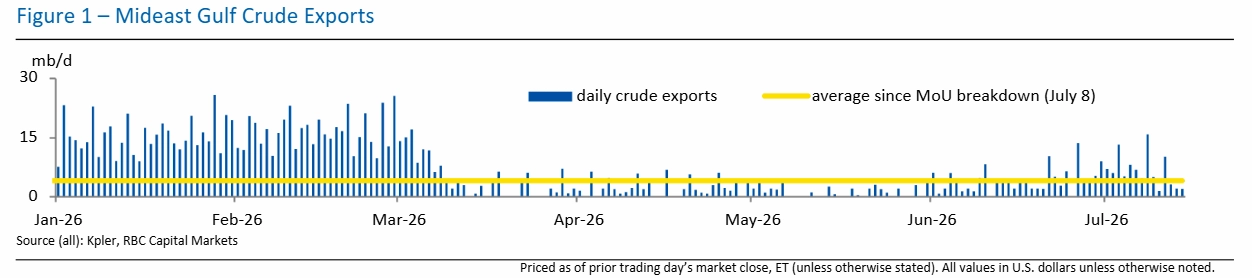
Figure 1 displays daily Mideast Gulf crude oil exports measured in million barrels per day (mb/d) from January 2026 through July 2026.
The chart uses blue bars to represent daily crude export volumes, which range from approximately 5 to 28 mb/d during the January-to-early-July period, showing significant daily volatility.
A yellow horizontal line indicates the average export level since the Memorandum of Understanding (MoU) breakdown on July 8, 2026, which sits near 3-4 mb/d—representing a dramatic reduction in export capacity.
The chart clearly illustrates the sharp decline in exports following the mid-July disruption event.
Data sourced from Kpler and RBC Capital Markets, with all values in U.S. dollars unless otherwise noted and priced as of the prior trading day's market close in Eastern Time.
The extent of Chinese demand recovery will prove pivotal for medium-term price trajectories. Having curtailed refinery operations throughout the conflict and entering a deliberate "eco" mode, China's eventual reengagement represents perhaps the most consequential demand variable. While energy transition and substitution effects have demonstrably shifted the demand profile over recent years, a massive structural deterioration has not yet materialized. With product export restrictions easing and refinery margins poised to recover absent further Strait deterioration, crude purchases will likely accelerate. Beyond commercial incentives, China maintains strategic inventory building motivations at favorable price levels.
Russian energy infrastructure damage continues cascading through global product markets. Ukraine has intensified attacks on Russian refineries including Salavat and Ilsky, driving estimated damaged capacity to approximately 4 mb/d. June refinery intake slumped to 3.43 mb/d — the lowest in datasets extending to 2016 — representing a 1.5 mb/d year-on-year and 500 kb/d month-on-month decline. This compression pushed June crude exports to 5.47 mb/d, the second-highest level in the dataset since October 2019. Ukraine's strategy has crystallized a domestic Russian fuel crisis, with escalation ongoing and repairs frequently requiring months.
Export bans have now extended from gasoline to diesel, a more consequential loss for global supplies and Russia alike. July clean product exports are estimated at just 620 kb/d (350 kb/d lower month-on-month, 760 kb/d lower year-on-year), with diesel projections of only 110 kb/d representing a 280 kb/d monthly and 680 kb/d annual decline. This contraction occurs as global product inventories remain below five-year averages across gasoline, diesel, and jet fuel, with gasoline and diesel hovering near the bottom of their ranges. With Ukrainian attacks continuing and little incentive for them to relent, refined product prices will remain supported. This will incrementally compress balances for major importers including Turkey and Brazil, potentially diverting alternate sources like U.S. supplies away from Europe and other destinations.
Helima Croft authored "Iran Flashpoints: False Dawn," published on July 15, 2026. For more information on the full report, please contact your RBC representative.
