
OPEC+ announced a 188 kb/d production increase on Sunday against a backdrop of continued uncertainty about the trajectory of Hormuz transits as well as the diplomatic path to converting the Memorandum of Understanding to a final deal by mid-August. We think the OPEC leadership will exercise diligence in determining the pace of production increases once the Hormuz evacuation phase concludes. Certainly, countries that have been impacted by the war are in a build-back mode when it comes to production and exports.
However, we think there is minimal appetite for a supply-driven price washout, especially given the financial burden of repairing infrastructure damage as well as additional security priorities, such as safeguarding desalination facilities. Multiple UAE officials have indicated that the country will continue to consult with OPEC member states about market conditions and will be very judicious about any future production increases beyond the stated 5 mb/d target.
"We think there is minimal appetite for a supply-driven price washout, especially given the financial burden of repairing infrastructure damage."
Helima Croft, Head of Global Commodity Strategy and MENA Research, RBC Capital Markets
Iraqi officials have issued somewhat contradictory statements, with some calling for greater production autonomy, which was interpreted as a veiled threat to leave the producer group. It is worth noting that Iraqi officials quickly denied this reporting, with the Oil Ministry issuing a statement reaffirming Baghdad's commitment to remaining in the producer group. To avoid the outcome of the war, the only country sitting on meaningful spare capacity was Saudi Arabia, as all the remaining producers were operating close to maximum production levels. Iraq remains bedeviled by fiscal and infrastructure challenges that make an enduring production surge difficult. Export infrastructure constraints remain a key challenge for Baghdad, with its flagship southern route through Basra operating at maximum capacity before the Iran crisis.
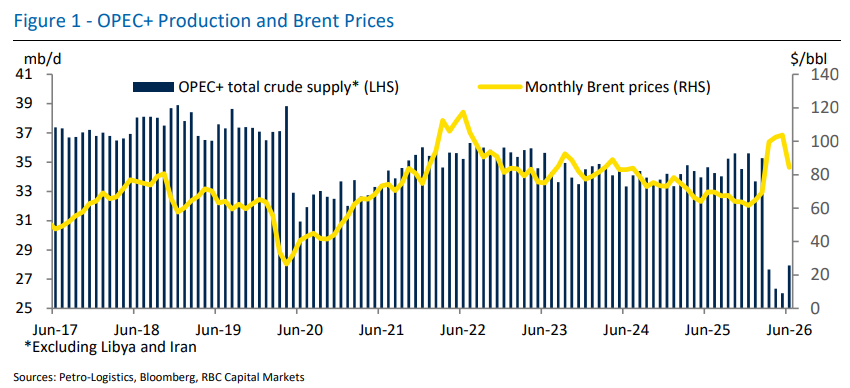
Figure 1, titled "OPEC+ Production and Brent Prices," is a dual-axis combination chart produced by RBC Capital Markets using data sourced from Petro-Logistics and Bloomberg, covering the period from June 2017 to June 2026.
The left vertical axis measures OPEC+ total crude supply in million barrels per day (mb/d), scaled from approximately 25 to 41 mb/d and represented by dark navy blue vertical bars; a footnote clarifies that this supply figure excludes Libya and Iran.
The right vertical axis measures monthly Brent crude oil prices in dollars per barrel ($/bbl), scaled from 0 to approximately $140/bbl and represented by a gold line.
From June 2017 through mid-2019, OPEC+ supply remained elevated in the 36–38 mb/d range while Brent prices fluctuated between roughly $55 and $85/bbl. A pronounced supply contraction is visible around June 2020, consistent with COVID-19-related production cuts, with supply declining to approximately 29–31 mb/d; Brent prices also fell sharply to approximately $40/bbl at that point before recovering.
Supply gradually increased through 2021 and into 2022 as production quotas were progressively eased. Brent prices surged to their highest level on the chart — approximately $120/bbl — around June 2022, before declining steadily through 2023–2025 into the $70–85/bbl range.
At the far right of the chart, in June 2026, OPEC+ supply registers the most pronounced single-period decline in the entire dataset, falling to approximately 26 mb/d — the lowest supply level recorded — while Brent prices simultaneously recovered to approximately $100/bbl, indicating that a significant production curtailment is supporting renewed price strength.
If Chinese imports remain at these depressed levels, additional OPEC barrels will not need to be purchased, but we think the key OPEC players will have a good line of sight into Chinese purchasing plans (especially given the joint operational relationships) and adjust accordingly. We recall that at ADIPEC last November, a senior CNPC executive indicated that Beijing saw itself playing an essential market stabilizer role, especially for its suppliers. Chinese strategic stockpiling ahead of the war seemingly provided something of a floor for prices and kept Brent above $60/bbl amid rampant glut concerns. In the current crisis, China indeed played a key role in helping avert a global economic downturn by slashing imports, and we will be watching for indications that the country will commence restocking at these price points.
At the same time, we think Hormuz transits will remain well below prewar levels given the enduring security threats and Iran's insistence on retaining operational control. While crossings have recently averaged around 40 ships per day, this is still well below the pre-war daily rate of 140, and we think Tier 1 Western and Japanese shippers will remain wary of two-way transits for the foreseeable future, especially given the significant chance that there will not be a final agreement by mid-August.
It is worth remembering it took over two years from the start of official talks for the U.S. and Iran to conclude the JCPOA, and therefore it seems to be a Herculean undertaking to resolve all the nuclear and Hormuz access issues in 60 days. An MoU extension could keep transits around current levels but is unlikely to be a catalyst for getting the more cautious companies to resume full operations. We concede that crude will likely remain under near-term pressure despite ongoing uncertainty, but we do not subscribe to the "back-to-normal" narrative that is ascendant in the market at the moment.
Helima Croft authored "OPEC+ Iran Update: Hazy Horizon," published on July 5, 2026. For more information on the full report, please contact your RBC representative.
