
With midterms now less than 40 days away, a ban on U.S. diesel exports has become a hotly debated policy option, with no clear solution to the global refinery shortfalls amidst the twin wars involving the world's largest energy producers. Retail diesel has risen by around 70%, and gasoline by 50% nationally since the start of the Iran conflict. Faced with increasingly negative polling data, several leading Senate Republicans have publicly called for a diesel export ban, and the President himself signaled an openness to implementing such restrictions. On September 22, he stated "I've said let's not send out the diesel. We make a lot of diesel [...]." And yet, the fact that Energy Secretary Chris Wright publicly called the ban a bad idea shows that this is not a settled issue even if the odds of restrictions have risen in recent weeks.
The actual form export restrictions could take could still fall short of a blanket ban, and could include select waivers, be limited in duration, and/or be tied to certain benchmarks. During the early months of the Ukraine war, some Biden administration officials had been proponents of product export restrictions tied to inventory levels, and this may be a potential policy roadmap for some members of the Trump administration. We also know that President Trump has passed on other policy options to lower product prices such as a proposal by the refinery industry to scale back implementation of the renewable fuel standards, reportedly due to strong opposition from the agricultural lobby.
"Export restrictions will likely be implemented if the White House political team conclude that they could help move the needle in key tossup congressional races and help retain Republican control of the Senate."
Helima Croft, Head of Global Commodity Strategy and MENA Research, RBC Capital Markets
We foresee an uneven impact regionally in the United States, and note that the timing of a ban, how temporary it is, as well as the time it takes for any price effects to pass through to the pump as key complications for the midterm math. Fundamentally for the domestic market, the clearest downside pressure would be in PADD 3. Here, an export ban is cleaner, as excess volumes would build inventories and thus lower prices as that product reaches the pumps. For other U.S. regions, it would be less straightforward; PADD 1 and PADD 5, for example, are more exposed to international markets and prices. As a result, they could be subject to price vulnerabilities as global prices rise further (barring a smooth redistribution of PADD 3 cargoes to each coast via Jones Act waivers and adequate vessel movement). While PADD 3 would have ample volumes to replace international cargoes in theory, logistics constraints or delays to this solution would leave those coasts vulnerable.
Even if it fully replaced other regions' import needs, PADD 3 would likely be left with a surplus that could quickly build stocks to pre-war levels, and rise to storage maximums in a matter of weeks. Price effects would gradually reach the pump as this occurs, with delayed passthrough (around 1-2 weeks), as the price implications can be slower moving on the way down than on the way up. Plus, key regions like PADD 1 could still be exposed to some extent to global markets (though these areas are probably not at the core of the midterm math), and thus will not benefit as much as other regions.
A ban would likely weaken refining margins as inventories in key regions fill, and thus potentially reducing incentives for refinery runs. With some speculation that refiners could opt for maintenance, which many have delayed thus far in the conflict. As refinery profitability decreases in turn, lower throughput would mean lower gasoline and jet fuel output, potentially creating higher domestic pricing for these fuels even if diesel sees relief. This would then have the opposite of the intended electoral effect, complicating the calculus for the administration. Additionally, in such a situation, while softer U.S. refinery runs could mean WTI weakens versus Brent, it would ultimately still not be immune to global dynamics.
Internationally, the ban would worsen scarcity and elevate prices, particularly burdening key diesel customers in LATAM and Europe competing in already-tight markets. Put simply, there is no supplier that could step in to fill the gap. As a result of the shock, we suspect there would be asymmetry in the diesel price reaction, with the magnitude of the surge in global diesel prices likely to materially outpace the decline in U.S. pricing. Opposing forces would support a decoupling between New York Mercantile Exchange Heating Oil (NYMEX HO) and European ICE Gasoil, driving a major widening of the spread between the two (AKA HOGO).
U.S. seaborne diesel exports averaged around 1.35 mb/d over the past three months, with September at 1.2 mb/d to date. Over that three-month period, Brazil, which already faces particular pressure from the Russian diesel export ban, has taken 12.6% of U.S. exports (followed by Chile at 9.3% and Mexico at 7.9%) as it has sought to replace cargoes. While the U.S. heads into seasonally strong diesel demand alongside its harvest season, Brazil is heading into planting season, and, given present and enduring supply headwinds, is seeing concerns about adequate supplies come time for harvest even without a U.S. ban. Europe, another significant recipient of U.S. diesel cargoes, has also relied heavily on U.S. volumes to bridge gaps in the global supply, and with inventory levels well below the 5-year average, buffers are limited.
While Europe could release additional stockpiles, as the option has been posited, it would take time and there could be hesitancy to deplete shock absorbers ahead of unclear winter needs and market conditions. China could potentially seek to further increase product exports and capitalize on the opportunity, but their appetite to increase incrementally is not limitless, as they are already exporting well beyond pre-war levels month-to-date in September (and well beyond any point in 2025). Generally, there are no easy mitigation options in our view, and global diesel markets would be subject to higher prices. However, we do not think these global dynamics factor into the midterm math particularly significantly.
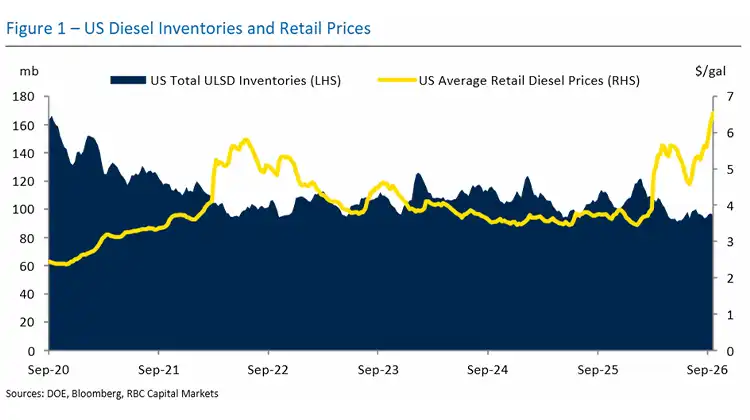
Figure 1 is a dual-axis time-series chart from RBC Capital Markets titled "US Diesel Inventories and Retail Prices," covering September 2020 through September 2026. The left vertical axis is scaled in million barrels (mb), ranging from 0 to 180, and is represented by a dark navy blue filled area chart plotting U.S. Total ULSD inventories. Inventories begin the period at a high of approximately 165 to 170 mb in late 2020, decline steeply through 2021 to roughly 90 to 100 mb by mid-2022, then fluctuate within a lower band of about 90 to 125 mb through 2026, ending near 100 mb. The right vertical axis is scaled in dollars per gallon (USD/gal), ranging from 0 to 7, and is represented by a thick bright yellow line chart plotting U.S. average retail diesel prices. Prices start around 2.40 to 2.50 USD/gal in September 2020, climb steadily through 2021, and spike sharply to nearly 5.80 USD/gal in mid-2022 before pulling back and consolidating between roughly 3.50 USD/gal and 4.80 USD/gal from late 2022 through 2025, then surging again to approximately 6.40 to 6.50 USD/gal by September 2026. The chart illustrates an inverse relationship: periods of depressed or falling inventory levels, most notably in 2022 and again in 2026, coincide with sharp spikes in retail diesel prices. The horizontal axis labels years from September 2020 to September 2026. The legend beneath the title identifies the blue area as "US Total ULSD Inventories (LHS)" and the yellow line as "US Average Retail Diesel Prices (RHS)." The source attribution at the bottom-left reads "Sources: DOE, Bloomberg, RBC Capital Markets," indicating the data originates from the U.S. Department of Energy and Bloomberg, compiled and published by RBC Capital Markets.
Recent gains made by Democrats in the polls may change the political calculus for a diesel export ban and if influential voices believe there is a clear electoral gain, they may push for one ahead of the midterms. While current polling overwhelmingly forecasts Democrats to regain control of the House, there are five critical tossup Senate races and if Democrats see a victory in just three of them, they would regain control of that chamber as well. These races are polling within a margin of error and vulnerable GOP candidates are rallying for tangible policy wins, seeking to assuage voter concern over high energy prices weeks ahead of elections. This pressure is especially acute in farm states such as Iowa where soaring diesel prices have become a flash point in elections, giving Democrats a chance to win seats that weren't viewed as competitive a year ago.
Rep. Ashley Hinson (R-Iowa), in a tossup Senate race against Democratic state Rep. Josh Turek, has pushed the administration to pause diesel exports, directly blaming the Iran war for higher prices at the pump in Iowa. The latest polls show her trailing Turek by a fraction of a percent for the Iowa Senate seat, a gap that could theoretically help to be closed with a favorable headline on fuel prices. House races in Iowa are also competitive, with two incumbent Republicans recently voting with Democrats to limit Trump's war powers in Iran in addition to calling for a diesel export ban.
In Alaska and Michigan, GOP Senate candidates who are trailing in polls have also campaigned for a diesel export ban, to which their Democratic challengers argue are simply election-year repositioning. Regardless of the efficacy of these 11th hour policy measures, if influential voices believe there is a clear electoral gain, they may push for one ahead of November. Should the midterms result in a divided government, Democrats would be in the position to go on the offense, prompting investigations and halting legislation.
Helima Croft authored "Washington Strategy: Diesel's Midterm Math," published on September 25, 2026. For more information on the full report, please contact your RBC representative.
