
Friday marks the six-month anniversary of the Iran war, and a diplomatic offramp remains elusive, despite the incessant "over-soon" headlines. From the moment President Trump told CBS News on March 9 that "I think the war is very complete, pretty much," a corner of the market has held a steadfast belief in an imminent end to the war. For our part, we have had repeated flashbacks to former US Defense Secretary Donald Rumsfeld's now-infamous statement to US servicemembers in February 2003 on the looming invasion of Iraq that "it could last six days, six weeks, I doubt six months." In the run-up to this inauspicious anniversary, there has been something of a messaging shift from the White House, with imminent conflict conclusion narratives being replaced by ones of the Hormuz being essentially open.
Certainly, the US naval escort service seems to be supporting improved crude exports via the Strait of Hormuz through the use of ship-to-ship transfers and tanker shuttle operations, with last week's exports from inside Hormuz around 1 mb/d higher than the 4-week average. That said, additional losses of volumes from Yanbu amid ongoing Houthi attacks in the Red Sea are limiting the overall volumetric gain from increased Hormuz exports, and we estimate that around 8 mb/d of Middle Eastern exports remain disrupted.
"The supply losses for both product and LNG exports remain severe."
Helima Croft, Head of Global Commodity Strategy and MENA Research, RBC Capital Markets
Moreover, the supply losses for both product and LNG exports remain severe. Diesel and European gas markets look set for a serious stress test as summer sunsets, given the ongoing attacks on both Middle Eastern and Russian refineries as well as the sustained loss of Qatari LNG exports. We estimate around 2.2 mb/d and 3 mb/d of refinery capacity from each respective region is offline. From our recent conversations with Middle East experts, it appears that above-ground damage from Iranian missile attacks on refineries is material and will require an extended repair period. By contrast, below-ground damage to other energy infrastructure is reportedly more limited, potentially allowing for swifter restarts.
Middle East Crude and Condensate Exports
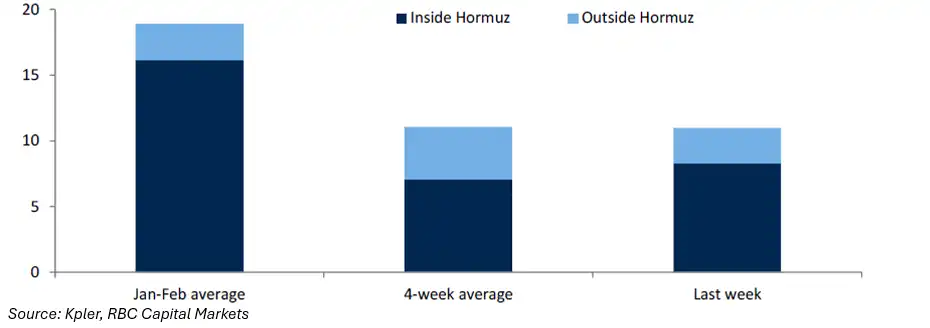
Middle East Crude and Condensate Exports" sourced from Kpler and RBC Capital Markets. The y-axis measures volume in million barrels per day (mb/d), scaled from 0 to 20 in increments of 5. The x-axis displays three time periods: "Jan-Feb average," "4-week average," and "Last week." Each bar is divided into a dark blue segment representing exports originating "Inside Hormuz" and a light blue segment representing exports originating "Outside Hormuz," as indicated by the legend at the top center. The chart illustrates a substantial drop in total exports from approximately 19 mb/d during the Jan-Feb average—driven primarily by roughly 16 mb/d from Inside Hormuz and 3 mb/d from Outside Hormuz—to roughly 11 mb/d for both the 4-week average and Last week. In the more recent periods, Inside Hormuz exports fell to approximately 7–8 mb/d while Outside Hormuz exports shifted to roughly 3–4 mb/d. Text on the right side of the image states: "All values in USD unless otherwise noted. Priced as of prior trading day's market close, ET (unless otherwise stated)." The source attribution at the bottom left reads: "Source: Kpler, RBC Capital Markets."
Iranian insistence on the full implementation of the June MoU terms continues to undermine a diplomatic offramp despite weekly reports of Pakistani-led progress. At this juncture, President Trump shows no signs of greenlighting an agreement that comes with "bags full of cash" and Hormuz-control optics. For now, they continue to insist on securing access to billions in frozen funds, the full removal of sanctions, the standing-up of a $300 billion reconstruction facility, alongside formal Hormuz operational control rights. We think such terms will remain unacceptable to the domestic "finish-the-job" camp as well as key US allies in the region. Similarly, we are skeptical of how the Iran–Oman maritime corridor negotiations will yield a deal that is acceptable to Washington if it codifies a Tehran tollbooth.
The Iranian negotiating stance may shift as the costs of the war mount—particularly because of the blockade-driven drop in imports—but it could still take months or more before there is an appreciable softening in the IRGC's settlement stance. Moreover, we struggle to reconcile how these recently elevated export levels will be maintained if President Trump decides to call it a day and turn his ships around given that the material US military commitment has been enabling the recent uptick in shipments through the Strait. The willingness of the US to maintain a permanent naval escort service in the Middle East and ensure the security of new de-risking infrastructure remains a critical unknown at this juncture. Hence, we suspect that we will be writing another anniversary note come February, even if the conflict remains primarily a greyzone one, and the Strait remains in a Schrödinger situation.
A consistent theme throughout our summer conversations is China's emergence as one of the few potential winners from the world's third major energy crisis. With its investment in a massive just-in-case strategic reserve, China has not only been able to weather the six-month supply disruption but has also provided a valuable assist to the global economy by slashing its crude imports by over 5 mb/d at the peak (now around 4 mb/d below pre-conflict). In the process, Beijing has burnished its responsible-global-actor credentials. As the world's leading electro-state, China is also seen as potentially dominating the provision of renewables as importing countries look to bolster their energy security by diversifying their molecule mix. Finally, we have also heard increasing alarm in security circles that the redeployment of US military assets from the Indo-Pacific theater to the Middle East provides Beijing with an opening to pursue a more assertive Taiwan strategy. While much ink has been spilled on the energy implications of the Iran war, the medium- and long-term geostrategic consequences continue to be among the biggest unknowns at this 180-day mark.
Helima Croft authored "Geopolitical Update: Inauspicious Anniversary—The Iran War at Six Months," published on August 27, 2026. For more information on the full report, please contact your RBC representative.
