Compounding Crises – Lebanon’s Political and Economic Turmoil
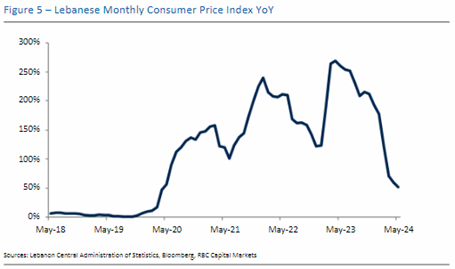
Since 2019, Lebanon has faced compounding political and economic crises following years of fiscal mismanagement in the post-Civil War period. In the past five years, Lebanon’s economy has faced what the World Bank has called one of the “most severe crises episodes since the mid-nineteenth century,” with the currency losing over 95% of its value since 2019, and inflation in the country often exceeding 200% for much of the same period.
Waves of anti-government protests starting in 2019 saw the resignation of multi-term Prime Minister Saad Hariri, who had strong ties in the US, France, and Saudi Arabia following allegations of embezzlement, and the subsequent withdrawal of his Future Movement party from government, which had been a leading counter to Hezbollah’s March 8 Alliance.
Following years of economic freefall, and exacerbated by the 2020 Beirut Port Explosion, the 2022 election saw a rise of anti-establishment members elected to parliament. Without a clear leading voice in the traditionally Western-leaning March 14 Alliance, and with neither of the traditional blocs holding a majority, there has been no compromise on forming a government, and the country remains without a president, and has a caretaker prime minister.
Hezbollah’s Role in Lebanon’s Political Gridlock
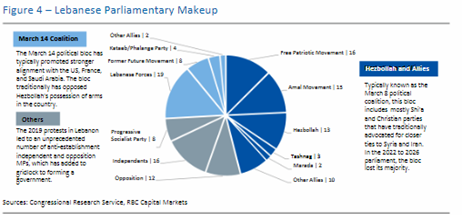
Hezbollah has been seen as a central player in Lebanon’s ongoing gridlock. In the 2022 election, while the group did not lose seats in parliament, its traditional coalition lost its majority, ensuring that neither of the country’s main blocs have the power to form a government without significant compromise. In a prior government, a deal was brokered that saw Saad Hariri hold the prime minister spot, with Michel Aoun of Hezbollah’s then- allied Free Patriotic Movement Maronite (FPM) party taking the presidency.
Since 2019, relations between Hezbollah and the FPM have deteriorated, and with the presidency reserved for a Maronite Catholic under the confessional system, the March 14 alliance’s pick from the far-right Marada Movement is viewed as untenable by the other Maronite parties on both sides of the political spectrum. Amid the caretaker government, Parliamentary Speaker Nabih Berri of the Shi’a Amal Movement has been a key voice in Beirut and an interlocuter between the West and coalition ally Hezbollah.
While the lack of a clear majority has given Hezbollah and its allies a stronger voice in government, discontent is growing amongst the Lebanese citizenry as the gridlock continues in part to prevent the reforms needed to unlock the foreign fiscal aid in full necessary to alleviate the country’s dismal economic position.
Echoes of 2006
Many have likened the current rising tensions to the events leading to the 2006 Lebanon War — the last full-blown conflict between Israel and Hezbollah. In the summer of 2006, triggered by Hezbollah’s capture of several IDF soldiers, Israel launched its most extensive campaign in Lebanon since the end of its 18-year occupation of southern Lebanon in 2000. With a stated purpose of removing Hezbollah’s military presence from the border, the two- month conflict saw intense fighting along the border, as well as significant Israeli strikes on Beirut’s southern suburbs.
The conflict quickly became an international priority following airstrikes on Beirut’s airport and the ensuing evacuations of hundreds of thousands of Lebanese with foreign passports organized by the US, Canada, France, the UK, and others. The 2006 war ended amid international pressure and by UN Security Council Resolution 1701, which stipulates that the area south of the Litani River on Israel’s border be free of Hezbollah weapons and fighters, and that the Lebanese Armed Forces (LAF) and UN international peacekeeping forces are to create a buffer zone.
Despite consistent Western military aid to the LAF, Hezbollah has not complied with the agreement, and while much of the group’s heavier weaponry lies beyond the Litani, artillery and anti-tank weaponry are still present in the region and have been the source of much of the fire targeting northern Israel. Since 2006, Hezbollah’s armaments and numbers have grown significantly, while the Lebanese government’s clout internationally has struggled in the past decade with their typical backers in Washington, Paris, and the Gulf capitals.
The Syrian Civil War also changed the calculus for Hezbollah, with many of the group’s fighters gaining battle experience fighting in support of Bashar al-Assad. In turn, the group has reportedly received an increasing number of weapons from the Syrian government, including systems sold to Damascus by Russia in support of their campaigns during the war.
Regional Factors – Iraq and Syria
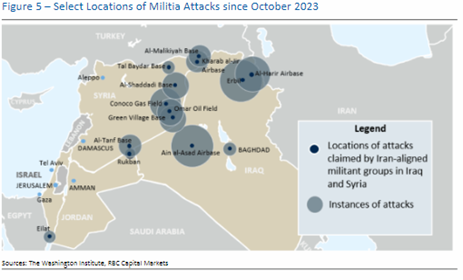
Amid growing fears of a wider war between Israel and Hezbollah, there has been renewed focus on Iran’s militia proxies in Iraq and Syria and their potential willingness to enter the conflict. The Islamic Resistance in Iraq — an umbrella moniker for various Iran-aligned armed actors — has already warned that it will target US military positions in the region in the event that Israel invades Lebanon.
Since mid-October, Islamic Resistance groups have claimed responsibility for hundreds of rocket and drone attacks on US military positions, including repeated attacks on bases housing US troops in Iraq as well as the drone strike that killed 3 US service members in a remote outpost in Jordan in late January. Following US counterstrikes on militia leaders, there has been a marked decline in attacks targeting US forces. However, the Islamic Resistance of Iraq has continued to target Israeli positions.
Meanwhile, Syria continues to serve as a weapons superhighway connecting Iran to Lebanon. Israel has also repeatedly targeted IRGC personnel and their aligned militias in the country, including the April strike on an Iranian consular complex in Damascus that killed the general overseeing covert operations in Syria and Lebanon, as well as seven other senior IRGC commanders.
Helima Croft authored “MENA Watch List: Lebanon – Catching Fire?” published on June 27, 2024. For more information on the full report, please contact your RBC representative.