Maple Leaf’s mission is to be the world’s most sustainable protein company. Its goals are wide, embracing animal welfare and social concerns as well as environmental stewardship.
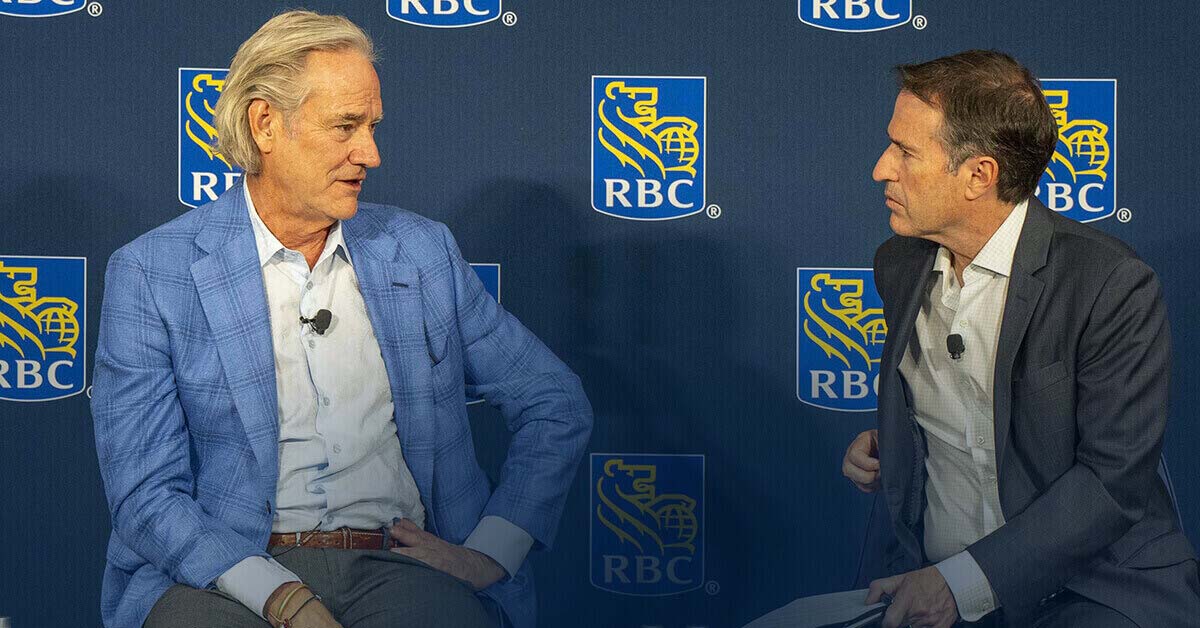
Michael McCain, long-time CEO and now Executive Chairman, retraced his company’s sustainability journey at RBC Capital Markets’ Sustainable Business Conference, in discussion with John Stackhouse, Senior Vice President, Office of the CEO, RBC.
Defining a purpose, overcoming resistance
It was while facing 200 activists in a room in Davos that Michael McCain’s vision for sustainability coalesced.
As the CEO of a meat production company, he admits he “felt a little bit like Darth Vader” as the 200 activists set out their case for eliminating the global consumption of meat by 2035.
McCain did not believe their goal was realistic. “But what was realistic is that we were part of the problem, and that it was fixable,” he says.
McCain admits he encountered resistance to the new purpose to "Raise the Good in Food" at first, though internally there was broad support for the company’s direction: “Our people actually embraced it very quickly, because they’re believers as well.”
McCain has repeatedly stated that the Maple Leaf will create value for all stakeholders, while rejecting the primacy of shareholders. He has kept those shareholders onside by consistently meeting their expectations: “There’s a distinction between meeting expectations and maximizing interest.”
Path to carbon neutrality
As part of a carbon-intensive industry, the company began with a carbon management strategy. It identified two major impacts: methane-producing manure, and feed grain production.
“We realized we were not going to meet our Science-Based Targets without very strategic initiatives,” McCain says. “There were two that have the ability to close the gap: one in regenerative agriculture, mostly focused on our Scope 3 emissions, and the other in anaerobic digestion.”
While pursuing these two game-changing initiatives, the company fast-tracked its path to carbon neutrality by investing in high-quality carbon offsets. The company became carbon neutral in 2019 and it remains the only large-scale food company to have reached that goal.
“We realized we were not going to meet our Science-Based Targets without very strategic initiatives.”
Michael McCain, Executive Chairman, Maple Leaf
Tough decisions on sustainability priorities
Inevitably, the quest for all-round sustainability comes with trade-offs. This has led to a temporary reversal in the company’s emissions progress over the past two years.
In large part, this was due to Maple Leaf’s investment in a major $850m food processing facility in London, Ontario. The plant includes an industry-leading, temperature-controlled environmental space for the poultry.
“We had to look at the trade-off between the extra emissions of that, against the animal welfare benefit,” McCain explains.
“We ultimately came to the conclusion that we’d have to find the emissions reductions someplace else, because we were going to look after the animals in our care.”
Need to explain the value of zero carbon
While his customers see a value in paying a premium for sustainable meat, McCain admits to some frustration that consumers are not motivated by carbon-neutral status, according to his own company’s research.
He believes businesses and politicians need to do a better job of explaining the importance of carbon reduction.
“Consumers will pay more for recyclable packaging. They will pay more for raising animals without antibiotics. They won’t pay a nickel for zero carbon,” he says. “What’s the value proposition? I think it needs to be made clear.
“I’ve always believed that we shouldn’t call it a carbon tax – it’s a garbage collection fee. If you’re not paying to have the garbage removed, it’s going to stay there, and it’s going to stink.”
“Consumers will pay more for recyclable packaging. They will pay more for raising animals without antibiotics. They won’t pay a nickel for zero carbon.”
Michael McCain, Executive Chairman, Maple Leaf
Business and government need to align
McCain believes the public and private sectors need to align more closely: “I feel one of the big things that the business community needs to do differently in the next 30 years is embrace government differently – to see them as strategic partners, as opposed to viewing them as the enemy or something to be taken advantage of.”
From the government side, he wants to see a standard approach to regulatory competitiveness, so that environmental rules are equally rigorous in all parts of the market.
“One of the key purposes of government is to create a level playing field,” he says. “It’s important in so many dimensions of what we do in business – but it’s really important in sustainability initiatives.”
“Business needs to embrace government differently – to see them as strategic partners, as opposed to the enemy or something to be taken advantage of.”
Michael McCain, Executive Chairman, Maple Leaf
Driving climate action and innovation
The RBC Climate Action Institute, established to foster collaboration between economists, policy analysts, and business strategists, aims to align business leaders and policy thinkers. It advances ideas and research that contribute to Canada’s climate progress, examining topics such as blue carbon opportunities, Indigenous participation in green projects, and how wood can spur Canada’s green building drive.
McCain worked with RBC CEO, Dave McKay, to set up CANZA, the Canadian Alliance for Net Zero Agri-food. It aims to bring farmers, private and public sectors together to coordinate innovations.
Whereas, the RBC Climate Action Institute focuses on critical climate-related topics, CANZA collaborates to drive net-zero innovations in the agri-food sector. Together, they contribute to Canada’s sustainable future.