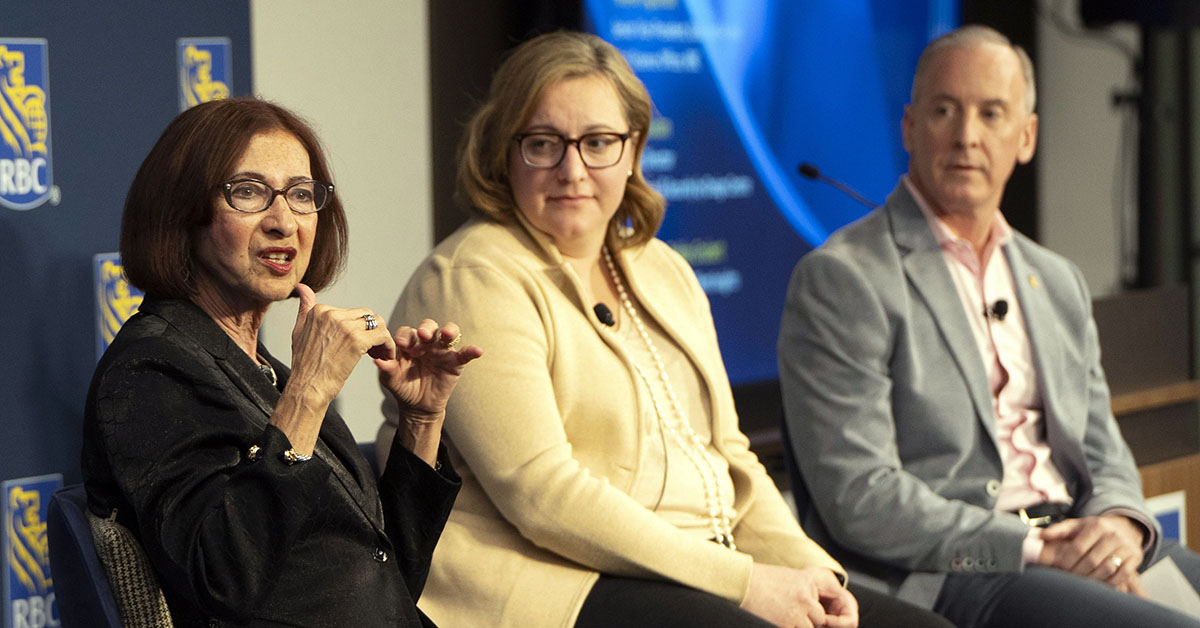
AI is one of the most transformative technologies impacting the world, but financial services organizations need to protect themselves and clients from fraud and other security risks. That was the strong message from panelists at RBC’s Sustainable Business Conference, where Bobby Grubert, Head, Digital Solutions & Client Insights, chaired a panel on the social and governance implications of the technology.
Europe takes the lead on AI legal framework
The panel discussion took place a day after Canadian Prime Minister Justin Trudeau announced a $2.4 billion investment in the country’s artificial intelligence sector
Ann Cavoukian, Executive Director at Global Privacy and Security by Design, welcomes the Canadian government’s investment, but expresses concern that it includes no specific mention of measures to ensure privacy.
While she was Information & Privacy Commissioner of Ontario, Cavoukian created Privacy by Design, a framework to embed privacy into technology. Which has become an international standard.
Cavoukian points out that the European Union has just introduced an AI Act, designed to address the risks of the technology while positioning Europe to play a leading role. The U.S. is now seeking to implement a similar framework.
“I’m hoping Canada will follow suit in bringing that here as well, so we can ensure that AI can grow, but in a non-privacy invasive manner,” she says.
“We want a world with AI. There’s no question it’s here to stay. The advances in the medical field, for example, are enormous. But you need to get privacy into the design of the operations before you get them up and running on a large scale.”
“We want a world with AI, but you need to get privacy into the design of the operations.”
Ann Cavoukian, Executive Director, Global Privacy and Security By Design
Safeguards by design, not afterthought
Foteini Agrafioti, Senior Vice President, Data and AI and Chief Science Officer at RBC, stressed that responsible data practices and consistent defence against security risks must be present at all times.
“The approach of many technology companies is to use any and all data that exists under the sun to train these models,” she says. “Any sensitive information embedded in that data could then be released through a future request to that model.”
RBC has recently established a set of Responsible AI pillars to help ensure the bank’s use of AI respects diversity and human integrity, and also guides how teams can consider, explore and build tools and bring them to market safely when the time is right
“It doesn’t come as an afterthought. You don’t wait until there is an issue to pull back on a service. You design that way from the get-go,” says Agrafioti.
Client privacy and data security remain a top priority for RBC which remains committed to responsible data practices – from how data is used to how it is protected. It is also committed to being transparent and explicit around customer consent.
The behaviour of machines, as well as how humans design and treat machines, are subject to bias and other ethical issues like privacy, accountability, fairness, explainability and transparency.
“We always assume that any practice that has been in place for a long time that collects data has been biased in some way,” she adds. “You expect that bias will be propagated downstream, if you don’t take care of it upfront, so you build models that can pass very detailed validation tests.”
“You don’t wait until there is an issue to pull back on a service. You design that way from the get-go.”
Foteini Agrafioti, Senior Vice President, Data and AI and Chief Science Officer, RBC
Productivity gains keep humans in the loop
Through the use of ethical AI, RBC is able to derive insights from data to help our 17 million clients lead better lives and shape their own banking experiences and also helps to maintain the bank’s equities research portfolio.
In the latter case, says Agrafioti, the bank is exploring internal use cases using generative AI with the potential to realize operational efficiencies, drive shareholder value and create new client offerings. The presence of “a human in the loop” makes this an obvious use case for AI, she adds.
“You’ve got someone there with high intellectual ability, to look at the outputs from these systems and judge, do they pass my thresholds of quality and accuracy, and then allow that to go in front of our clients,” she explains.
With potential productivity gains across the bank, RBC Capital Markets has recently set up an Office of AI, acting as a ‘front door’ to provide governance and standardization for potential use cases.
Leaders must stay ahead of the rules
Businesses must prepare for regulation, says Cavoukian. “Industries have to become aware of the fact that this is only the beginning, in terms of the regulatory acts that have been introduced very recently.” She urges organizations to embed privacy and security into their operations. “Leaders of the company should be thinking, what can we do here that reflects the intention of the regulation, but protects my customers and their data?”
Cavoukian also rejects the false dichotomy sometimes presented that security and privacy are mutually exclusive. “It’s nonsense that you can’t have both – you must have both,” she insists. “In fact, if you don’t have strong security, you’re not going to have any privacy.”