
The wider Middle East war scenario seems to be unfolding, with the pace of Israel/Hezbollah cross-border attacks growing more furious by the hour and the IDF issuing evacuation orders for residents of southern Lebanon.
In the past 24 hours, Israeli air forces have carried out the most extensive strikes on locations in southern Lebanon in the past year, as well as missile strikes on Hezbollah positions in the Bekaa Valley, where much of the group’s more advanced and long-range weapons systems are based. Hezbollah has launched hundreds of projectiles into northern Israel, with the group indicating it targeted military sites in and around the port city of Haifa.
The White House has worked furiously to prevent a full-blown Israel/Hezbollah war, and now appears to be hoping that it can stave off an Israeli ground invasion and keep Iran on the sidelines.
Led by Special Envoy Amos Hochstein, the White House has tried to broker a deal that would see Hezbollah halt rocket attacks and withdraw from the border to a position beyond the Litani River; however, to date the Lebanese militia has rejected such terms, vowing to continue its strikes and prevent roughly 70,000 internally displaced Israeli citizens from returning to the north until there is a lasting ceasefire in Gaza. Up to this point, Iran has largely avoided direct engagement in the year-long Gaza conflict, choosing to fight it largely as a proxy war. Despite providing weapons and financial support to Axis of Resistance militias, Iran has been benefiting financially from elevated oil exports this year.
The concern in Washington has been that Iran would feel compelled to come to the aid of Hezbollah, its most important regional partner.
Founded in 1982 alongside the Iranian Revolution, Hezbollah provides Iran with strategic depth due to its global network of cells, most notably in West Africa and Latin America. Hezbollah’s global footprint, in turn, has served as something of a deterrent against direct military strikes on its nuclear facilities. Iranian officials had previously indicated that an Israeli ground invasion, along the lines of what occurred in 2006, would be a red line. However, with Israel inflicting serious damage on Hezbollah leadership and military capabilities, the Iranian calculus may change, and Tehran could be compelled to provide more fulsome assistance. We continue to see a fog of war dynamic, where neither side accurately assesses the other’s escalation trip wire, as a significant risk.
Figure 1 - Regional Map with Areas of Hezbollah Influence

Sources: Wall Street Journal, AEI Critical Threats Project, RBC Capital Markets
Figure 2 - Iran and Houthi-Linked Attacks on Infrastructure in 2019
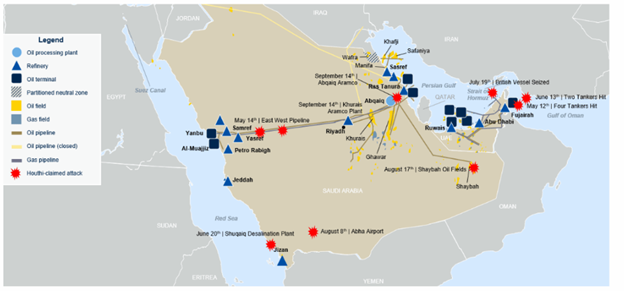
Sources: Wall Street Journal, AEI Critical Threats Project, RBC Capital Markets
Though oil rebounded last week, we do not see the current price as accurately reflecting a wider Middle East war scenario.
Many market participants have seemingly written off a threat to regional oil supplies. While we are not forecasting a closure of the Strait of Hormuz, we do think that direct Iranian involvement would raise the prospect of a repeat of the 2019 scenario when the IRGC and allies targeted tankers and critical energy infrastructure in the region. It is our understanding that the March 2023 diplomatic deal between Saudi Arabia and Iran has helped stave off further attacks on the Kingdom’s infrastructure to date. However, in a wider war scenario, we could envision that regional energy supplies could potentially be caught in the crossfire. We also cannot rule out that Israel may look to further degrade the capabilities of its principal antagonist by taking more direct aim at Iran’s key military and economic assets. Hence, we continue to caution against consigning this war to the back burner, as the wake-up risk remains high.
Helima Croft, Christopher Louney, and Brian Leisen authored “Lebanon Quick Take: Fast and Furious,” published on August 23, 2024. For more information on the full report, please contact your RBC representative.