
Israel’s assassination of Hezbollah Secretary General Hassan Nasrallah has plunged the region into uncertainty.
At the time of writing, it is unclear whether the assassination of Nasrallah, which capped 10 days of covert attacks and airstrikes that eliminated the militia’s top ranks, will be a precursor to an Israeli ground invasion of southern Lebanon. There has been no indication that the Netanyahu government is backing away from creating a buffer zone that will enable the return of around 70,000 internally displaced Israelis to the north of the country.
During our meetings last week with high-level officials from Washington and the Middle East on the sidelines of the UN General Assembly, there was a clear view that Iran was reluctant to get directly involved in the Lebanon conflict, fearing that it could provide Israel with the justification to attack its nuclear facilities and key economic assets, such as its oil facilities.
Senior Iranian officials had reportedly indicated to their regional counterparts that a ground invasion would still represent something of a redline. However, given that the liquidation of Hezbollah’s leadership has not led to any clear indications that Iran will come off the sidelines, a ground invasion of Lebanon may not be a significantly binding catalyst for more direct Iranian involvement.
Some of the officials with whom we spoke pointed to the growing influence of newly elected President Masoud Pezeshkian as a reason for Iran’s reticence.
Pezeshkian was elected on a platform of improving the economy and securing sanctions relief from the West. It is our understanding that he is counselling the Supreme Leader to focus his efforts on revitalizing the economy and avoiding military action that would undermine this goal. And yet, even if Iran would like to continue to allow its weakened proxies to do the fighting, Prime Minister Netanyahu may still conclude that it is in Israel’s best interest to build on the tactical victories of the last 10 days to set back Iran’s nuclear advances and close the ATM of the Axis of Resistance.
Even if Supreme Leader Khamenei retains the “strategic patience” policy, there could be elements in the Revolutionary Guard pushing for an aggressive response.
Not only did Hezbollah’s global reach provide Iran a measure of deterrence against attacks on its nuclear facilities, but the Lebanese militia also provided critical training services to the Islamic Revolutionary Guard Corps (IRGC) Quds Force and other Axis of Resistance proxies. Moreover, among the dead from Friday’s airstrike were high-level Quds Force officials. Certainly, the other Iranian proxies, including the Houthis and the numerous Iraqi militias, could target US forces in the region in retaliation.
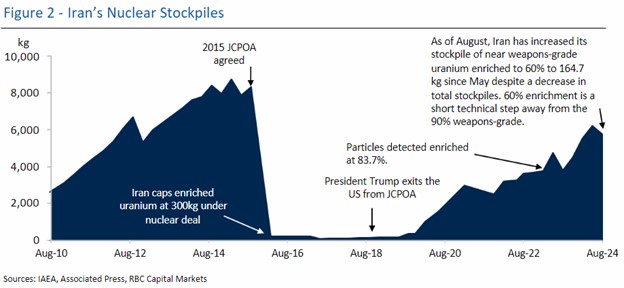
Senior diplomats from the Middle East suggested that Iran may now sprint to obtain nuclear weapons and secure the ultimate deterrence.
The International Atomic Energy Agency’s latest assessment in August 2024 showed that Iran’s stockpile of 60% highly enriched uranium (which is a short technical step away from the 90% weapons-grade level) had grown to 164.7 kg, up 22.6 kg from the previous report in May. In July, US Secretary of State Anthony Blinken said that Iran then needed only “one or two weeks” to produce enough weapons-grade material for a weapon, marking the shortest breakout time that US officials have ever stated.
We suspect that some oil market participants will look past this escalation given that there still has not been a major physical supply disruption and Iran has not demonstrated any appetite to enter this nearly year-long conflict.
And yet, it is extremely difficult to see where this regional conflict is headed, and whether this is the beginning of the end, or the end of the beginning.
Helima Croft authored “Middle East Quick Take: Uncharted Waters,” published on September 29, 2024. For more information on the full report, please contact your RBC representative.