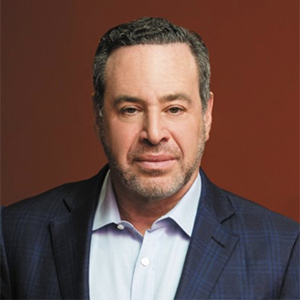
The outcome of the U.S. election surprised David Frum, the political commentator, staff writer at The Atlantic and former speechwriter for President George W. Bush.
Frum admits he expected a Democratic win, having overestimated the effect on voters of the abortion issue, wage inflation and Donald Trump’s personality.
“Other politicians who try to imitate the Trump trick of all-points offensiveness will find it doesn't work,” Frum warns. “But he's somehow become bigger than his material.”
Frum joined John Stackhouse, Senior Vice President at RBC Capital Markets, to predict what happens next.
A death knell for open trade?
Given that, as Frum puts it, “the Americans have voted for instability”, what is this likely to mean for U.S. trading partners?
Frum sees the return of Robert Lighthizer as U.S. Trade Representative as highly significant. Like Trump, he says, Lighthizer is a protectionist who believes any deal has a winner and a loser: “The whole idea of mutuality in gain from trade is a completely alien concept to him.”
That means revision of the North American Free Trade Agreement (NAFTA) could see Canada and Mexico pressured to agree to more barriers against external parties if they want to keep the access they already enjoy, says Frum.
If the U.S. were to withdraw from NAFTA dispute settling mechanisms, Canada would be unable to rely on support from Mexico under its own new president, Claudia Sheinbaum, a nationalist and socialist.
“Creating leverage in an asymmetrical relationship requires a lot of creativity and people to bust outside the bounds of conventional thinking,” says Frum. He believes Canada and others, however reluctantly, will have to consider stronger relationships with the Chinese.
Only one Canadian industry – oil and gas – is likely to benefit from the new U.S. administration, through comprehensive deregulation, according to Frum.
He believes Trump’s return may also negatively affect the U.K., which has hoped for rapid work on a trade deal to compensate for its withdrawal from the EU. “The U.S./U.K. agreement will not happen,” he declares.
“The whole idea of mutuality in gain from trade is a completely alien concept to Robert Lighthizer.”
David Frum, Staff writer, The Atlantic
Tariffs risk triggering downward spiral
Trump’s championing of trade tariffs is not a negotiating tactic, Frum believes: “The only thing he has been absolutely consistent about since 1987 is his belief that imports subtract from GDP, and exports add to GDP.” Since Congress has delegated many of its tariff powers to the President, tariffs are all but certain, Frum adds.
In Trump’s first term, there was little retaliation as other nations opted to wait it out. This time, Frum foresees a downward spiral of world trade. “Tariffs beget tariffs,” he points out.
U.S. immigration policy could hit Canada hard
Frum is sceptical about the practicality of Trump’s promise for mass deportation of immigrants: “The risk is that you end up with thousands of people in detention camps all across the United States.”
Nevertheless, he believes, the effect of the policy on Canada will be significant. “Canada's immigration system remains extremely lax. The one option you will have, if you're a Venezuelan or Haitian or Cuban in the United States threatened with removal, is take a bus to Buffalo and walk across the Canadian border.
“The immigration shock to Canada may be even bigger than the trade shock; it may arrive even sooner,” he adds.
“The immigration shock to Canada may be even bigger than the trade shock; it may arrive even sooner.”
David Frum, Staff writer, The Atlantic
Pursuit of strength may have unintended effects
If the new administration adopts an isolationist outlook, the impacts would be unpredictable for the U.S. economy and for its geopolitical strength, Frum concludes.
The impact on currency is hard to predict, he says: “We’re heading into a period of real potential volatility from many different corners, including the reaction to American policy, and currency markets are going to be a scary place to be.”
The paradox of U.S. attempts to control currency is that the rest of the world retreats to the dollar in response to uncertainty, including “irrational” U.S. policy. “You can unilaterally move the dollar; you just can’t make the dollar move in the way you want,” Frum adds.
Another unintended effect of Trump policy might be to inadvertently goad China to divert from its current “aggressive but not adventurous” state into a more proactive mood.
“One of America's greatest strengths is the force multiplier it has from being at the center of all these networks of alliances with other rich, powerful, technologically advanced countries,” Frum concludes. “If Trump upsets that, the United States objectively looks weaker.”