
There were no major surprises at the year-end OPEC+ ministerial meeting, with the group reaffirming last month's decision by the countries making voluntary cuts to pause increases for Q1'26. Once again, the virtual gathering took place against a volatile geopolitical backdrop, with a string of provocative attacks on both Iraqi and Russian energy infrastructure, and Washington continuing to escalate its threats against the Maduro government in Venezuela. Despite this turmoil, price action remains subdued as many market participants continue to point to a looming supply glut and are anticipating a swift resolution to the Russia/Ukraine conflict that would facilitate sweeping sanctions relief.
The recent round of supremely bearish forecasts seems predicated in part on a view that OPEC will contribute to the supply glut by keeping production at elevated levels regardless of market conditions—essentially that group will be on autopilot for the foreseeable future. However, we believe that policy will remain dynamic, and that the OPEC leadership would look to avoid a repeat of the inventory overhang experience of 2015. In addition, we think the move by the producers making voluntary reductions to unwind the 2.2 and 1.6 mb/d cuts has led to a useful spare capacity accounting exercise. The actual number of barrels coming onto the market has fallen well short of the headline increases due to consistent overproduction by certain members. Moreover, next year's OPEC+ maximum sustainable production capacity assessment should provide even more transparency on the true state of the oil shock absorbers that can be deployed in the event of an unplanned outage.
There remain several oil market special situations that warrant close watching for the remainder of the year. We remain skeptical that Russia will relinquish its maximalist territorial ambitions or that Europe will reward Moscow for the dismemberment of Ukraine by rewinding the clock back to January 2022 and allowing it to regain access to its most important energy market. Moreover, we believe that Ukraine retains a vote, and the reduction in US assistance has only led Kyiv to develop its own domestic capabilities, particularly in the area of drone production.
"If this weekend's drone attacks on CPC and the shadow fleet tankers prove to be the start of a new trend, as opposed to a one-off, the risk profile of the Black Sea commodity corridor would need to be substantially re-rated."
- Helima Croft, Head of Global Commodity Strategy and MENA Research, RBC Capital Markets
Ukrainian attacks on russian infrastructure since the start of summer
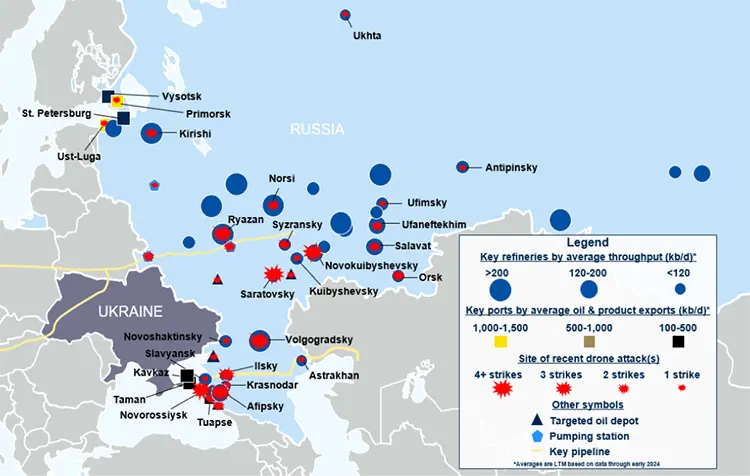
Sources: Platts, WSJ, Reuters, Bloomberg, RBC Capital Markets
This weekend brought a clear demonstration of Ukrainian capabilities. On Saturday, two Ukrainian naval drones struck the Caspian Pipeline Consortium (CPC) marine terminal near Novorossiysk, resulting in significant damage to Single Mooring Point 2. CPC has halted all loadings at the terminal with only one of three mooring points currently operational (the other is undergoing repairs), potentially disrupting the flow of roughly 700 kb/d of Russian and Kazakh crude. The duration of the disruption is unclear, with CPC looking into alternate routes as well as for the immediate drone threat to abate. Additionally, over the weekend two sanctioned Russian shadow fleet tankers were struck by drones in the Black Sea, causing "critical damage" to both vessels.
It is worth noting that despite the White House's renewed diplomatic push, the blocking sanctions on both Rosneft and Lukoil remain in place and key foreign refiners continue to shun those barrels. The duration of these executive branch measures certainly is an open question, but the combination of these sanctions plus the ongoing attacks on Russian energy infrastructure could force actual shut-ins despite Moscow's aversion to closing taps in arctic winter conditions.
At the same time, Iraqi infrastructure continues to be targeted by Iran-backed militias, with rocket attacks on Wednesday disrupting the operations of the Khor Mor gas field in the Kurdistan region. The field provides gas supplies for regional power generation, and the direct hit on a storage tank resulted in a production halt and widespread power cuts. While operations at the field resumed on Sunday, the ongoing attacks by these Iraqi militias demonstrate that Iran retains regional disruptive capabilities despite its Axis of Resistance being seriously degraded by Israeli/US action.
The Venezuela situation also continues to look headed for an explosive endgame, with President Trump declaring the country's airspace closed on Saturday and deploying more military assets to the region. The practical implications of the airspace closure comments remain unclear as no enforcement plan has been put forward and commercial flights—including some from international carriers—continue to operate. Nonetheless, it does seemingly move the standoff another rung up the escalatory latter. At the same time, the US is pushing for the deployment of advanced radar systems in nearby Grenada and Trinidad and Tobago, and Washington has reached an agreement with the Dominican Republic to allow military operations at its air base installations. The key immediate question in our view is whether President Maduro will leave voluntarily in the face of a massive US military buildup or if Washington will intervene directly to remove him from office.
At the same time, we think there is risk of a rocky post-Maduro transition, especially if the military seeks to maintain power and blocks a US-friendly government from taking office. The Venezuelan military, which is deeply tied to global narcotic trafficking networks, may have a deep financial incentive to try to maintain its position; hence, the open question of whether the US will become directly involved in the internal security dynamics to ensure a stable transfer of power. We suspect that the America First wing of the Republican party may be reluctant to put US boots on the ground and there may be limits to what the US can accomplish with air power alone. Though a full repeal of US sanctions could theoretically lead to an increase of several hundred kb/d of production, we would stress rebuilding Venezuela's energy sector may be a prolonged process and that it would be exceedingly difficult to roll back the clock to the pre-Chavez era when production exceeded 3 mb/d.
Helima Croft authored "Geopolitical Update: Special Situations," published on November 30, 2025. For more information on the full report, please contact your RBC representative.