With the protests in Iran showing no signs of abating, President Trump is facing a stark choice over whether to enforce his Mar-a-Lago red line on civilian casualties. The situation remains extremely fluid, but the scale of the latest social unrest seemingly exceeds anything since 2009 and includes the all-important participation of bazaar merchants angered over the sharp deterioration of the Iranian rial. The merchants played a critical role in the 1979 revolution, and their withdrawal of support for Shah Mohammad Reza Pahlavi helped seal his fate.
What remains to be seen is whether there will be significant ruptures in the Iranian security forces. In 2009, Supreme Leader Khamenei was able to ride out the protests, in part because the IRGC and Basij militias obeyed orders to fire on demonstrators. This stands in stark contrast to the actions of the Egyptian military in 2011, when leaders ultimately disobeyed orders to clear Tahrir Square and decided that President Hosni Mubarak was a liability for maintaining Military Inc. There are no indications yet that Ayatollah Khamenei has lost control of the guardsmen and we think their support — or lack thereof — will be a critical variable for the durability of the regime.
"Democracy promotion does not necessarily appear high on the President's priority list, and he has shown a preference for working with strongmen, such as Egyptian President Abdel Fattah El-Sisi."
-Helima Croft, Head of Global Commodity Strategy and MENA Research, RBC Capital Markets
Direct U.S. intervention would indeed represent a serious wildcard. Given the ongoing U.S. military deployment to the waters off Venezuela, it may take some time to shuffle the requisite assets to the Middle East. It is also uncertain who would emerge if Khamenei was forced to vacate his office. While the exiled son of the Shah, Reza Pahlavi, is presenting himself as a viable successor, there is a credible scenario under which the guardsmen essentially sacrifice Khamenei to preserve their grip on power; much in the same way the Venezuelan military and key Chavist civilian officials are maintaining control after the Maduro ouster.
We see several paths for oil becoming caught in the crosshairs of the latest Iranian unrest. The most obvious would be if the oil workers join the protests and walked off the job. There are several historic examples of this happening, but there have not been recent strike-driven supply disruptions despite multiple waves of protests and deepening economic discontent. There is also a risk that the IRGC might target regional energy supplies to raise the cost of American intervention. Though the Axis of Resistance has been severely degraded by U.S. and Israeli actions, especially Hezbollah, the Iraqi militias could still potentially be activated by Tehran. These militias have targeted energy infrastructure as recently as November, when they did significant damage to Kurdish facilities.
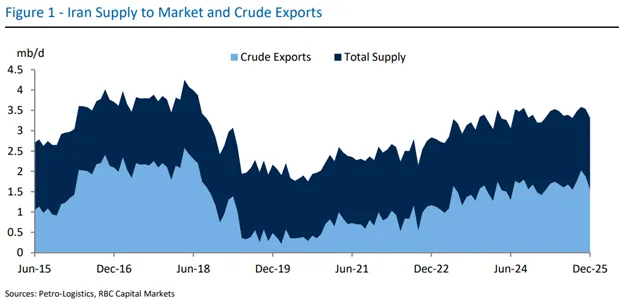
Though we do not think the IRGC and remaining Axis of Resistance members could close critical waterways such as the Strait of Hormuz, they could still target individual tankers in a manner similar to what was seen in 2019. At a minimum, the IRGC could escalate their rhetorical threats to economic assets in the region as part of their effort to change Washington's calculus about intervening on the side of the Iranian demonstrators.
The Iran crisis comes as the White House is racing to craft the post-Maduro governing plan for Venezuela. During our conversations in Washington last week, we heard concerns about the enormous structural challenges facing the country following 27 years of Chavez/Maduro rule. Many D.C.-based observers continue to contend that Cuba is the principal prize for Secretary of State Marco Rubio and suggest that the energy revitalization story may have been deployed to secure presidential sign off.
"With everything everywhere happening all at once, we continue to warn against fading the geopolitical risk story for oil in 2026."
-Helima Croft, Head of Global Commodity Strategy and MENA Research, RBC Capital Markets
While Russia has seemingly moved down the immediate White House priority list following the Maduro capture and Iran protests, we think it is noteworthy that President Trump has signaled support for the Sanctioning Russia Act of 2025 Senate bill that would look to impose further sanctions on Russia, including a 500% tariff on importers of Russian oil. Even though the proposed bill includes a 180-day presidential waiver for national security concerns, we view President Trump's apparent support as one more indication there is no quick repeal of the sanctions architecture.
Finally, we also anticipate more Ukrainian attacks on Russian energy operations, with the tacit approval of the United States, with Ukrainian drones targeting multiple Lukoil drilling
Helima Croft authored "Geopolitical Update: Everything Everywhere All at Once 2.0," published on January 11, 2026. For more information on the full report, please contact your RBC representative.