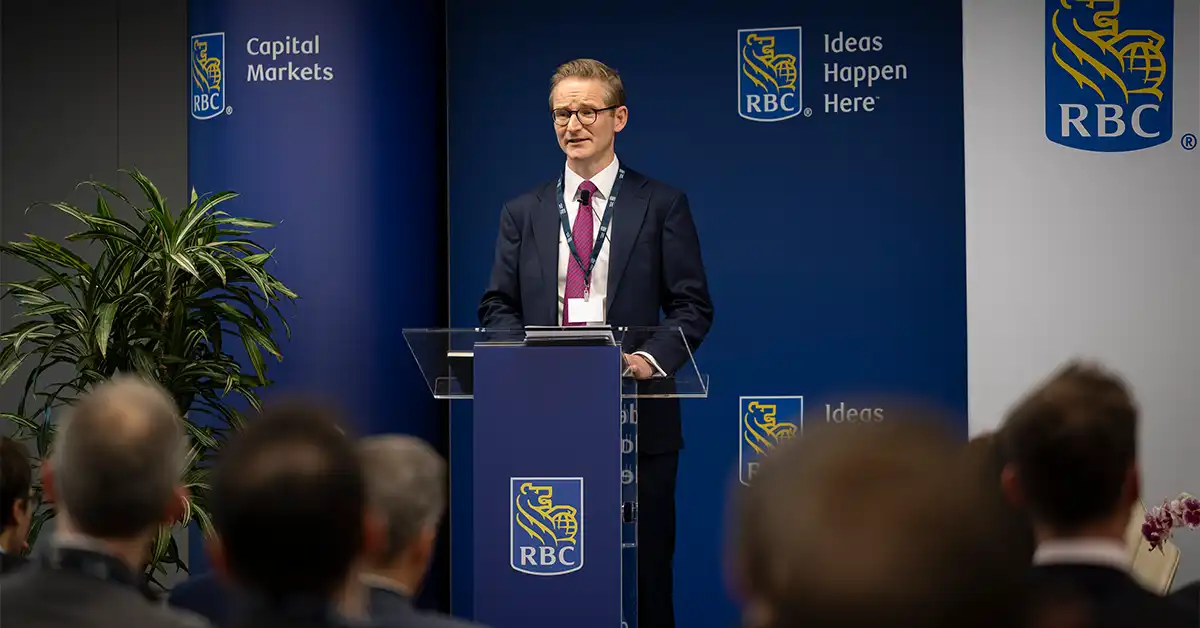
The 2026 UK Focus Conference arrived at a pivotal moment for Britain. With over 300 companies and investors converging at RBC's London venue, the event delivered a clear message: the UK is at an inflection point where government ambition, technological disruption, and geopolitical turbulence will determine its economic future.
From ambition to delivery
Iain Anderson, Non-Executive Director of the Department for Business and Trade, set the tone early. The UK's industrial strategy isn't merely aspirational—it's producing tangible results. Since launching in June 2025, the government has secured £250 billion in investment into strategic sectors and created 45,000 jobs. Anderson spoke of a deliberate pivot from "political chopping and changing" to long-term stability, backed by three pillars: stability in policy, speed in regulation, and place-based investment beyond London and the Southeast. The government is backing innovation across eight core sectors, from clean energy to life sciences, with an explicit ambition articulated by Business Secretary Peter Kyle: making the UK the best place in the world to start, grow, and invest in the industries defining the 2030s. This isn't Westminster waffling; it's a deliberate reorientation of state power toward growth.
Yet the real test lies in market acceptance. Our panel, "Navigating UK Markets in 2026" featured investment leaders Jean Roche of Schroders, Dev Chakrabarti of Alliance Bernstein, and Matthew Sabben-Clare of Cinven and Chair of the BVCA, who painted a more cautious picture. Panelists candidly acknowledged that consensus sentiment toward the UK remains decidedly underweight. The question animating their discussion: does this reflect justified concern about structural headwinds, or an underappreciation of the value being created by the government's industrial strategy? For investors willing to lean into the UK narrative alongside genuine sector opportunities in infrastructure, energy transition, and advanced manufacturing, the underweight positioning by the broader market may represent an asymmetric opportunity.
The AI inflection point
Matt Clifford, Vice Chair of the UK's AI Safety Institute and a key advisor to two Prime Ministers on AI strategy, brought a sobering but exhilarating perspective. AI isn't a bubble—it's a long curve of computational acceleration that shows no sign of stopping. The key metric: since 2013, computational power deployed to train frontier AI models has increased a billion-fold. Tasks that once took humans days can now be delegated to AI and completed reliably in hours. Most strikingly, the complexity of delegable tasks is doubling every seven months. Clifford warned that there are seven doublings left before the next general election—enough to transform an hour's worth of human labor into a month's worth by 2030. For knowledge workers, this has profound implications.
Yet Clifford also outlined five potential constraints: technical limits, business model viability, supply chain vulnerabilities (especially memory and computing infrastructure), power availability, and political backlash. The last may be most underpriced. Public skepticism about AI's job impact, environmental toll, and child safety could become the binding constraint on progress. For investors navigating this terrain, the panel discussion on company scale offered relevant context. With mega-cap tech stocks having dominated global market returns, mid-cap companies—particularly those with exposure to AI infrastructure, enterprise adoption, or specialized applications—may offer superior risk-adjusted returns for investors with deep domain expertise and conviction in the technology's transformative potential. The panel's focus on identifying sector opportunities and international comparisons underscored that distinguishing between genuine AI disruption and cyclical valuation moves requires rigorous analytical work.
A fractured world demands British strength
Former UK Foreign Secretary William Hague provided the geopolitical reality check. The world is not becoming safer. With three of five UN Security Council permanent members (China, Russia, and America) actively pursuing territorial expansion, the old rules-based international order is fracturing. Trump's unilateral actions—from Venezuela to Greenland—are signaling a new era of great power competition. Hague emphasized that Britain's path forward doesn't lie in hoping for structural solutions; it lies in making itself a success domestically.
The UK remains an education superpower—hosting three of the world's top ten universities despite comprising just 1% of global population. Oxford alone has spawned 180 spin-outs, yet most venture capital follows innovative UK firms to Silicon Valley or elsewhere. Hague's plea to investors was direct: the UK's intellectual property and entrepreneurial talent are assets we cannot afford to squander. The panel reinforced this point through its exploration of how UK and international companies operate differently. UK companies often face higher structural costs and regulatory complexity, yet when assessed through international comparisons—whether by valuation multiples or operating metrics—many reveal either significant discounts or superior management execution relative to global peers. This raises an important investment consideration: a UK company performing well despite operating in a more challenging environment may represent better capital allocation and strategic thinking than an international peer operating in more benign conditions.
Energy, complexity, and the cost of competitiveness
A recurring concern threaded through all three keynotes: energy costs. The UK's commercial electricity prices are among the highest in the developed world—four times higher than the US and twice the EU average. This handicaps energy-intensive sectors like advanced manufacturing, AI, and defense. Anderson promised government intervention "very soon," signaling that energy policy reform will be central to the industrial strategy's success. Yet solving energy costs isn't merely a technical challenge; it's a supply chain problem that touches grid connections, transformer production, and renewable capacity. The theme running beneath this was clear: delivering on the industrial strategy requires solving a thousand micro-problems, not just setting ambitious goals. Panel participants acknowledged these complexities, noting that UK equities may trade at discounts precisely because the market underestimates management's ability to navigate and overcome these structural obstacles.
Capital must follow conviction—and market structure matters
All speakers converged on one point: the UK has talent and innovation but lacks the capital to scale and retain its best companies. Hague spoke of DeepMind (sold to Google for $400 million) and recently, Oxford Ionics ($1.1 billion, immediately bought by a US firm) and Organ Ox ($1.5 billion, immediately acquired by a Japanese corporation). The pattern is clear: UK entrepreneurs generate ideas of trillion-dollar potential, but external capital tends to capture the upside.
The panel's discussion of public-private market dynamics added important nuance to this narrative. Matthew Sabben-Clare highlighted the growing phenomenon of take-privates and de-equitization trends, noting a material gap between public and private valuations for UK assets. When sophisticated capital identifies opportunities to acquire UK companies at what it views as compelling prices and subsequently take them private, this raises questions about market efficiency: either public markets are correctly discounting genuine structural concerns, or capital structure and investor preferences are creating valuation arbitrage that patient, long-term capital can exploit.
Dev Chakrabarti's 20-year track record managing concentrated global growth portfolios suggests that best opportunities often emerge where consensus is skeptical. Jean Roche's use of international comparisons to assess UK valuations likely revealed material discounts relative to European and global peers. For investors at the conference, this created an implicit tension: consensus underweights the UK, yet government action, AI tailwinds, geopolitical stability, and valuation discounts may be converging to create a rare window of opportunity. The panel's exploration of whether company scale presents a distinct investment opportunity in mid-caps—often overlooked when mega-caps dominate—suggested that patient capital willing to do the work might identify dislocation between where consensus is positioned and where fundamentals are trending.
The question facing investors is whether to interpret the pattern of UK asset outmigration and valuation discounts as a sign of fundamental structural weakness, or as evidence of a mispriced opportunity waiting for investors with conviction and a long-term horizon. For the UK to succeed in executing its industrial strategy and retaining its best companies, capital must follow conviction rather than sentiment.