The U.S. military escalation against Iran appears increasingly likely despite growing pre-election pressure, with both Washington and Tehran maintaining entrenched negotiating positions. The conflict has proven impervious to pre-election off-ramps, expanding in scope with Houthi entry into the war. Regional talks in Tehran and Vice President Vance's reported outreach to Iran's hardline Supreme National Security Council secretary suggest the administration is calibrating rather than reversing course.
The critical strategic question is whether U.S. military action will constitute a final strike before withdrawal, or will be a more extensive operation designed to finish the job and orchestrate regime change. Some regional actors warn that a brief escalation followed by hasty exit would essentially amount to an Iranian victory despite reconstruction costs. Others caution that a sweeping military campaign dramatically increases the risk of Iranian retaliatory strikes on critical civilian infrastructure, including desalination facilities, alongside expanded proxy attacks on U.S. allies throughout the region.
While Congress cannot force an end to the war, Democratic control of either or both chambers will likely intensify efforts to control the purse strings. Even if the administration maintains veto authority over broad policy reversals, Democratic gains could embolden Republicans to challenge the administration's authority on Iran war funding through year-end defense legislation. With the size of Tuesday's Democratic victory determining the degree of Republican defections likely, the midterm results will substantially influence congressional leverage over military spending and escalation decisions heading into 2027.
A Democratic House victory would trigger a wave of hearings and investigations on energy deals involving administration insiders and military actions affecting major global producers. Venezuela will face intense scrutiny, with lawmakers seeking to determine whether oil companies had advance knowledge of the January military operation against Nicolás Maduro. Inquiries could expand to examine whether companies received privileged information or benefited from the operation, and challenge the Pentagon's authority to take a 35 percent stake in North American Blue Energy Partners.
"Even if the [Democratic] party only captures the House of Representatives, we anticipate a wave of hearings and investigations on energy deals involving administration insiders, as well as military actions/foreign policy decisions involving key global producers."
Helima Croft, Head of Global Commodity Strategy and MENA Research, RBC Capital Markets
Russia sanctions waivers and the recent diesel deal will draw bipartisan criticism, particularly from GOP Russia critics including Senators Susan Collins, Mitch McConnell, and Lisa Murkowski. Democratic-led committees will review the administration's suspension of sanctions measures mandated by the Graham Act, which authorizes 100 percent secondary tariffs on imports from Russia oil purchasers and imposes further restrictions on Russian banks and energy investment.
The scale of a Democratic victory could influence whether Republicans defect to challenge the administration's waiver authority through defense legislation. Beyond Venezuela and Russia, congressional reviews will likely examine government equity stakes in critical mineral firms and CFTC investigations into large energy trades around Iran war developments.
Growing concerns over electricity affordability could reshape the administration's data center acceleration initiative, despite likely bipartisan backing for AI and data center infrastructure expansion. The House's bipartisan passage of the Ratepayer Protection Act signals growing support for requiring data centers to shoulder their own costs. Democratic control would pursue stricter oversight, with House Judiciary ranking member Jamie Raskin already investigating major hyperscalers over nondisclosure agreements with local governments regarding data center projects.
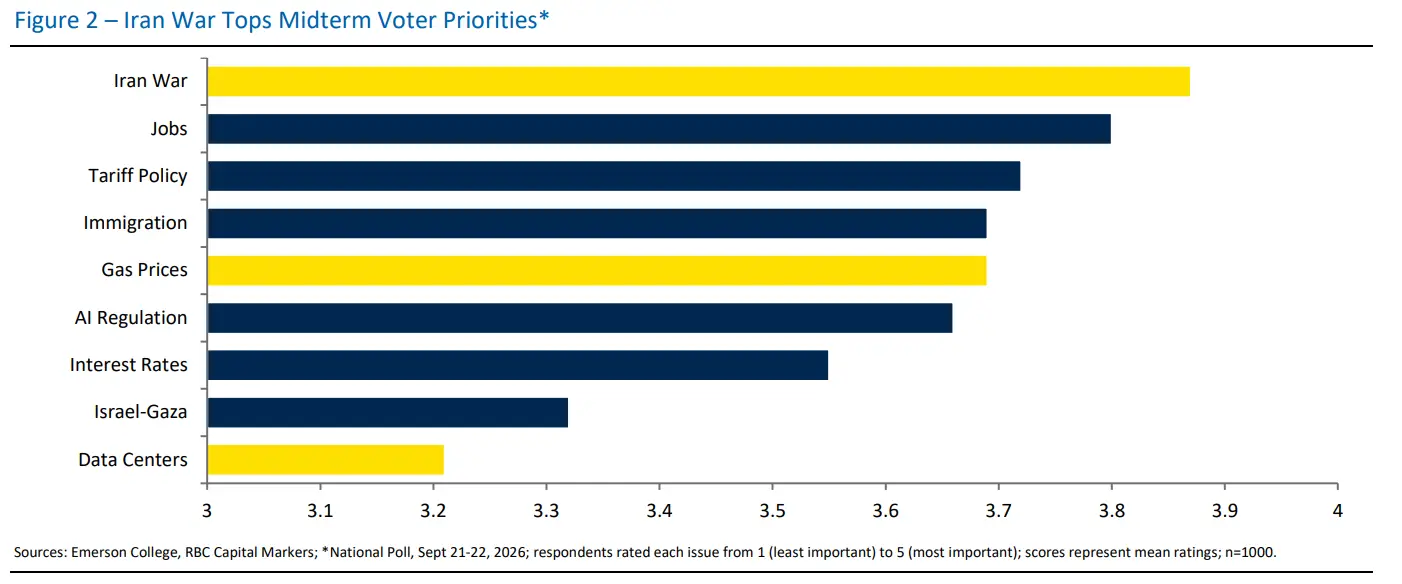
Figure 2, titled "Iran War Tops Midterm Voter Priorities*," is a horizontal bar chart ranking nine political, economic, and geopolitical issues by their mean importance rating from voters on a 1-to-5 scale, with the x-axis displaying a truncated range from 3.0 to 4.0. From highest to lowest, the issues and their approximate mean scores are: Iran War at approximately 3.87 (highlighted in yellow), Jobs at approximately 3.80, Tariff Policy at approximately 3.72, Immigration at approximately 3.69, Gas Prices at approximately 3.69 (highlighted in yellow), AI Regulation at approximately 3.66, Interest Rates at approximately 3.55, Israel-Gaza at approximately 3.32, and Data Centers at approximately 3.21 (highlighted in yellow). The remaining bars are dark navy blue. The footer notes the sources as Emerson College and RBC Capital Markets, based on a National Poll conducted September 21–22, 2026, where respondents rated each issue from 1 (least important) to 5 (most important), with scores representing mean ratings and a sample size of n=1000.
Democratic congressional control could complicate broader efforts to expand conventional energy production and roll back environmental regulations. New majorities could investigate federal leasing decisions, environmental deregulation, and DOE funding allocations. Clean energy developers could benefit from heightened oversight of restrictions on offshore wind and solar approvals, though presidential veto authority and existing executive powers would limit Democrats' ability to reverse policies or reinstate repealed incentives.
Bipartisan permitting reform offers the clearest avenue for legislative cooperation, yet skepticism remains that this historical nonstarter could succeed post-election. The recently introduced American Affordability and Jobs Act seeks to accelerate energy infrastructure development across conventional and renewable technologies, though Democrats increasingly demand assurances against discriminatory treatment of clean energy projects. A sizable Democratic victory could strengthen their leverage, potentially complicating passage in the lame-duck session.
Ultimately, Democratic gains could constrain the administration's energy agenda through congressional oversight and legislative leverage, even as the administration pursues priorities through executive and regulatory authority.
Helima Croft authored "Washington Strategy: Margins Matter," published on October 28, 2026. For more information on the full report, please contact your RBC representative.
